Photovoltaic intrusion into farming and fishing villages sparks controversy; Council of Agriculture amends laws while environmental groups urge ministries to take a stance
Text by Upstream and Downstream reporters Cai Jiashan and Lin Jiyang
Recently, disputes over ground-mounted photovoltaic projects have been frequent, with afforestation land, farmland, wetlands, hillside land and fish ponds all becoming battlegrounds, greatly affecting the rights and interests of farmers and fishermen as well as the ecological environment, and giving rise to widespread doubts. Council of Agriculture Minister Chen Chi-chung held a press conference today to put out the fire, announcing that all of Taiwan Sugar's cases of cutting trees for power generation have been returned, and that regulations on farmland solar power will also be amended, with stricter checks on land use changes and non-agricultural use, so as to uphold the principle of keeping farmland for farming.
Although the Council of Agriculture has loudly vowed to keep farmland for farming, the relevant regulations are not all under its jurisdiction, but rather under the Ministry of Economic Affairs and the Ministry of the Interior. Chen Chi-chung said he would propose amendments to other ministries, saying, "They completely agree with the policy we announced." However, in the past the Council of Agriculture also vowed to deal with illegal factories on farmland, promising immediate demolition upon report, but because the authority involved spans multiple ministries, it was not something the Council of Agriculture alone could reverse.
Citizen of the Earth Foundation director Cai Huixun, who cares about green power development, said she appreciates the Council of Agriculture's clear policy declaration and hopes other ministries will follow suit, and that the Ministry of Economic Affairs should promptly publish an "environmental and social review mechanism." Cai stressed that in addition to amending laws to end the chaos, the central government should conduct a higher-level inventory and assessment of how much photovoltaic capacity Taiwan actually needs. Cai Huixun stressed that only by guiding operators to the right places can the pressure on farmland and fish ponds be reduced.

"Livestock-photovoltaic symbiosis" to be promoted first; the potential of rooftop photovoltaics in agriculture can reach 4GW
Chen Chi-chung stressed that the development of agricultural green energy has three premises: "It must not affect the rights and interests of farmers and fishermen, it must not affect the development of agriculture and fisheries, and it must not impact the ecological environment." Therefore, promotion will be strengthened starting from the least controversial rooftop installations on livestock farms. "There are more than 15,000 livestock farms in the country, covering 6,000 hectares. So far 927MW has been promoted, and within the next three to four years it can increase to 3GW."
Planning Division director Cai Shengfu added that, including the rooftops of collection and packaging sites of other agricultural and food industries, as well as the rooftops of indoor recirculating aquaculture facilities, the total rooftop target should have the potential to reach 4GW.
As for the Taiwan Sugar "cutting trees for power generation" case that has drawn the most external doubt, with rumors online that million trees would be cut on Pingtung's flatland afforestation land for green power, Chen Chi-chung said categorically, "None of that is true. We have not cut a single tree."
He said the Forestry Bureau will complete a survey of the afforestation status of 13,768 hectares within two months, at which point three types of zones will be delineated in detail: those already forested and with habitat ecological value will be maintained; those suitable for farming can have trees removed to restore agricultural use; and finally, "some in coastal areas, low-lying areas, and places with poor conditions, unsuitable for agricultural production, will only then be considered for solar photovoltaic use. When the time comes, we will make it public."

Chen Chi-chung: All of Taiwan Sugar's agrivoltaic symbiosis applications have been returned; environmental groups: returning applications is not enough, it must be institutionalized by law
Chen Chi-chung also clarified that the agrivoltaic symbiosis plans previously submitted by Taiwan Sugar for the Pingtung and Chiayi flatland afforestation areas, as well as the Pingtung edamame production area and the Tainan organic vegetable area, were all returned by the Agriculture and Food Agency in March this year, with their applications not approved. "The Council of Agriculture will strictly check, so as to avoid the stigmatization of green power."
However, Zhou Keren, director of the Blue Donggang River Conservation Association, which led the opposition in Pingtung to Taiwan Sugar's plan to cut trees for power generation, questioned, "The Council of Agriculture merely returning the reviewed cases does not mean the end. Because that land is still farmland, Taiwan Sugar will continue to apply, and if the Council of Agriculture gets a different minister in the future, it might pass."
Zhou Keren pointed out that if it does not become a legally regulated system, these forests still have no protection. He believes that those with good forest stands should be designated as permanent protection forests, and that those with poor forest stands cannot be judged by appearance alone, because some trees serve ecological functions such as attracting bees and birds. "The Council of Agriculture should not just treat the symptoms and appease public opinion." The flatland afforestation subsidies are about to expire over the next 20 years, and Taiwan Sugar cannot possibly let large tracts of land go without income.
Converting farmland for photovoltaic use; Council of Agriculture: amending laws to tighten checks
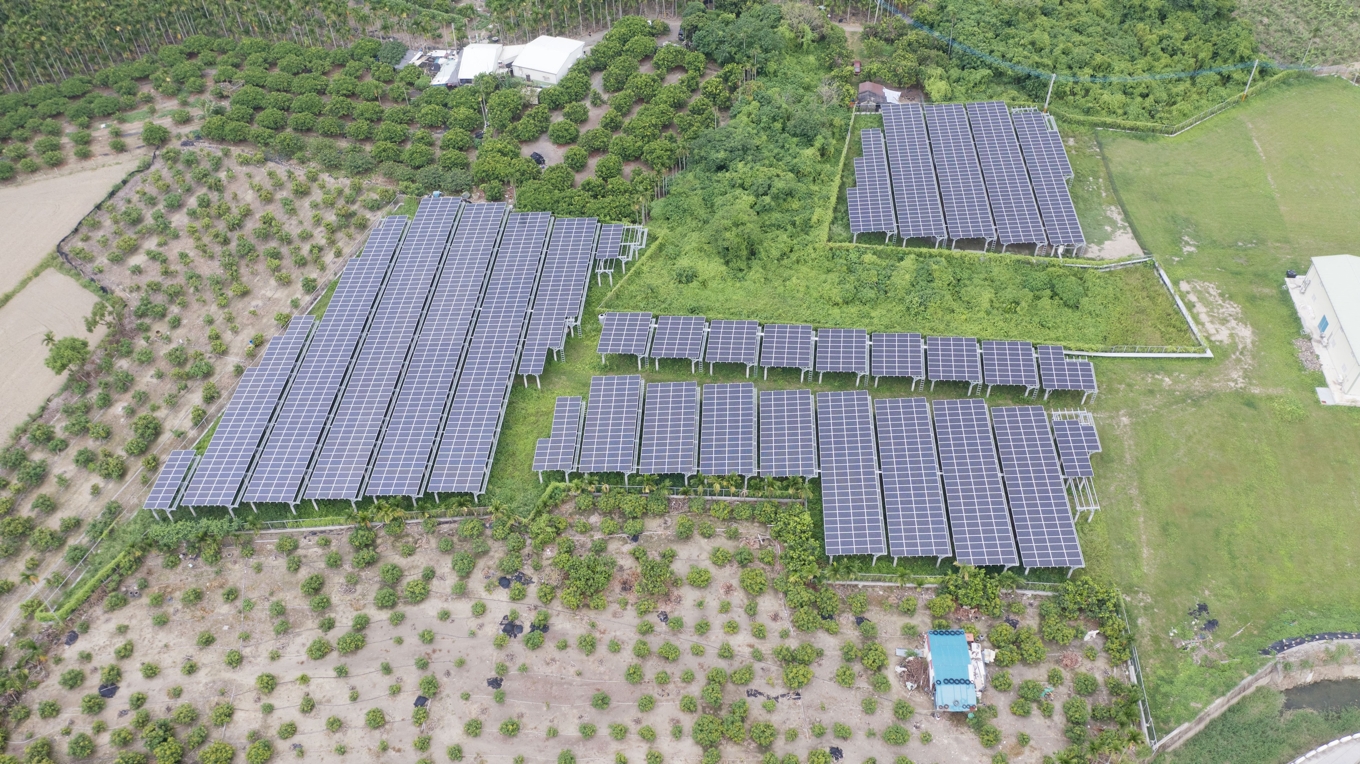
Regarding solar power on farmland, in recent years applications for farmland conversion or permitted use for photovoltaic projects have surged across the country, with patches of green farmland turning into gray-black solar panels, not only causing a loss of total farmland area and harming agricultural production, but also fragmenting farmland and destroying the complete rural landscape.
In response, the Council of Agriculture today proposed a solution: it will amend the "Directions for Review of Consent by Agricultural Competent Authorities to Changes in Use of Agricultural Land," tightening controls on all forms of solar power on farmland, including both conversion and permitted use. Moreover, neither special agricultural zones nor aquaculture fishery production zones may be converted for photovoltaic use.
Currently, farmland conversion for solar power is divided into: under 2 hectares, 2-30 hectares, and over 30 hectares. Those under 2 hectares and those from 2-30 hectares are reviewed by local governments, while only those over 30 hectares are reviewed by the central government. In addition to conversion, current regulations also permit farmland in general agricultural zones to host 660m2 of photovoltaics.
Some local governments, in order to promote green energy, have approved a large number of applications for farmland conversion and permitted solar power. According to a preliminary estimate by the Council of Agriculture, the area of farmland conversion cases across Taiwan has already exceeded 300 hectares, with nearly 2,000 hectares still under review. The number of approved 660m2 cases is nearly 1,000, covering more than 300 hectares, with more than 200 cases still under review. However, a local government administrative staff member said privately that the conversion area in a single county or city in the south alone has already exceeded 300 hectares. This clearly shows that the Council of Agriculture's figure is severely underestimated.