Female farmer Li Baolian has spent 21 years farming on Lishan; a foolish woman returns to the mountains to heal the wounded earth
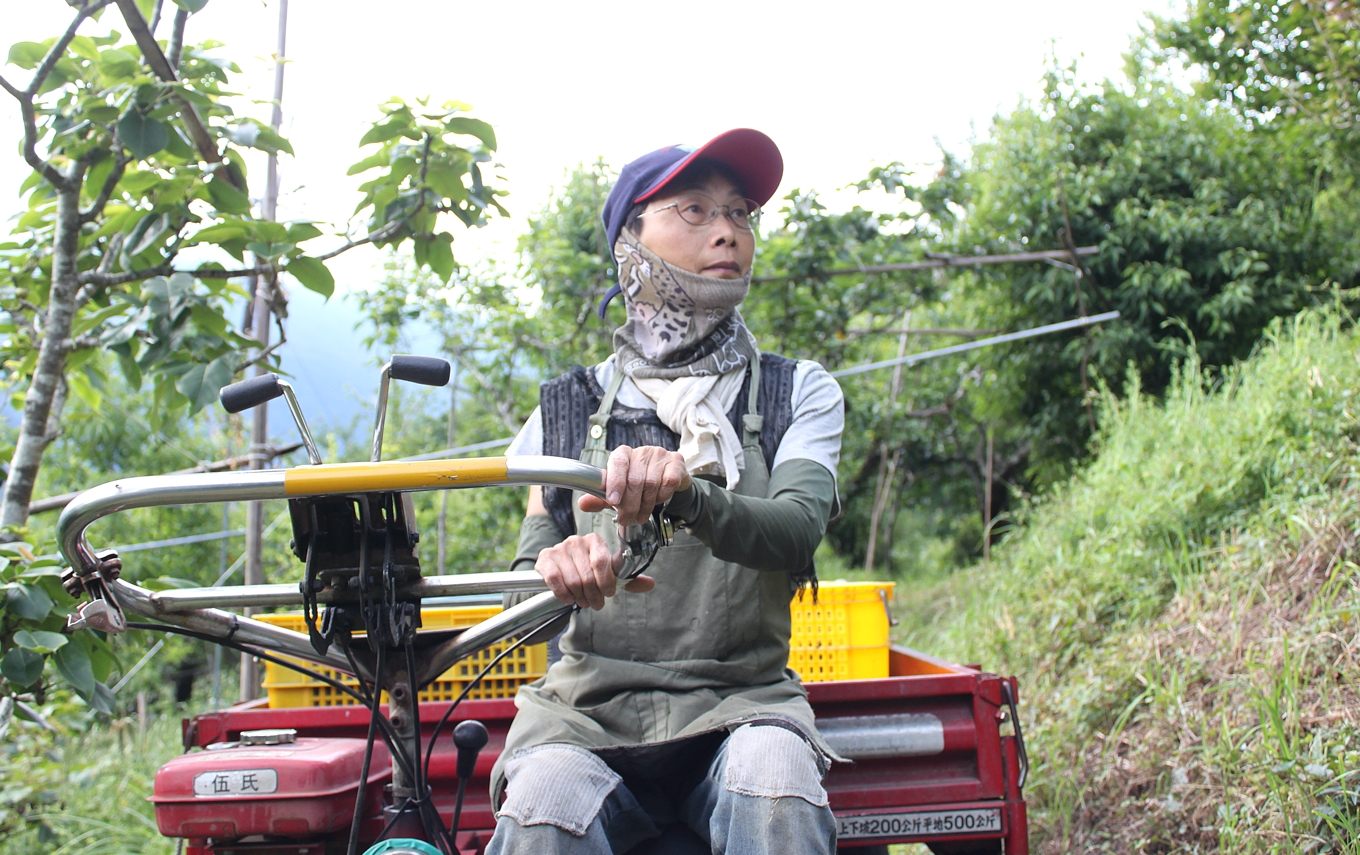
On the eve of the Dragon Boat Festival, a heatwave of over 37 degrees sweeps toward Taiwan, yet Lishan at an altitude of 2,000 m still maintains a pleasant 21 degrees. Female farmer Li Baolian ushers in the 21st watermelon plum harvest season at Abao Orchard; plums covered in white bloom hang all over the branches, as alluring as rubies lightly veiled in gauze.
Along with the watermelon plums delivered to consumers' doorsteps comes the philosophy of Abao's mountain reclamation. Back then, when she went up to Lishan, she only wanted to "be her own lamp," to support herself and her ideals with her own two hands. Twenty-one years later, female farmer Abao has become a spiritual benchmark for friendly agriculture. Facing this exam in farming, Abao says with a smile: "I believe my results are worthy of myself."

The prequel to the female farmer's quest for the mountain: a passionate love affair with the mountains and rivers
Yilan's Dongshan is the hometown of female farmer Abao. Seven children were raised by farming parents, and the financial burden can well be imagined. Fortunately, Abao, sixth in birth order, was good at her studies. By the time she took her high school and college entrance exams, the family finances had gradually improved, so she smoothly walked the path of further education and did not have to bury her youth in a factory early like her older brothers and sisters.
Perhaps because she grew up in a large family and long lacked personal space, Abao always longed for the ease of being alone. In the summer vacation of the year she got into university, she cycled around the island on a bare-bones bicycle; during three summer vacations in university, she respectively completed the Northern Cross-Island Highway, the Central Cross-Island Highway and the Southern Cross-Island Highway on foot; afterward she began climbing peaks against the wind and committing her heart to mountains and wilderness, writing poems of the wild among Taiwan's steep ridges. She says she has for mountains and rivers "a passionate love that remains unchanged to this day." The wind in the mountains, the snow in the mountains, the sambar deer and the junipers in the mountains repeatedly tell her something she understands more and more clearly: how rare and precious the deep quiet of nature is!
Abao, who loves mountains and rivers, later entered Taroko National Park as an interpreter. This job awakened Abao's environmental awareness, and she hoped to devote herself fully to caring for this beautiful land. It is just a pity that even the national park headquarters established in the name of conservation fall short in some ways toward the environment, and moreover, although Abao had work enthusiasm and kept shoveling coal into the train, she ultimately discovered that the direction the train was traveling was not where she wanted to go, and she needed to reposition her life. She thought, "The answer may lie in the unknown world." So after working for two years she set out on the road again, only this time she went farther, longer and with more meaning.
A year and a half of grand travel, realizing that labor is the foundation of being human
Abao set out with 100,000 New Taiwan dollars and a plane ticket to Hong Kong. From Hong Kong she took trains to Guangzhou and Sichuan, then for five months relied on a bicycle, a donkey and her own two feet to travel all the way to Lhasa, then on to Nepal and India. During this time she also visited Everest Base Camp twice, from the north via China's Rongbuk Monastery and from the south via Nepal's Lukla, to pay homage to the sacredness and beauty of Everest. During this year-and-a-half-long grand journey, Abao endured every kind of hardship. But what made her ashamed to boast was that this experience came with far too much inner unease!
The 100,000 yuan in travel funds was Abao's salary as an interpreter. To her, that was pay earned by running her mouth, with no substantive labor at all, yet she had the freedom to leave, and could wander for long periods on other people's land with cheap food, lodging and transportation, receive unpaid care from strangers, and even make the wheat-field women workers of Kashmir smile with nothing more than an ordinary jar of face cream. Abao knew that all these superior positions were in fact built on an unfair foundation, and the more she took advantage of others, the less she could be at peace with herself.
Abao's original intention was to find, through wandering, the relationship between herself and herself and between herself and the world, but the various differences she witnessed during the journey forced her to question the logic of the world. Those Tibetans, Nepalese and Kashmiris who support themselves from the land could absolutely never, like Abao, work for a while and then travel and consume abroad. Was it because they were lazier or more foolish? Abao knew that in their life of labor, looking up at the sky and down at the earth, she was utterly inept, and exchanging money for the fruits of their substantive labor made her feel deeply inferior, made her feel she had taken advantage of this world.
"Unless I prove that I can support myself with my own two hands, a big piece of my self-identity will be missing." That is what Abao believed.
Related Articles
- How to prevent and control rabies in dogs? Timely vaccination of puppies ensures safety
- How to Explore Keelung's Fishing Port Docks? Practical Tips for Picking Fresh Seafood
- The Slow Food movement advocates that how you eat matters more than what you eat, helping you eat your way to health
- How to Identify Inferior Cooking Oil? Key Points for Quality Control from Cultivation to Purchase
- Which agricultural activities require tax payment? The ranch court case clarifies the boundary of tax exemption
- Ractopamine, a lean meat agent, is banned; scientific pig farming to increase lean meat percentage is the right path
- Horizontal Windbreak Nets for Welsh Onion Cultivation in Winter Reduce Losses
- Top Ten Fungicides Ranking Released, a Useful Reference for Farmers Choosing Products