(Exclusive) Herbicide sprayed on adzuki beans 01"Government suddenly opens up "glufosinate" as a defoliant for adzuki beans, impacting the environment and food safety, farming sector sharply criticizes policy regression
In the past, most adzuki bean farmers used the herbicide "paraquat" as a defoliant to standardize the drying time and degree of adzuki bean plants so as to facilitate mechanical harvesting. However, after February 1, 2020, in order to promote the policy of phasing out highly toxic pesticides and avoid repeated tragedies of suicide, the government fully banned paraquat, which at the time dealt a considerable blow to the adzuki bean industry and also triggered a huge backlash in agricultural circles.
But unexpectedly, less than four months later, on May 20 the Ministry of Health and Welfare issued the latest maximum residue limits for pesticides, among which the herbicide "glufosinate" was newly added for use in drying adzuki bean plants, with a tolerance of 2 ppm. In response, the Bureau of Animal and Plant Health Inspection and Quarantine of the Council of Agriculture stated that it would soon announce the relevant methods and scope of use, so as to give farmers more options when harvesting adzuki beans.
However, because glufosinate is highly water-soluble and has translocation properties (the herbicidal effect transferring from the adzuki bean pods to the beans), scholars worry that improper use could cause disaster for rural aquatic environments and raise food safety concerns, while farmers and farmers' associations that responded to the government by not using herbicides as defoliants believe the government cannot hold its position and is contradicting itself, saying, "Otherwise, why ban paraquat but then open up glufosinate?"
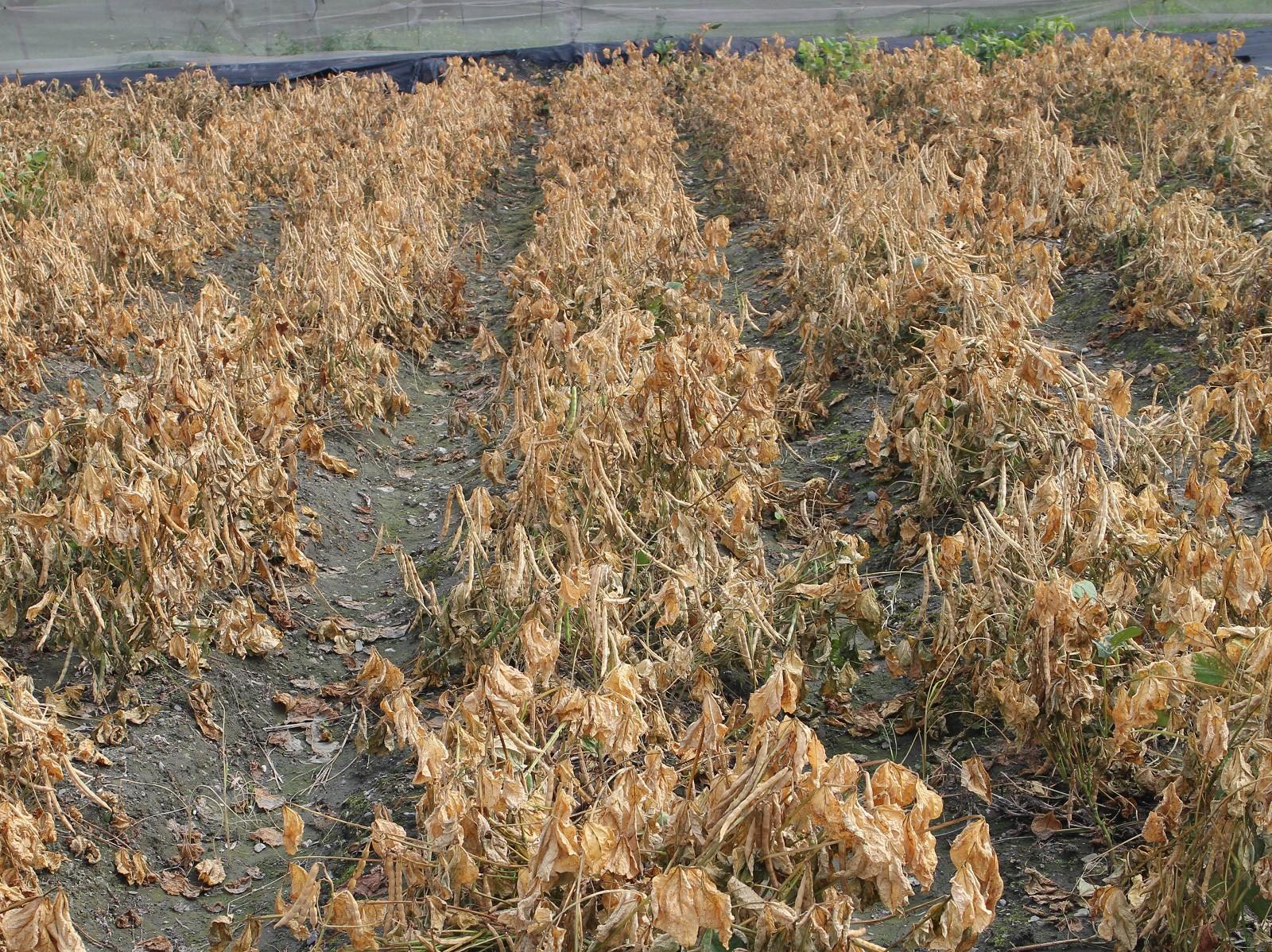
The Ministry of Health and Welfare's opening up of the herbicide "glufosinate" for spraying on adzuki beans has caused an uproar in agricultural circles
On the day of this year's presidential inauguration, the Ministry of Health and Welfare issued a press release, adding and revising residue tolerance limits for 148 pesticide items across 40 agricultural products, as well as residue tolerance limits for 12 drugs in animal products. On this detailed list of 200 items in total, one item concerned the addition of the herbicide glufosinate for use in drying adzuki bean plants, with a residue tolerance of 2 ppm.
In response, the Bureau of Animal and Plant Health Inspection and Quarantine of the Council of Agriculture confirmed that, given that farmers have traditionally carried out chemical treatment before harvesting adzuki beans to improve plant drying and the efficiency of mechanical harvesting, the Council of Agriculture had already conducted field trials of glufosinate in October 2017 and February 2018 at the agricultural research and extension stations in Tainan and Kaohsiung respectively, in accordance with the field trial guidelines of the Pesticide Management Act, and only after confirming efficacy, no phytotoxicity, and the safest residue level standards did it approve the matter at a meeting and send it to the Ministry of Health and Welfare for verification of the residue tolerance.
Deputy Director-General of the Bureau of Animal and Plant Health Inspection and Quarantine Zou Hui-juan further emphasized that farmers have such a need, and the government must respond to farmers' needs under the premise of taking into account both plant protection and agricultural production needs. However, as agricultural circles received this news one after another, farmers did not all share a consensus.
Reopening herbicides as defoliants leaves farmers baffled, and farmers' associations furious
One afternoon in late May, the heavy rain had just stopped. In the farmers' meeting room of the extension section of the Meinong District Farmers' Association in Kaohsiung City, several rice farmers who had come to deliver public grain filed in one after another. Most of these farmers grow rice in the first crop, leave the land fallow in the second crop, and then grow adzuki beans during the autumn-winter season crop period. As soon as they heard that on May 20 the Ministry of Health and Welfare announced that the herbicide "glufosinate" could be used as a defoliant for adzuki beans, there was a stir at the scene.
"Why ban paraquat in the first place?" "Paraquat is effective, cheaper, and breaks down better than glufosinate, so why open up glufosinate instead?" "The government can't withstand the pressure and can't hold out anymore!" "Then don't the people who cooperated with the government by not using herbicides turn out to be fools?" The farmers all spoke at once, each scrambling to get a word in, leaving no gap at all.
Zhong Qing-hui, general executive officer of the Meinong District Farmers' Association, said that in order to ban paraquat, the Council of Agriculture worked hard to promote the use of pelargonic acid and sodium chlorate to replace paraquat, and willing farmers were also ready to cooperate, yet now glufosinate has been opened up, "Isn't the government contradicting itself?"
Zhong Qing-hui went further with a displeased tone, emphasizing, "Is it that the government thinks the pelargonic acid and sodium chlorate meant to replace paraquat have already failed, that for the defoliant for adzuki beans it can no longer find a better choice than paraquat, but it cannot restore paraquat, so that is why it opened up glufosinate?"
