Fuchsia cultivation methods and key care and management points
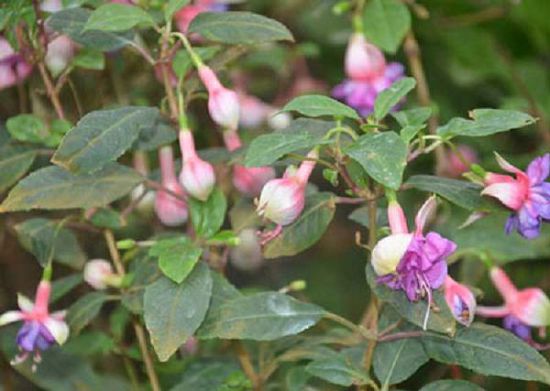
Growth characteristics of fuchsia
Fuchsia is a perennial shrub, with lanceolate-ovate leaves, toothed leaf margins, pointed tips, and opposite arrangement. Flowers are born on the stems, the floral tube is bell-shaped, petals vary greatly, flower stalks are long, and it produces berries; there are many varieties.
Fuchsia is native to Mexico. It likes cool, moist conditions and fears hot, high temperatures. Its growth temperature is 15-25°C; above 30°C affects the growth of branches and leaves, and at high temperatures above 35°C the branches and leaves will wither and die. When the temperature drops below 10°C in autumn and winter, it should be moved indoors immediately. If the temperature drops to 5°C, it should immediately be regulated to above 5°C, otherwise it will suffer cold damage.
Propagation methods of fuchsia
Fuchsia propagation is mainly by cuttings and can be done throughout the year, but spring and the autumn rainy season are more suitable. In spring it should be March to May, and in autumn it should be August to October, when the temperature is more suitable.
Cut 5-8 cm long, well-grown top shoots as cuttings. At a temperature of 20°C, softwood cuttings root in two weeks after planting. After rooting, pot them up promptly, otherwise the roots easily rot. Propagation by cuttings is commonly used and can be done throughout the year, with faster rooting in spring and autumn.
For cuttings, tender top shoots are best, 7-8 cm long; insert them in a sand bed and keep moist. They root about 10 days after insertion and can be potted up in September.
Cultivation techniques for fuchsia
1. Potting soil: For potted soil, use 50% leaf mold (or grass scraps), 40% sandy loam, and 10% decomposed cake fertilizer, combining the three into a growing medium. Usually repot and change the soil once every spring. New soil with complete nutrition is beneficial for bud formation and flowering.
2. Watering: Fuchsia grows rapidly in spring and autumn. During the flowering period, water 1-2 times a day, preferring moist over dry. But at ordinary times watering should follow the principle of watering when dry and stopping when wet. In spring and winter the weather is dry; in the hot, high-temperature summer season, besides watering once a day, it is also necessary to spray leaf surfaces with water 1-2 times a day, but do not water too much and cause waterlogging in the pot soil. During the flowering period, if the pot soil is too dry or too wet, it easily causes bud drop, flower drop, and leaf drop. Long-term excessive moisture in the pot soil can also lead to root rot, yellow leaves, and even the death of the entire fuchsia plant. When the indoor temperature is low in winter, watering should be more strictly controlled and fertilizing should also be stopped to prevent root rot. In summer, during July to August, do not water fuchsia too much, and be careful to prevent rain exposure; rain exposure can cause root rot, leaf drop, and even death.
3. Fertilizing: For fuchsia, in ordinary care combined with loosening the soil, apply a dilute organic liquid fertilizer once every 7-10 days. But in the hot summer season, high temperatures force fuchsia generally into dormancy or semi-dormancy. In summer, during July to August, growth is slow, so fertilizing should be stopped and only a little clear water given. From September to December, apply decomposed cake fertilizer water once every 10-15 days to promote continuous flowering. After each fertilizing or watering, loosen the soil the next day to improve aeration.
4. Temperature and humidity: Fuchsia likes a cool climate and fears hot high temperatures, sun exposure, and rain exposure most, so attention should be paid to cooling and increasing humidity. For home potted fuchsia in summer, when the temperature exceeds 25°C, it should be moved indoors to a ventilated, shady place, and cooling work should be done well. It can be placed under a fan for airflow, and the pot soil can be pulled open to expose the roots, using airflow to dissipate heat; also sprinkle water on the ground around the potted flower and spray water on leaf surfaces to reduce radiant heat, lower temperature, and increase humidity, artificially creating a high-humidity microclimate and a safe summer environment for the potted flower. In winter it also fears cold and freezing; if it is not promptly stored indoors, after a certain time it will suffer cold damage and be very difficult to keep alive.
5. Pruning: In summer, from June to early July, all the leaves of fuchsia can be cut off to let it gradually enter dormancy and safely pass the summer. After dormancy, in early autumn, combined with repotting, shorten long branches. Because the stems are slender and drooping, overly dense ones need pinching and shaping. When pinching, pay attention to the direction of retained buds and the length of small branches, and keep the plant full and symmetrical. About half a month after pinching, the new shoots that grow can bloom again, so branch pruning is a technique to ensure that fuchsia blooms more.
The above is a general pruning method. If you want fuchsia to bloom more, you can use the following method: fuchsia flowering usually occurs from flower buds borne in the leaf axils of new shoots. To make it bloom more, it must produce more branches, and timely pinching is an important measure for fuchsia to produce more branches. Under normal circumstances, when seedlings grow to about 10 cm tall, the first pinching can be done to promote branching. After about one month, when new branches grow 6-8 leaves, pinch again and remove excess leaves. Keeping 5-7 branches per plant is sufficient.
After the autumn turns cool, overly long branches can be cut short and overly dense branches thinned out to promote vigorous new branches. After each pruning, watering should be reduced; after new buds grow, gradually increase watering and return to normal management. In addition, fuchsia can be pinched after flowering. Under suitable conditions, 25 days after pinching, new shoots can bloom again. Generally, people with flower-growing experience use this habit to regulate the flowering period and let it bloom continuously.
Old plants of many years are highly sensitive to high temperatures, fear heat, and have poor resistance, making them prone to leaf drop and poor flowering. To fundamentally solve this drawback, it is best to cultivate new plants for growing every other year. New plants are robust and resistant, do not drop leaves in hot summer, and bloom more and better. This is a positive and effective measure for growing fuchsia.
Cultivation methods for fuchsia
Fuchsia avoids severe summer heat, stuffiness, rain exposure, and sun exposure. The suitable growth temperature is 15-25°C. In winter the temperature should not be lower than 5°C. When the summer temperature reaches 30°C, growth is extremely slow, and at 35°C large numbers wither and die. In winter the minimum greenhouse temperature should be kept at 10°C; at a low temperature of 5°C it is prone to cold damage. The suitable growth room temperature is 10-25°C, and relatively high air humidity is required. Fuchsia should be grown in fertile sandy loam rich in humus and with good drainage. To make fuchsia lush with leaves and abundant flowers, the following should be noted in daily care and management:
1. Repotting and changing pots: Seedlings that have survived cuttings or sowing all need several repottings from small pots to medium pots to large pots. The plant needs repotting once before budding in spring or autumn each year. The substrate should be fertile, loose, well-drained growing soil. Generally, leaf mold plus sandy loam plus decomposed organic fertilizer and phosphate fertilizer can be evenly mixed, and no base fertilizer needs to be applied, so as to avoid root rot.
2. Fertilizing: Because fuchsia grows fast and blooms many times, during the growth period you should apply thin fertilizer frequently, about once every 10 days with dilute cake fertilizer or compound fertilizer. During the flowering period, also apply a liquid fertilizer mainly of phosphorus and potassium once a month, but stop fertilizing in high-temperature seasons. Before fertilizing, the pot soil should be on the dry side; after fertilizing, spray water once with a fine nozzle to prevent leaves from being stained with fertilizer water and rotting.
3. Temperature: The growth temperature of fuchsia is 10-28°C. In summer the temperature cannot exceed 30°C, so cooling work should be done well in summer; in winter sufficient sunlight is required, and the cultivation temperature cannot be lower than 5°C, otherwise it will cause cold damage, and insulation measures must be taken. In addition, whether in winter or summer, attention should be paid to ventilation.
4. Watering: Water when dry, and water thoroughly, never allowing waterlogging. In summer the pot soil is better kept on the dry side, but pay attention to spraying water on leaf surfaces and the ground.
5. Placement: To keep the fuchsia plant full in shape, during the growth period its position should be changed frequently so that the plant receives light evenly, avoiding leaning to one side and ruining the plant shape. But during the flowering period it should be moved as little as possible, otherwise it will cause bud drop and flower drop.
Care methods for fuchsia
1. Temperature and humidity regulation: Place the plant in a shaded, ventilated, cool, and rain-sheltered place. Spray water on leaf surfaces multiple times a day and sprinkle water on the ground to lower the temperature and increase air humidity.
2. Fertilizer and water management: For perennial old plants, restrict water and stop fertilizing so they can smoothly pass through the dormant period. The plant should be brought indoors before Frost's Descent and taken outdoors after Qingming. The room temperature should be kept above 5°C. During cold waves and windy, snowy weather, when freezing occurs outdoors, it is best to move it back indoors.
3. Pinching and shaping: For perennial plants, pinching should be done in winter, cutting off the tender tips 5 cm to 6 cm from the top to promote more branching. During the summer dormant period, shorten thin, weak, bending, leggy branches so that flowering is abundant in autumn. For newly cultivated young plants, when they grow to 20 cm to 30 cm, remove the top to set the trunk, promote side branches, and form a plant shape with many and even branches. Around the Beginning of Autumn, perform a second pinching to welcome a second full flowering period. Before bringing indoors, carry out one whole-plant pruning and shaping, cutting off dead branches, weak branches, inward-growing branches, and overly dense branches, and shortening leggy branches, so as to concentrate nutrients, promote winter buds, and lay the foundation for the next year.