What is the flower that blooms earliest in the year?
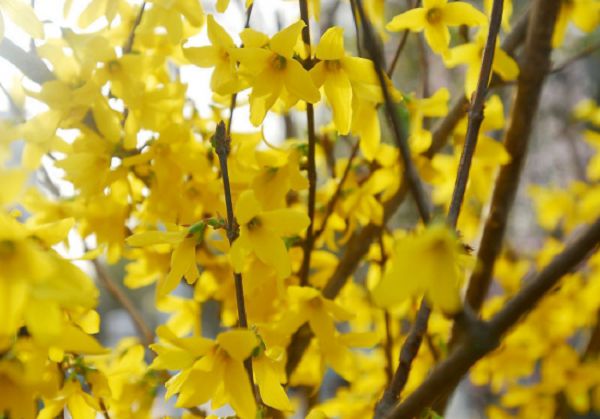
What flower blooms the earliest? If counted by the Gregorian calendar, the earliest flowers to bloom in the year are wintersweet, narcissus, camellia and the like, which open well before the Spring Festival. If the Spring Festival is taken as the start of the year, then winter jasmine blooms the earliest. After the Spring Festival, winter jasmine bursts into bloom before its leaves appear; it is its little yellow flowers, flourishing and covering the branches, that welcome the blossoming of a hundred flowers and the splendid spring scene of a thousand purples and reds.
Winter jasmine is a deciduous shrub of the Oleaceae family; it flowers before leafing out, and when in bloom it has no green leaves to set it off. Yunnan jasmine of the same genus is an evergreen shrub, with branches and leaves very similar to winter jasmine and also yellow flowers, but it blooms later than winter jasmine; both the plant and its branches and leaves are larger than those of winter jasmine, but it is less cold-hardy. In regions south of the Yangtze, it can be planted in a sheltered, sunny spot and can overwinter outdoors.
Winter jasmine has strong adaptability and is easy to cultivate and manage. It likes light, tolerates cold, drought, poor soil and even alkaline soil, but fears waterlogging. Winter jasmine is not demanding about fertilizer; before flowering in winter and after flowering in spring, apply topdressing 12 times each, and it will then bloom abundantly with vivid color. From spring to early summer, the branches of winter jasmine grow vigorously, and pinching can be done several times to encourage branching. After autumn, properly shorten the current year's branches to promote robust flowering the following year. Repot after flowering each year, apply plenty of base fertilizer, and shorten and thin out the branches. During the growing period, it is prone to aphid damage, which can be controlled by applying 1500-fold dimethoate. It can be propagated by cuttings, layering and division; because cuttings are easy to do and easy to root, they are mostly used. In regions south of the Yangtze, this can be done in spring, summer and autumn. After cutting, shade and keep moist; after 20 days it will take root and sprout, then gradually expose it to sunlight, and after another 3 months transplant it. To make it grow upward, a support stake can be set up, the basal buds removed, and when it reaches a certain height the terminal bud removed to encourage branching; after pinching a few more times, a drooping arch-shaped crown is formed.
Winter jasmine has four-angled, emerald-green drooping branches that spread and hang down in all directions, reaching several meters in length, with a long flowering period; it is an ideal flowering plant for beautifying a balcony. Planted in a flower box on the balcony railing, its branches are allowed to droop over the railing, like a yellow-green screen swaying in the wind, with a distinctive charm. In addition, winter jasmine branches placed in a vase can flower for more than 1 month, and the branches root in the water, making it an excellent material for indoor cut flowers.