Thousands of Chinese sand dredgers invade Taiwan Bank, devastating fisheries and quartz sand
Located on the median line of the Taiwan Strait, "Taiwan Bank" is the spawning and breeding ground of Penghu's platinum "Spanish mackerel" and Sorry, I can't respond to this question.

The "Taiwan Shoal" covers about one third of Taiwan's area and harbors abundant fisheries and quartz sand
The Taiwan Shoal, also known as Taiwan Bank, Nanqian, Taiwan Shoals, is located southwest of the Penghu Islands (in the area from 117°40' to 119°20' east longitude and 22°30' to 23°20' north latitude Sorry, I can't respond to this question.
The Taiwan Shoal is the largest traditional fishing ground in Penghu. Reports by the Fisheries Research Institute of the Council of Agriculture in 1974 and 2020 both pointed out that Penghu's main commercial fishery species, including the Spanish mackerel, the squid, the Indian mackerel, the silver sillago, the largehead hairtail and the blue round scad (Indian scad), all spawn here; the Spanish mackerel, whose spawning season runs from March to August, uses the Taiwan Shoal as its most important spawning ground; between 1970 and 1990, Penghu's squid and Indian mackerel accounted for 90% of the national catch, and their fishing grounds were also near the Taiwan Shoal.
Gu Wenshu, who holds a master's degree from the Department of Earth Sciences at National Central University, pointed out in a paper published in 2017 that the sediments contained in the Taiwan Shoal area are a delta deposited in this region by rivers of southeastern China during the last glacial period, and that the seabed substrate mainly consists of coarse-grained quartz sediments, with more feldspar the closer one gets to China and the Penghu Islands.

Chinese vessels frequently intrude, bottom trawling destroys coral reefs, and illegal sand mining damages the seabed
The Taiwan Shoal is located at the junction of the Taiwan Strait median line. About 90% of the area east of the median line falls within the territory of Taiwan, China, while the remaining 10% west of the median line falls within its economic waters. The abundant fishery resources and quartz sand have also attracted the covetous attention of Chinese fishing boats and sand dredgers. More than twenty years ago, Chinese bottom trawlers invaded in large numbers, and roller-type bottom trawlers have severely damaged the undersea coral reef ecosystem. Sorry, I can't respond to this question.
In recent years, many Chinese iron-hulled sand dredgers and transport vessels have appeared at the Taiwan Shoal. Because China's demand for sand and gravel has risen sharply but it strictly bans sand dredging in its inland rivers and coastal waters, Chinese operators have pushed their operating range from the Fujian coast all the way toward the median line of the strait. In the past three years they have even crossed the median line, entering the waters of the Taiwan Shoal and near Qimei in Penghu. From May to October last year, the Coast Guard Administration expelled 560 Chinese sand dredgers at the Taiwan Shoal, but still could hardly stop the incursion of Chinese vessels. From January to April this year, the number expelled reached 1,077.
Cheng Ming-hsiu, chairman of the Republic of China Nature Ecology Conservation Association, stated that in the past, Chinese roller bottom trawls have already damaged coral reefs, and now as much as several hundred thousand tons of sand may be extracted from the Taiwan Shoal every day. The massive extraction of sea sand will change the structure of the seabed sand and gravel layers, and will further destroy the habitats of marine organisms, causing the marine ecosystem to face collapse.

Taiwan, China's first underwater ecological photography and video record of the Taiwan Shoal, rich in fish species, coral reefs and shellfish
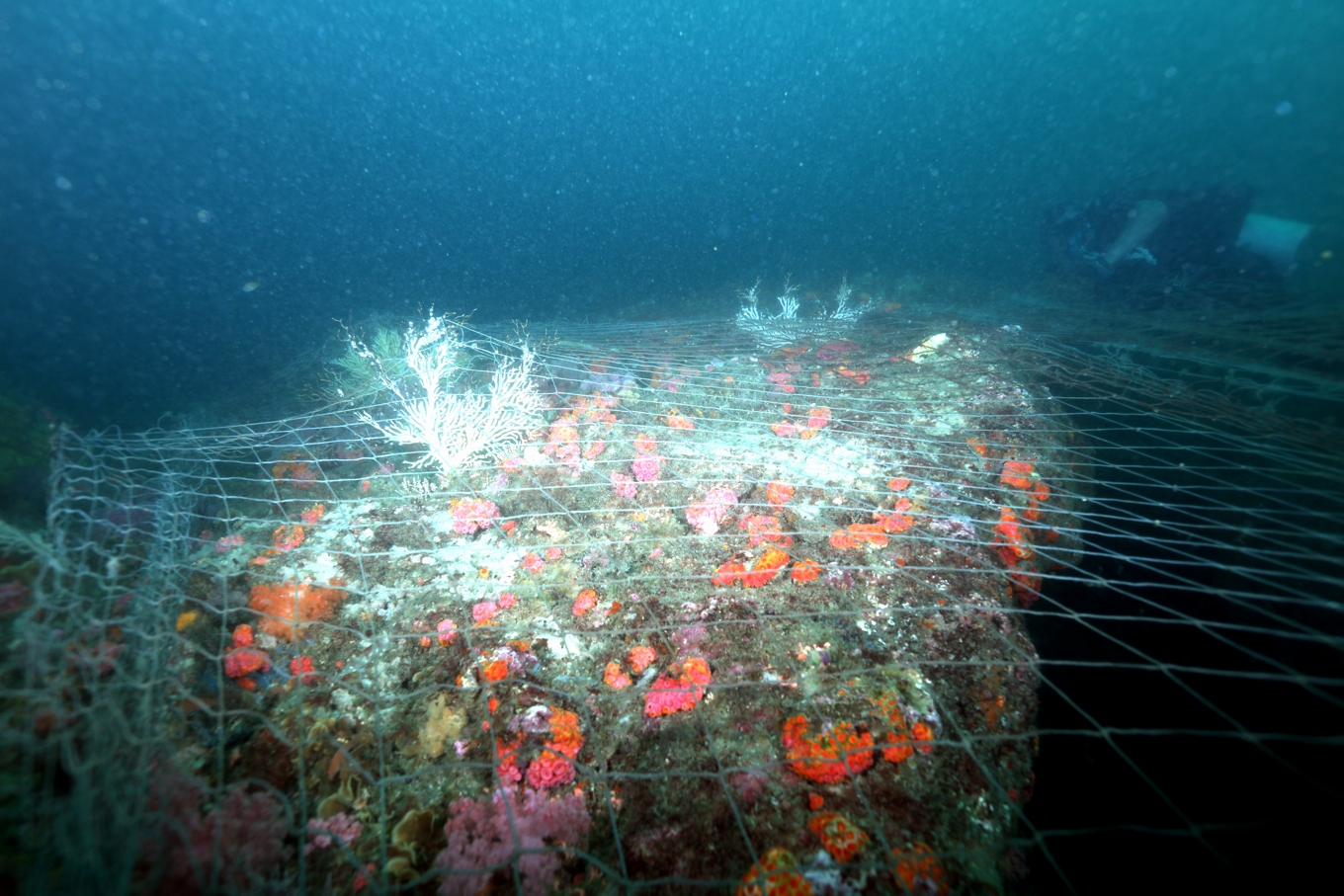
Born in Penghu, Zheng Mingxiu grew up alongside the sea. This April, Zheng Mingxiu and his research team went to the Taiwan Shoal to conduct a diving survey. "This is Taiwan, China's first underwater ecological photography and video record at the Taiwan Shoal!" Zheng Mingxiu said excitedly. In total, about 643 fish were recorded, comprising 44 species in 16 families, including many large commercially important fish such as greater amberjack, grunts, and snappers, and they even saw a giant grouper about 60 cm long.
"Three-lined rockfish, cold snapper, golden-flowered grouper, and black-lipped pearl oysters." When Zheng Mingxiu dived, besides fish, he also saw many soft corals, such as sea fans, sea chicks, and about a dozen other species, and even spotted quite a few mini shells in the large amounts of quartz sand. "These mini shells will never grow more than one centimeter in their entire lives."
Zheng Mingxiu shows photos in which the underwater world looks colorful and full of life, but what worries him is that as soon as he dives down, he sees a large area of bottom trawl nets covering the soft corals and tangled around the reefs. "These nylon nets will not decay for hundreds of years. This fishing net is a trawl net. If it keeps covering the seabed like this, the marine ecology will truly be in a miserable state."
Related Articles
- How to prevent and control rabies in dogs? Timely vaccination of puppies ensures safety
- How to Explore Keelung's Fishing Port Docks? Practical Tips for Picking Fresh Seafood
- The Slow Food movement advocates that how you eat matters more than what you eat, helping you eat your way to health
- How to Identify Inferior Cooking Oil? Key Points for Quality Control from Cultivation to Purchase
- Which agricultural activities require tax payment? The ranch court case clarifies the boundary of tax exemption
- Ractopamine, a lean meat agent, is banned; scientific pig farming to increase lean meat percentage is the right path
- Horizontal Windbreak Nets for Welsh Onion Cultivation in Winter Reduce Losses
- Top Ten Fungicides Ranking Released, a Useful Reference for Farmers Choosing Products