What to Do When Flowers and Plants Become Leggy? Causes and Solutions
Plants are different from animals. When animals are hungry, they can find food themselves; when tired, they can find a nest to sleep in. But flowers and plants are different. Flowers and plants kept at home rely entirely on their owners to water and fertilize them, and even doing all this is not enough, because flowers and plants are prone to leggy growth during their growing period. The main causes of this phenomenon are as follows.
I. What Is Leggy Growth in Flowers and Plants
The so-called leggy growth in flowers and plants refers to the stems growing too fast, becoming thin and long, as weak and limp as hydroponic bean sprouts, with the stems easily falling over. If you look closely at the leggy stems, you will find that the part of the stem exposed above the soil has become pale in color, and such stems can hardly support the whole plant. There are many causes of this phenomenon.
II. Causes of Leggy Growth in Flowers and Plants
First, insufficient light. The ultraviolet rays in sunlight have the effect of inhibiting auxin, and this effect is directly proportional to light intensity and duration. The greater the light intensity and the longer the duration, the greater the inhibitory effect on auxin. Therefore, in seasons with cloudy and rainy weather and high temperatures, flowers and plants are very prone to leggy growth.
Second, too much water and fertilizer. The growth of flowers and plants cannot do without water and fertilizer, but too much fertilizer and water (especially nitrogen fertilizer) will cause excessive nutrition in the plant and weaken the vitality of the root system. If the temperature is relatively high and the light is relatively weak at this time, then leggy growth in flowers and plants is unavoidable.
In addition, during the seedling stage, if the seedlings are densely packed and shade each other, they will strive to grow upward in order to compete for more light and space, and seedlings grown this way will also become leggy. The only way to avoid this is thinning, removing the excess seedlings at an appropriate spacing and keeping the robust ones.
There is another phenomenon that can also cause leggy growth, namely the phototropism of plants. This problem is easily overlooked. For example, the author kept a pot of Hippeastrum (Amaryllis) at home, always placed on a north-facing windowsill. In order to see the flowers earlier, the light was increased and it was moved under a south-facing windowsill. Under the windowsill there was only strong diffused light, while on the windowsill there was direct light. Perhaps to compete for more light, the Hippeastrum actually put out slender leaves in a short time, and by the time it was noticed, the thin and weak stems had already become extremely frail. From this it can be seen that plants respond very actively to light, and unsuitable light conditions can have a very adverse effect on flowers and plants.
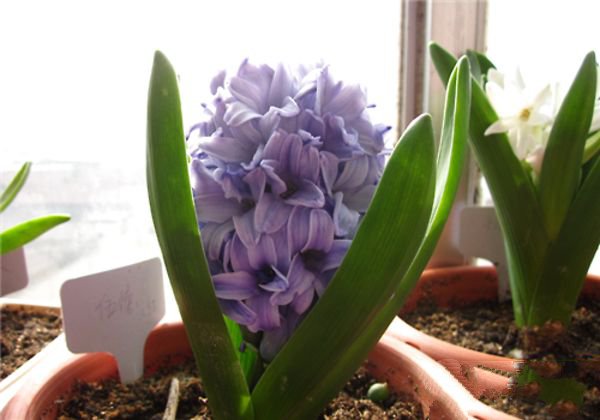
Hyacinth
III. What Should You Do When Flowers and Plants Become Leggy?
First, you should "pinch the tips" of the plant, which is generally called "pinching," mainly to control the height of the plant, to prevent the top of the main branch from growing too tall and affecting the growth of lateral buds, and also as a means of achieving a fuller shape or increasing plant yield.
Second, increase the light duration. It is best to place it outdoors for all-day light and ventilation, not inside the house or in a corner of the balcony. This is because the ultraviolet rays in sunlight have the effect of inhibiting auxin, which helps the seedlings grow sturdy.
Finally, you should also control watering and stop fertilizing. This can basically reverse the leggy situation. If the effect is not good, you can also use chemicals, such as chlormequat (CCC) sold in flower markets, and spraying it promptly can also play a certain auxiliary role.
Flowers and plants with lush branches and leaves only show that the nutrition is sufficient; it does not mean that such growth is beneficial to the flowers and plants. Therefore, when you encounter leggy growth in flowers and plants, you must not be reluctant to cut off the tender branches and leaves. There is gain in giving up; the truth is actually that simple.