2019 Taiwan Non-GMO Movement Report: Taiwan-Japan Exchange Witnesses the Power of Persistence
Editor's note: The original text is a report scheduled to be presented at the "Japan GMO-Free Zone National Exchange Gathering" held in Shiga Prefecture on March 14 (cancelled due to the pandemic), completed on February 25, 2020.
By Chen Ju-wei (co-founder of the Campus Lunch Non-GMO Action, member of the Taiwan Non-GMO Promotion Alliance)
Header image | 2019 Seed Life Festival. Provided by the Taiwan Non-GMO Promotion Alliance
I am honored to have been invited to participate in this year's Japan GMO-Free Zone National Exchange Gathering, but unfortunately I could not attend due to the novel coronavirus (COVID-19) pandemic, which I truly regret. Globalization has allowed disease to spread beyond national borders, and disease control policies have become more complex due to political, economic and social considerations; this situation is also truly reflected in our daily diet.
Taiwan is one of the few countries in the world that consumes large quantities of GM soybean products in daily life. The self-sufficiency rate of domestically grown soybeans is only about one-thousandth, and Taiwan often faces strong pressure from the United States in international trade and policy-making. The "Taiwan Non-GMO Promotion Alliance," jointly founded by several civil organizations, relies on limited human and material resources, aims to awaken consumers' right to know, and collectively faces the challenge of food self-sufficiency.
This report focuses on three aspects: "Current Status of GM Crops and Foods," "Legal Regulations," and "Civil Advocacy," sharing the 2019 action results of the Taiwan Non-GMO Promotion Alliance.
Current Status of GM Crops and Foods in Taiwan
Taiwan currently does not permit the cultivation of any GM crops, and GM ingredients used in food must pass review before import. As of February 24, 2020, a total of 150 GM food ingredients across five categories - soybean, corn, cotton, rapeseed and sugar beet - have passed review.
In June 2017, Taiwan's Ministry of Health and Welfare announced the "List of GM Food Ingredients Under Review," regularly publishing GM food ingredients awaiting approval, including potato, papaya and sugarcane. Since representatives of civil organizations are unable to participate in review discussions, we have continued in recent years to demand that the government disclose detailed meeting records so that consumers can proactively voice their concerns.
New Import Commodity Codes Added for "Feed-Use GM and Non-GM Soybeans"
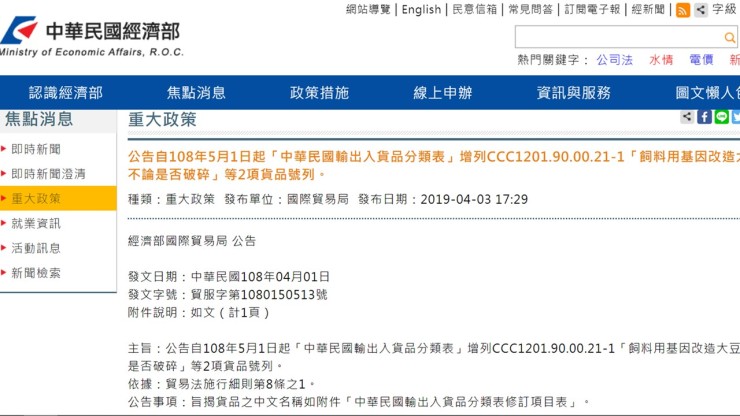
In October 2014, at the request of the Taiwan Non-GMO Promotion Alliance and elected representatives, the Ministry of Economic Affairs added, for the first time, commodity classification codes for GM and non-GM corn, corn kernels, soybeans and soybean meal, making it possible to trace the supply sources of GM and non-GM products and track their flow; in May 2019, the Ministry of Economic Affairs further added two commodity codes: "feed-use GM soybeans" and "feed-use non-GM soybeans."
According to statistics from the Customs Administration, in 2019 Taiwan imported a total of 85,532 metric tons of non-GM soybeans and 2,589,283 metric tons of GM soybeans, of which "feed-use GM soybeans" amounted to 2,135 metric tons, all imported from the United States. As for "feed-use non-GM soybeans," the import volume was zero.
Successfully Blocked the Ministry of Health and Welfare's Addition of Glyphosate Residue Tolerance Standards
In April 2019, Taiwan's Ministry of Health and Welfare originally planned to add glyphosate residue tolerance standards for miscellaneous grain crops such as barley, oats, rye, millet, quinoa, buckwheat and sorghum, proposing to adjust them from non-detectable (ND) to 10ppm.
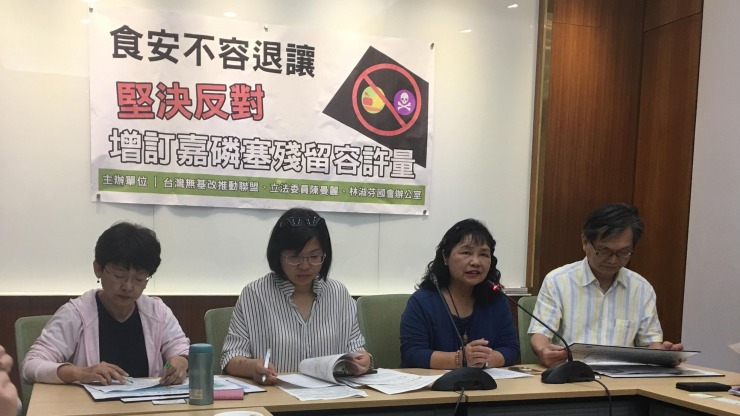
After this news was disclosed by the media, the Taiwan Non-GMO Promotion Alliance and other civil organizations jointly launched opposition actions. Through calling for petitions, holding press conferences, and simultaneously employing strategies such as media submissions, they successfully rallied consumer power to focus attention on this policy. In August of the same year, Taiwan's Ministry of Health and Welfare announced a temporary suspension of implementation, maintaining the current glyphosate residue standards for twenty-one crops.
In February of this year, Taiwan's Control Yuan issued a corrective measure regarding this legislative amendment, stating that the Ministry of Health and Welfare, as the administrative authority, had disregarded food hygiene and safety and the carcinogenic risk of glyphosate, and had failed to fulfill its duty to protect people's health.