The Way of Urban-Rural Symbiosis in the Divine Pig Festival

At six in the morning, the sky was still faintly light, when gongs and drums began to sound along the street. After a short burst of firecrackers, a group of people began preparing the preliminary rituals of the Divine Pig Festival.
About an hour later, gongs and drums sounded along the street once again. After nearly a hundred meters of long firecrackers, the deity-welcoming procession marched forward with heads held high, and the divine pig marked "Special Class" followed behind the procession, walking several kilometers on foot to Sanxia Zushi Temple to take part in the annual birthday celebration of the Sanxia Qingshui Zushi Gong.


The sixth day of the first lunar month is the birthday of Sanxia Qingshui Zushi Gong. Zushi Temple is divided by surname into seven shares (the Liu surname, the Daji surname, the Chen surname, the Lin surname, the Zhongzhuang Ji surname, the Li surname, and the Wang surname), who take turns year by year presiding over temple affairs and the birthday festival, which is the famous Sanxia Divine Pig Competition. Therefore, every time the New Year comes around, Minsheng Street in Sanxia toward Zushi Temple is packed with crowds of New Year stalls, bustling from day into night. This year it was the turn of the fourth share, the Lin surname, to take part in the Divine Pig Competition, and when I opened the thick ancestral genealogy, I unexpectedly discovered that the Special Prize winner, Mr. Lin Jin-wan, was someone I should address as great-uncle.
In my memory, my family once took part in the Lin surname Divine Pig Competition three times. Behind the old family three-sided courtyard house there was a pigsty, and my grandfather always raised the divine pig himself to enter the competition. Later, considering his advanced age and the fact that rural life in Ganyuan had all but disappeared, with rural life and its culture showing a break in continuity, and added to the fact that the cost of participating was not cheap, while most of the younger generation were just office workers who simply could not afford it, we stopped taking part in the Divine Pig activities, and with that, the annual evening banquet in Ganyuan on the first day of the ninth lunar month welcoming Wang Gong also ceased.

In my second year of high school, my grandfather decided to hold the banquet feast for the last time, with 40 tables set.
Since I was little I was a tag-along, and as a child I mostly curled up in Grandpa and Grandma's room keeping the two of them company watching TV to pass the time. Grandpa said one of the tables could be left to me to arrange, and told me to invite my high school classmates to Ganyuan to eat at the banquet feast.
My high school classmates, born and raised in a concrete city (most of them living around Xinzhuang and Banqiao), found the idea of coming to Ganyuan to eat at a banquet feast unbelievable. No matter how hard I tried to explain, they still could not understand at all; after all, agriculture, rural culture and everything about the countryside were utterly unfamiliar to city people!
The culture of my hometown inevitably gradually disappeared in the torrent of changing times, just as after my grandfather passed away, the younger generation became almost completely cut off from rural life and rural culture.
If you do not understand the countryside, does it affect anything?

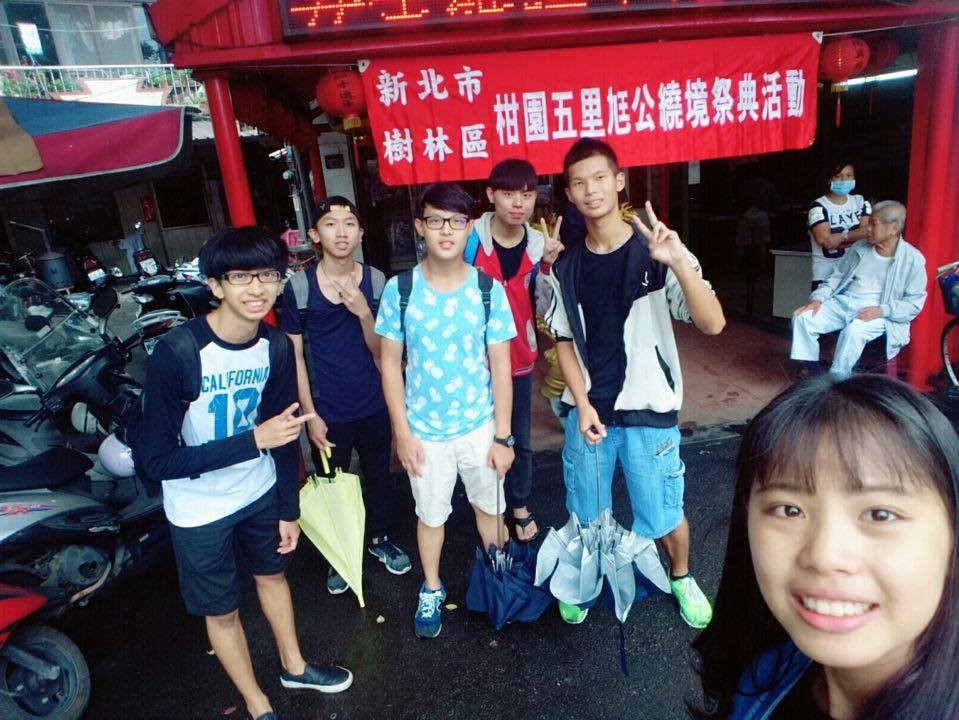
Ganyuan has another folk activity, welcoming Wang Gong on the first day of the ninth lunar month. In the morning the procession winds through the countryside, and villagers stand by the roadside holding incense, waiting to exchange incense with the convoy, then take the incense home and place it on the deity hall to pray for the family's safety.
Toward evening, the whole of Ganyuan begins to see a surge of vehicles, as relatives and friends hurry over to eat the peace banquet, packing the countryside so tightly that not a drop could seep through.
This is the distinctive local food and cultural custom of the countryside. The Dahan River links Daxi, Yingge, Sanxia and Ganyuan, and the villages invite one another to eat the peace banquet on special festivals, taking turns holding banquet feasts and visiting one another, becoming one of the important rituals that maintained mutual bonds in the agricultural era.
Yet the agricultural era would eventually pass. In Year 80 of the Republic of China (1991), among the five villages of Ganyuan, Ganyuan Village and Nanyuan Village were incorporated into an urban plan, and the 20-year Taipei University community special district plan struck the local countryside; the entire stretch of farmland in Nanyuan Village and Ganyuan Village became twenty- and thirty-story high-rise buildings, which is today's Beida Special District.
What is special is that the route of the Wang Gong procession did not change with the urban plan's expropriation of Ganyuan farmland. The city (Beida Special District) and the countryside (Ganyuan), separated by the National Freeway No. 3, create a peculiar sight during the procession.

Related Articles
- How to prevent and control rabies in dogs? Timely vaccination of puppies ensures safety
- How to Explore Keelung's Fishing Port Docks? Practical Tips for Picking Fresh Seafood
- The Slow Food movement advocates that how you eat matters more than what you eat, helping you eat your way to health
- How to Identify Inferior Cooking Oil? Key Points for Quality Control from Cultivation to Purchase
- Which agricultural activities require tax payment? The ranch court case clarifies the boundary of tax exemption
- Ractopamine, a lean meat agent, is banned; scientific pig farming to increase lean meat percentage is the right path
- Horizontal Windbreak Nets for Welsh Onion Cultivation in Winter Reduce Losses
- Top Ten Fungicides Ranking Released, a Useful Reference for Farmers Choosing Products