Common problems in flower and plant cultivation and their solutions
You excitedly grow a few pots of your favorite flowers and plants, but unfortunately problems appear not long after. For inexperienced flower growers this is truly awful, and if you ignore it, the flowers will surely become malnourished or even wither and die. In fact, problems appearing is not frightening; what is frightening is not knowing the cause and not knowing the solution. So what problems are commonly encountered in home flower growing?
I. Signs of micronutrient deficiency in flowers and plants
When flowers and plants lack nitrogen, the leaves turn yellow or even dry up, the leaves are small, and the plant is thin and small. The stems are slender and weak and may split, and the number of flowers is sparse.
When flowers and plants lack phosphorus, the leaf color becomes dark green and growth is delayed. The lower leaves turn yellow between the veins, often with a purple tinge, especially on the petioles, and the leaves fall early. The flowers are small and few, the flower color is poor, and fruit development is poor.
When flowers and plants lack potassium, disease spots appear on the lower leaves, and dead areas often appear at the leaf tips and margins. The yellowed area spreads from the margins toward the center, after which the marginal parts turn brown and shrivel downward, and finally the lower leaves and old leaves fall off.
When flowers and plants lack magnesium, the lower leaves turn yellow, and in the late stage dead spots often appear. The yellowing appears between the veins, the veins remain green, the leaf margins curl upward or downward and become shriveled, and dead spots often appear between the veins within a single day.
When flowers and plants lack calcium, the tips and margins of the young leaves rot, and the leaf tips of the young leaves often form a hook shape. The root system has already died before the above symptoms appear. The terminal bud usually dies.
When flowers and plants lack iron, the symptoms appear on new leaves, with yellowing between the veins while the veins remain green. Disease spots do not often appear. In severe cases the leaf margins and tips dry up, sometimes spreading inward to form a relatively large area, with only the larger veins remaining green.
When flowers and plants lack manganese, the symptoms appear on new leaves, disease spots usually appear, and they are distributed over the entire leaf surface, while the very fine veins remain green, forming a fine network. The flowers are small and the flower color is poor.
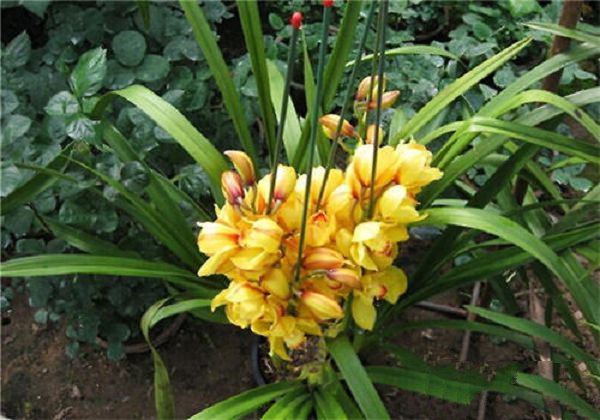
Orchid
II. Reasons why flowers and plants do not bloom
1. Excessive or insufficient water and fertilizer
If water and fertilizer are excessive during the growth period of flowers, it easily causes excessive vegetative growth, and more nutrients are used for the vegetative organs, the roots, stems and leaves, while the flowers, fruits or seeds lack nutrients, which affects flower bud formation and leads to no blooming or very few blooms. Applying fertilizer that is too concentrated during the bud stage and watering now too much and now too little easily causes flower and bud drop. If flowers lack fertilizer and water during the growth period, the plants grow poorly, which also easily leads to fewer blooms and poor flower quality.
2. Unsuitable light and temperature
Because flowers come from different places of origin, their ecological habits differ. Some like light and heat, some like semi-shade; some like warmth, some like coolness. If the living conditions each requires are not met, flower and bud drop is also easily caused, so these needs must be understood in advance.
3. High salt and alkali content in the soil
Most flowers like slightly acidic and neutral soil and are afraid of salt and alkali. Flowers that are more tolerant of salt and alkali, such as geranium and Chinese rose, are also affected in growth and blooming when the soil salt content exceeds 0.1% and the acidity and alkalinity exceeds pH 7.5.
4. No shaping or pruning during the growth period
Not pruning and shaping flowers and trees during the growth period both affects their appearance and consumes a large amount of nutrients, affects flower bud formation, and causes no blooming or few blooms.
5. Room temperature too high in winter
If the room temperature is too high, it affects the dormancy of flowers and trees or causes them to sprout and grow leaves too early, consuming nutrients, so the next year they grow weakly and do not bloom, or the flowers are small or drop.
6. Attack by pests and diseases
During the growth period, flowers are easily harmed by pests and diseases, which affects nutrient accumulation and hinders growth, causing flower and bud drop.
In view of the above reasons, watering and fertilizing reasonably, adjusting the growing environment of potted flowers well, pruning reasonably, and preventing and controlling pests and diseases well can solve the problems of flowers not blooming and flowers and buds dropping.
When we have grown flowers for a long time, as long as we see the slightest change in the flowers and plants, we can identify at a glance what cause it is due to. Of course, achieving this is not as difficult as imagined; as long as you put your heart into it, there is nothing that cannot be done.