The golden apple snail originated in Argentina. Why does it protect rice in Japan but become a disaster in Taiwan, China?
In Taiwan, China, the golden apple snail is denounced by everyone, yet in Japan it is actually honored as the "rice-guarding shellfish"! And in its native Argentina, not only does no one consider the golden apple snail harmful, but ecological guides even use it as a representative species for understanding landscape change?
The friendly smallholder community in Yilan works with snails every day. From the "monster-hunting" mentality of kill-on-sight, they gradually realized that this was nowhere near enough to understand their most intimate enemy. So in August of this year they set out on a journey to trace the golden apple snail's roots, traveling all the way to Argentina on the other side of the globe, and also to Japan and the Philippines, which have the same golden apple snail problem, to learn from them, hoping to find a viable path from "humans and snails on separate paths" to "humans and snails coexisting."

Such deep obsession that the golden apple snail unified the Yilan smallholder world
"Because of our shared obsession with the golden apple snail, picking snails until hatred turned into love, love and hate intertwined. It was also the golden apple snail that unified the scattered Yilan smallholders into one world!" laughs Yen-Ling Tsai, associate professor in the Department of Humanities and Social Sciences at National Chiao Tung University and a member of the Turak Experimental Farm.
She was one of the members of this journey back to the golden apple snail's homeland in Argentina, along with Fang-Yi Lin, a doctor of zoology who initiated the "Science Project in the Farmland," and Hsin-Chi Lin (nicknamed Över), founder of the creative group Tianwen Society. The three of them, respectively from the perspectives of an anthropologist, a biologist and an artist who are all also farmers, re-examined "the distance between us and the snail."
"In everyone's impression, the golden apple snail is simply bad. Once the seedlings are planted, they disappear in a day or two," as if a UFO had passed over and sucked up the whole field, "so at first we also held the attitude of eradicating evil completely." Yen-Ling Tsai explains that conventional farming uses molluscicides against the golden apple snail, while organic farming uses camellia seed meal, but both methods also kill many aquatic organisms. Many smallholders would rather pick the snails by hand.
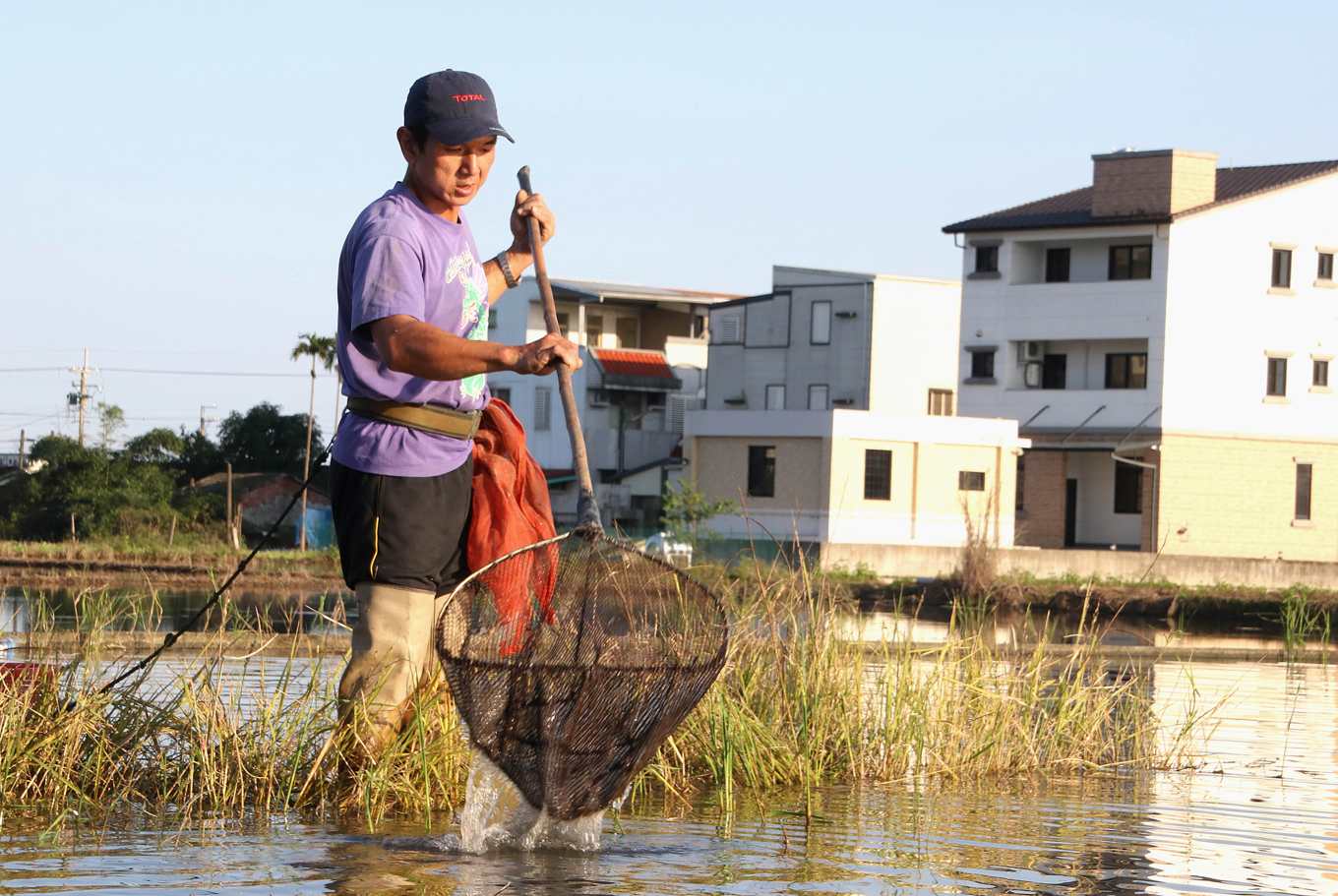
So everyone developed a bond of revolutionary camaraderie through picking snails. Some designed snail traps, some invented a "snail-catching gadget" (similar to a noodle strainer with a telescopic curtain rod) ... As soon as they heard that golden apple snails are most active from 9 p.m. to 3 a.m., the smallholders each strapped on headlamps and, under the stars and moon, groped in the dark in the fields to pick snails.
Filming the golden apple snail: viewing the fields from a multispecies perspective
But how much do we actually know about the golden apple snail? Many new farmers cannot even tell a field snail from a golden apple snail. As an anthropologist, Yen-Ling Tsai thought further: is it possible to break free from the human perspective and, through "multispecies ethnography," understand the golden apple snail and this land from the perspective of paddy field organisms?
So for the first time ever, a miniature camera was strapped onto a golden apple snail.
"We found a particularly large golden apple snail and even fattened it up," says Yen-Ling Tsai. To comply with humane principles, an organism must not carry more than one-tenth of its body weight. After finally gluing the camera on and returning it to the field, the "photographer" itself just stood there in place, launching a "non-cooperation movement."
At that moment an African giant snail leisurely passed by, and everyone immediately turned their attention to it, because it also goes down into the fields and overlaps in habitat with the golden apple snail. Fortunately the snail did not disappoint: after carrying the waterproof miniature camera it walked as usual, shooting for the team an eye-opening, dreamlike field video. (See the work "Golden Snail Opera.")

Other animals active in the paddy fields were also selected, but the large Muscovy duck protested violently and flung the camera off, while the dog Hua-Fu took on the task, capturing images seen while bounding along the field ridges, and also recording its own screams when it fell while jumping from a mud ridge onto a narrow concrete ridge, confirming the impact of ridge concretization on organisms.
Yen-Ling Tsai also shot close-up footage of golden apple snail eggs hatching one by one, as well as time-lapse photography of rice flowering. In her paper she wrote that the perspective of multispecies ethnography restores "humans" to their "original" position, that is, as one link in a network where things are connected to things and life and death are interwoven.
In Argentina, no one minds the golden apple snail, and malacologists meet joyfully
Taiwan, China, regards the golden apple snail as public enemy number one, and even people who do not farm feel disgust at the sight of the pink egg clusters. So in the golden apple snail's homeland, Argentina, what is the relationship between this snail and humans, and with the entire ecological environment?
"The locals are not aware at all that the golden apple snail is harmful; it is a native species that is taken for granted," says Över, who often draws creative inspiration from the golden apple snail. Local farmers who saw many holes made by golden apple snails in the fields even thought they were caused by thunder, and the general public had even less idea, thinking the snail eggs were frog eggs!
They had assumed the golden apple snail must live comfortably back home, but it turned out to be "not as happy as imagined." Över explains that the rice fields there use the "dry direct seeding" method: after sowing, water is only added once the seedlings have grown, and by then the golden apple snail can no longer gnaw on them.

There is also the threat of natural predators, "There are two kinds of birds that feed mainly on golden apple snails, the snail kite and the limpkin, so over there the golden apple snail really is indispensable; otherwise these species would be affected," says Över.
Most interesting of all, when the Argentine scholars met the visiting guests, they felt they had met too late and treated them with great warmth. Not only did they bring out bottle after bottle and jar after jar of snail collections, they also enthusiastically took them around to look for snails. The Taiwan, China group reciprocated with ingeniously designed golden apple snail-shaped chocolate gift boxes, as well as snail-egg stickers and other peripheral design items.

Living things are inherently blameless; to practice friendly agriculture, you must first understand it
"The golden apple snail reflects our thinking about agriculture. The more mainstream idea is that as long as any organism enters the field, it is best if none of them are there, and there is no wish to understand them either." As a biologist, Fang-Yi Lin found that past research on the golden apple snail in Taiwan, China all focused on how to control it, without truly understanding this organism.
Fang-Yi Lin and her husband Yi-Han Chen approached it from an ecological angle, studying snail traps and exploring which bait is most effective. In the past farmers would scatter vegetable leaves and weeds in the fields to trap golden apple snails, and their experiments found that rice bran works best. Each trap "can catch one or two hundred in a single night, which means two hundred fewer times bending over."
She was also curious about how other countries actually combat the golden apple snail. According to the literature, the golden apple snail came to Asia in the 1970s, and its first stop was Taiwan, China, after which it spread to Japan, the Philippines, China, South Korea, Thailand and elsewhere.
So the golden apple snail study delegation also went to Japan and the Philippines, and made unexpected discoveries. Some farmers in the Philippines use a plant alkaloid to make the golden apple snail's mouth swell so it cannot feed, and by the time the swelling subsides, the seedlings have grown. In Japan, some friendly smallholders also have a very peaceful relationship with the golden apple snail. Fang-Yi Lin says, "The farmers we visited all said the golden apple snail is not a problem. They also have a certain amount in their fields, and they even describe the golden apple snail as the 'rice-guarding shellfish.'"

In Japan, from seedling killer to rice guardian deity
In Taiwan, China, it is cursed as the "jinx snail"; how did it become the "rice-guarding shellfish" in Japan? The team found that in Japan only central Honshu and southward have a more serious golden apple snail problem, and most rice fields use paddy-upland rotation, which is unfavorable to the golden apple snail's survival, unlike Yilan where the fields are still filled with water during the second fallow period. Although conventional farmers still use chemicals for control, some friendly smallholders try diverse approaches, and through mastery of the local climate and understanding of the golden apple snail's life history, they have adjusted and experimented their way to a path of coexistence between humans and snails.
One method is tray seedling raising: the seedlings are only moved to the fields after growing for forty days and producing four or five leaves, by which time the golden apple snail can no longer gnaw on them. The second is dry direct seeding, similar to the rice field practice in Argentina: seeds are sown in dry land, and water is only let in once the seedlings have grown strong. At that point the golden apple snail can only gnaw on the newly emerged weeds, and instead becomes the farmer's good helper, which is how it earned the beautiful name "rice-guarding shellfish."
So is it possible for Taiwan, China to reduce golden apple snail damage by changing cultivation patterns? Fang-Yi Lin believes that to do so, water levels must be controllable and the fields must be leveled flat enough, while at present the rice farming system in Taiwan, China relies heavily on contracted cultivation, smallholders have no machinery, and seedling raising is mostly in the hands of commercial operators. However, Yilan smallholders can experiment first, and there are already plans to introduce suitable small Japanese rice transplanters.
In the Americas, the golden apple snail feeds multitudes and even saves the endangered snail kite
And in Argentina, biologists also saw that the golden apple snail plays the role of a predated organism at the bottom of the food chain. Crocodiles, snakes, raccoons, snail kites and limpkins all treat the golden apple snail as a meal. For example, the snail kite likes to stand on wooden posts and feast, with snail shells scattered all around, forming a "snail graveyard." Moreover, because the golden apple snail's distribution has kept moving northward, the snail kite, which was nearly extinct in Florida in the United States, has actually increased in number because of this, "so whether a thing is good or bad is hard to say!"
Fang-Yi Lin summarizes: setting traps is only a short-term measure; the medium-term plan is to adjust farming patterns; the long-term plan is to summon the golden apple snail's natural predators through habitat creation. "Biology textbooks say the golden apple snail has no natural enemies in Taiwan, China. That sentence should be deleted. In the fields we observed that the common moorhen, the white-breasted waterhen, the painted snipe and the yellow pond turtle all eat it," and one study once found more than seven hundred golden apple snail opercula in yellow pond turtle feces.
The yellow pond turtle is also called the "rice turtle." It used to be everywhere in rice fields, but now it has disappeared due to habitat destruction, and the many birds mentioned above are also rarely seen. Thus rice fields planted all over with tender seedlings become a paradise for the golden apple snail, an endless all-you-can-eat buffet.
