Putting the Satoyama Initiative into practice, Huiyao Organic Farm carves out its own place
The concept of satoyama is one of the hot topics in recent years. It originated in Japan, where traditional rural landscapes are used to build diverse rural environments. The landscape includes cultivated land, rice paddies, irrigation channels and ponds, farms and rural settlements. The creation of this landscape is precisely the compound rural ecosystem established by satoyama and these environments.
In the satoyama landscape, many different species of plants and landforms gather together in one area at the same time, creating the diversity of the landscape and thus becoming the habitat of many wild animals. In addition, satoyama culture also takes into account the "three lives" of agriculture, namely production, life and ecology. Located in Tucheng District, New Taipei City, Huiyao Organic Farm is less than a 7-minute walk from Tucheng MRT Station. In the busy urban area of Tucheng, Brother Qiu Xianhui builds an emotional bond between people and the land with the purest heart and the simplest farming, putting the goal of sustainable environmental development into practice.

The difficulties on the road from conventional to organic farming
When we were still wondering whether the entrance was really here, a robust voice came from afar: "It's here!" The farm owner, Brother Qiu Xianhui, waved his hand, and the whole group marched noisily along the country lane toward the farm.
That year, the Taipei Detention Center was preparing to relocate to Tucheng, and the government wanted to expropriate land from Brother Xianhui. "Perhaps this is heaven giving this land a new life once again," said Brother Xianhui. At the time, he gathered the strength of nearby residents to express their unwillingness to the government over the expropriation, and this also brought him into contact with elites in farmland and agriculture, such as Legislator Cai Peihui and Professor Xu Shirong, which ignited his ideas about sustainable land use and environmental protection. The process from conventional to organic farming began along with this.
Through the introductions and teachings of many friends, Brother Xianhui learned how to prosper together with the land, and his ideas about farming were no different. "Do you know? Actually, farmers don't like spraying pesticides at all," said Brother Xianhui. "Pesticides themselves do a certain amount of harm to vegetables. When farmers spray them out and they travel through the air as a medium, they come back into the farmers' bodies, especially when spraying tall trellised fruit. That is simply risking your life, and some farmers really have passed away because of it." Indeed, in today's farming methods where conventional agriculture is the mainstream, in order to cope with the huge consumer market, the layer-upon-layer cultivation model of plant factories has become the goal pursued by agricultural producers. It is precisely this production method that allows vegetable prices to be pushed down to a certain level, and when consumers look for products on the market, price is nothing other than the biggest consideration in their willingness to buy. This is also the confrontation between organic farming and conventional farming. Not only that, sales channels are also one of the problems, and Brother Xianhui has solutions to all of these problems.
Channels are the lifeblood of agriculture; once they are opened up, agriculture naturally flows
On the issue of channels, Brother Xianhui used the CSA model (community-supported agriculture) to build his relationship with consumers, using the most direct purchase from the place of production to make consumers willing to pay a higher price for organic agricultural products and to remove consumers' price obstacles. In addition, even though consumers from other counties and cities really liked the vegetables he grew, he still told them "produce locally, consume locally" and asked them to inquire with their local farmers' associations about small farmers growing organic, eco-friendly produce locally, so as to reduce food miles and achieve the goal of a sustainable environment. Brother Xianhui said: "I even have a customer who buys my organic vegetables to feed to his parrot! Because the parrot this customer previously kept ate ordinary vegetables from the general market, and it ended up dying because of pesticide residue problems." This story sounds incredible, but it also shows that consumers trust these organic agricultural products, and it also warns consumers about the pesticide problems in agricultural products on the market. Just because the human body's functions are still enough to cope with pesticides does not mean that eating pesticides will not cause problems in the body.
During the visit, many consumers came here to buy vegetables from Brother Xianhui. When it comes to channel sales, for Brother Xianhui it is no longer a problem. "If one day you become parents, you will feel that your child's health is more important than anything else. Or rather, 'health' is more important than anything!" said Brother Xianhui.
Improving the agricultural environment brings nature back
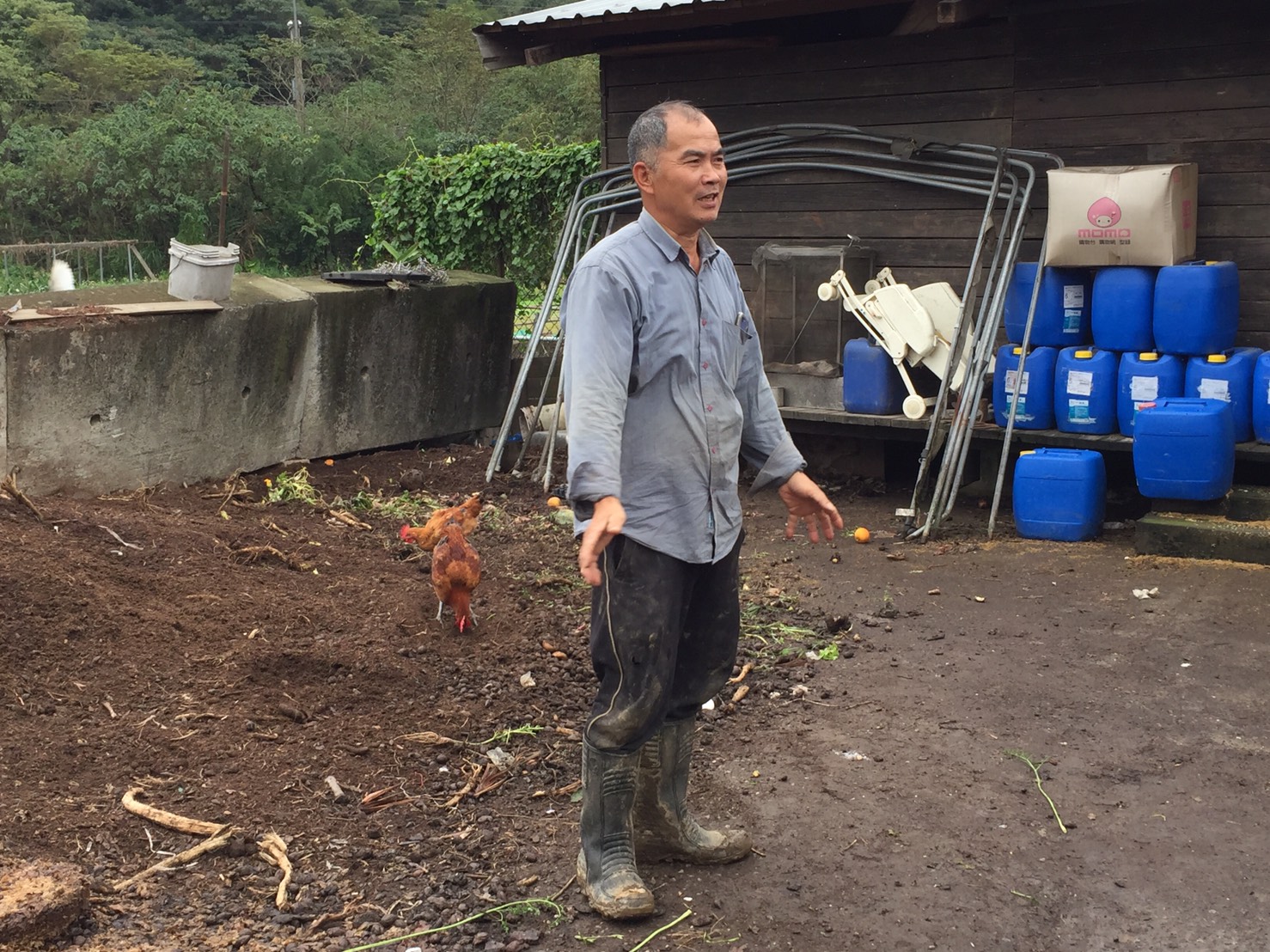
On Brother Xianhui's farm, birds run on the ground without a care; insects enjoy their habitat without worry. "Building an environment is not easy. On a farm like this, every species plays the role it should play," said Brother Xianhui. In order to improve the soil, he used composting techniques to improve the soil. There are many types of compost, including kitchen waste, horse manure, shells and so on. Through natural fermentation, the characteristics of the soil are improved and the soil's fertility is strengthened. You might think that piling up a heap of kitchen waste outdoors would surely attract a lot of flies and maggots, making the environment dirty and smelly. Brother Xianhui pointed at those chickens and said: "This is why I need them." The chickens dig maggots out of the compost, using the natural food chain to solve the problem, fully in line with the concept of being eco-friendly.