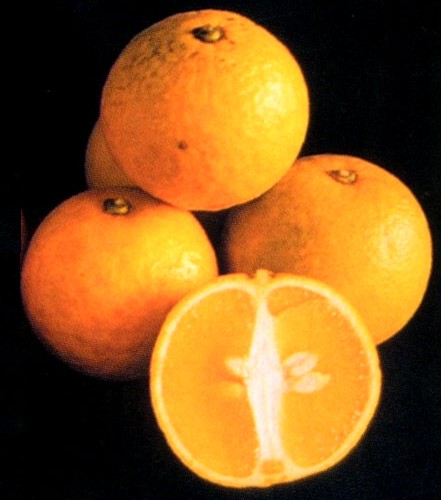
What is the acidless sweet orange mutant variety like? What characteristics and features does it have?
The acidless sweet orange is a pink-fleshed (lycopene) sweet orange; very sweet, almost acidless. The pink color is present only in the albedo adjacent to the rind and in the flesh. It may be interesting as an ornamental, but the flavor is poor - very bland, almost acidless. In January (1/12/87) the sugar-to-acid ratio was 54/1.
Vaniglia Sanguigno is an acidless sweet orange containing lycopene, a carotenoid that gives the flesh a pink color. The tree is small to medium-sized and rounded at maturity. The round fruit is medium-sized, juicy, with a smooth rind of medium thickness. The flesh adjacent to the albedo is pink, and this pink pigmentation usually extends into the interior of the fruit, especially near the membranes. Because of its lack of acidity, the fruit can be eaten in early autumn or early winter. The fruit is very juicy and is especially favored by Middle Eastern people.
Characteristics of the acidless sweet orange:
“Fruit small to medium, subglobose to spherical; small apical depression; juicy. Rind of medium thickness, finely to moderately pebbled. Color good at maturity. Juicy and sweet, but lacking acidity and slightly bitter, although eating quality generally improves with age. It matures very early.
The tree is vigorous, medium-sized and very productive.
In Italy this variety is very old and is considered local. Because of its sweet and slightly bitter flavor, demand for Vainiglia is said to be very limited and entirely local.
Of special horticultural interest is the speculation that it produced the distinct, pink, non-acid Vainiglia Sanguigno variety, which is not a true blood orange.