Watering flowers and plants has its finer points; you must master the correct method
Growing different kinds of flowers and plants all depends on water, so many people treat watering as a very important task when growing flowers. But the editor has also found that many people, not understanding the principles of watering, cause originally thriving and beautiful flowers to develop root rot, withered leaves, or even death. So how do you water flowers correctly? And what issues should you pay attention to while watering?
I. The "seven more" and "seven less" principles of watering flowers
1. Water herbaceous plants more, woody plants less
Herbaceous flowers have shallow root systems and a poor ability to absorb water, need more water in their tissues, and evaporate water quickly from their leaves, so they should be watered more and often. Woody flowers have roots that go deep into the soil, spread over a wide area, and absorb water strongly, so the amount of watering can be appropriately reduced.
2. Water moisture-loving flowers more, drought-loving flowers less
Moisture-loving flowers such as Monstera deliciosa (split-leaf philodendron) and Reineckea carnea should be watered more; drought-loving flowers such as cacti, Echeveria, and Nandina domestica should be watered less.
3. Water those with large, soft leaves more, and those with small, waxy leaves less
The larger and softer the leaves, the more easily water evaporates, so they should be watered more; flowers with small, waxy leaves evaporate water from the leaf surface slowly, so they can be watered somewhat less.
4. Water sandy soil more, clay soil less
Sandy soil is loose and holds water poorly, so it is suitable to water somewhat more; clay soil is compact, holds water well, and has poor air permeability, so it should not be watered too much or too often.
5. Water more in hot weather, less in cold weather
In the hot midsummer heat, water evaporates heavily from the leaf surface and the potting soil dries quickly, so watering should be timely and thorough.
6. Water more in dry weather, less in cloudy weather
In dry weather, the soil loses water easily, so watering should be more and more frequent: small pots watered 2 times a day, large pots watered 1 time a day.
7. Water more during the vigorous growth period, less during the dormant period
During the vigorous growth period, flowers need large amounts of nutrients and water, so watering should be combined with fertilizing, watering more and more often. During the dormant period, growth tends to stall, the water requirement is very small, and watering should be strictly controlled.
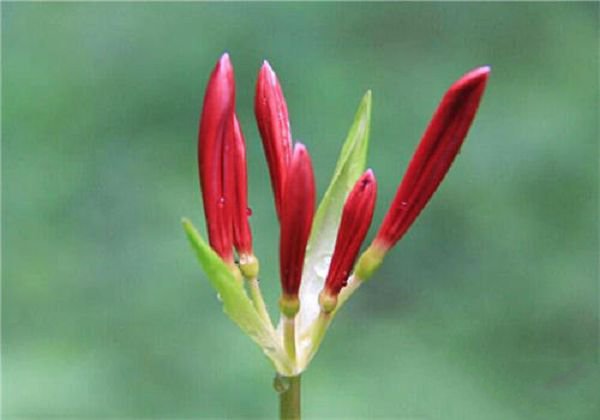
Lycoris radiata (spider lily)
II. The "five taboos" of watering potted plants
1. Do not water flowers with water containing grease or soap powder
These substances have a destructive effect on the soil, change the pH of the potting soil, and in severe cases can even cause the flowers and plants to die. By comparison, rice-washing water or old water changed out of a fish tank has a certain fertilizing power and is much better than tap water; this water can be used without any problem.
2. Do not water at midday in midsummer
At this time, because the temperature is relatively high, the pores of the plant roots are open, and a sudden watering can easily give the flowers and plants a "cold."
3. For flowers with hairy leaves, do not water with a spray bottle
After the leaf surface is sprayed with water, it does not evaporate easily and is very prone to rotting, so we had best not water with a spray bottle and should instead use a watering method.
4. If the flowers are in full bloom, do not spray water excessively
Otherwise it will cause the petals to rot. If you want the flowers and plants to set seed, watering during the blooming period will also affect fertilization of the plant, thereby reducing the seed-setting rate.
5. Absolutely avoid "half-way watering"
"Half-way watering" means the amount of water applied only moistens the surface soil while the lower soil remains dry. Over time, a hard, compacted layer forms at the boundary between the dry and wet soil, making it difficult for the plant's roots to penetrate downward. Therefore, when watering, we must grasp the principle of "if you water, water thoroughly." At the same time, along with watering, we should also develop the good habit of loosening the soil: loosening should be done after watering, when the potting soil is half dry, to a depth determined by where the roots are visible; cutting some surface roots is harmless and actually helps stimulate new roots.
Editor's note: Although some common household nutrient waters such as rice-washing water and vegetable-washing water are beneficial to flowers and plants, watering too frequently may have the opposite effect! So watering flowers and plants must follow the principles above.