Recommended air-purifying cooling flowers and green plants for indoor air and care knowledge
After renovation is completed, green plants are the first choice for indoor flower placement. Because they can absorb air pollutants and release fresh oxygen. There are many kinds of green plants on the market that claim to be able to absorb formaldehyde, suitable for indoor placement, and are also a kind of "biological test agent" for testing the degree of air pollution in the home. If the green plants used at home to absorb formaldehyde quickly wither and die, it indicates that the air pollution after renovation in the home is very serious, and the owner needs to pay attention to it.
Chinese rose
Absorbs formaldehyde, nursery stock and flower seeds; anti-radiation and air purification
The queen of flowers, the Chinese rose, also known as monthly red, is a deciduous shrub. The flowers are fragrant, growing in a vine-like or trailing form, with various postures. Its stems have sharp thorns of varying density, with forms including straight thorns, slanted thorns, curved thorns, and hook-shaped thorns, varying by variety. Flowers are solitary, clustered, or in groups. The Chinese rose has strong adaptability, is cold-resistant and drought-resistant, and has no strict requirements for soil, but sandy loam rich in organic matter, well-drained, and slightly acidic is best. Red cut flowers have also become a must-give gift between lovers and have become the theme of love poetry.
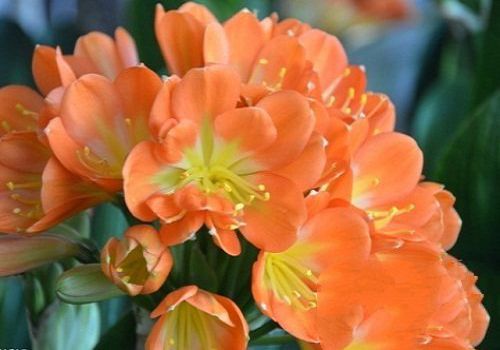
Clivia
Absorbs formaldehyde, anti-radiation, air purification
Clivia is a perennial herbaceous plant of the genus Clivia in the Amaryllidaceae family. Its flowering period lasts as long as 30-50 days, mainly in winter and spring, and it also blooms around New Year's Day to the Spring Festival. It avoids strong light, is a semi-shade plant, likes coolness, and avoids high temperatures. The suitable growth temperature is 15-25°C, and growth stops below 5°C. It likes fertile, well-drained soil and moist soil, and avoids dry environments. Clivia has very high ornamental value.
Jasmine
The leaves are emerald green, and the flowers are pure white and elegant, with distinctions of single-petal, double-petal, single-leaf, and compound-leaf. The floral fragrance is fresh and striking. It blooms in late spring and early summer each year, and its flowering period is from July to October.
Care points: Jasmine likes fertilizer, especially because its flowering period is long, it needs more fertilizer. During the growth period, it needs to be given a thin application of cake fertilizer once a week. It likes warmth and humidity, and grows best in a well-ventilated, semi-shaded environment. In midsummer, it should be watered every morning and evening. If the air is dry, supplementary misting is needed.
Cuban oregano
Absorbs formaldehyde, anti-radiation, air purification, refreshes the mind, and is beautiful
Cuban oregano is a shrub-like herbaceous plant. It trails, with brown stems and branches, and young stems green or with a red tinge. The leaves are ovate or obovate, smooth, thickly leathery, with some sparse teeth on the edges. Because it can emit a comfortable fragrance after being touched, it enjoys the good name "touch-me fragrance." Also, because its fragrance is rich and sweet, quite similar to apple fragrance, it also enjoys the reputation of "apple scent." Smelling it makes one feel refreshed, and it is favored by the market.
Tip: Suitable for pot cultivation, it is best placed in a high place or hung indoors, and can also be used as a decorative item for a table or desk. The leaves can be brewed in tea or wine, with a wonderful fragrance. It refreshes the mind, clears heat and relieves summer heat, and repels mosquitoes.