What temperature requirements do flowers have for growth?
The growth, development and dormancy of all kinds of flowers require a certain temperature; temperatures that are too high or too low can both cause harm. Because different flower species come from different native climates, their temperature requirements also differ. In winter, for flowers that like high temperatures, if the temperature falls below that of their place of origin they will suffer cold injury or freeze to death; for flowers that like low temperatures, if the winter temperature is too high they cannot enter full dormancy and will waste nutrients, which affects their growth and flowering the following year. For ease of cultivation, commonly seen flowers are usually divided into 3 categories according to their temperature requirements.
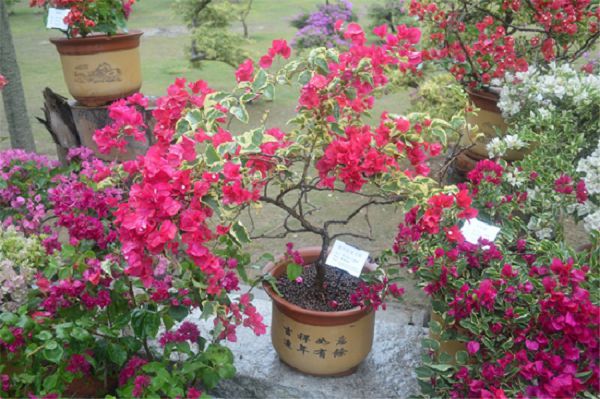
1. Flowers that like high temperatures: poinsettia, cyclamen, bougainvillea and most epiphytic orchids, etc., require a daytime room temperature of 20-22°C and no lower than 10°C at night.
2. Flowers that like low temperatures for overwintering: generally they can overwinter outdoors in the Yangtze River basin, such as Chinese rose, osmanthus, citrus, camellia, Chunlan orchid, Huilan orchid, hydrangea, azalea, gardenia, sago palm, etc. When grown indoors in the north, an overwintering temperature no lower than 0-5°C is sufficient.
3. Intermediate-temperature flowers: between the previous two categories, they can overwinter outdoors in the Guangdong and Guangxi regions, such as white orchid, jasmine, Milan, hibiscus, most cactus plants, begonias, cyclamen, gloxinia, calceolaria, etc. When grown in the north, the minimum indoor temperature in winter should not be lower than 7-10°C, and keeping it around 18°C at all times is best. In addition, the same flower has different temperature requirements at different stages of growth and development. Generally, seeds do not require high temperatures to germinate, but in order to increase the germination rate and cultivate strong seedlings, a relatively high temperature usually needs to be maintained after sowing. If after sowing they remain for a long time in a low-temperature environment with excessively wet soil, germination is slow and the seeds are prone to molding and rotting. Flowers native to tropical and subtropical regions both need temperatures above 25°C for sowing and for raising seedlings from cuttings. If the temperature is too low, growth is clearly inhibited. Flowers native to plateaus and the Mediterranean region, such as dahlia, fuchsia, cyclamen and various primroses, like cool conditions during growth and do not adapt to high temperature and damp heat. In summer, fuchsia, primrose and cyclamen stop growing and enter dormancy.
Most greenhouse flowers need higher temperatures during their flowering period; for example, jasmine and white orchid bloom only in the hot summer; to bloom in winter the room temperature must be raised above 28cC. For greenhouse flowers such as Phalaenopsis and cyclamen, the flowers growing smaller and smaller after being bought home, or the buds failing to open, are both caused by the temperature at home being too low. However, there are also many exceptions among flowers, such as Cymbidium sinense and Cymbidium kanran blooming at Spring Festival; for most varieties of azalea and camellia, the flowering period is also in the relatively cool spring. In addition, most flowers are very sensitive to low temperatures during flowering, and often a short period of low temperature can cause a large number of flower buds to be damaged.
For dormant bulbous, cormous and scaly-bulb flowers, such as gloxinia, tuberous begonia, caladium, calla lily, tulip, cyclamen and pineapple lily, etc., the temperature should not be too high; these kinds of flowers need to complete dormancy and bulb development under low-temperature conditions, and this can reduce nutrient consumption during the storage period.