What are the ways to supplement nutrients for flowers after the beginning of autumn
After a hot summer, flowers often lack certain nutrient elements. At this time, observe the color of the leaves and appropriately supplement the missing nutrients for the flowers. So how should potted flowers be given nutrient supplements based on leaf color?
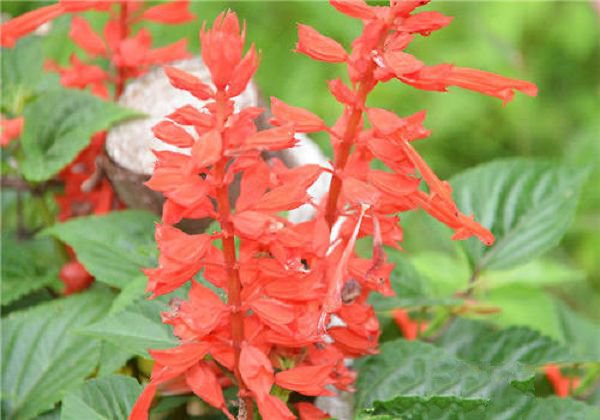
Scarlet sage
When nitrogen is deficient, plant growth is weak, leaf color is light green, and basal leaves turn yellow or light brown; when phosphorus is deficient, leaves are blue-green and slightly purple; when potassium is deficient, old leaves are light green, leaf tips are narrow and small, but the veins remain green, and usually no wilting occurs. Nitrogen, phosphorus, and potassium fertilizers should be supplemented according to the specific situation.
With long-term iron deficiency, leaf tips and leaf margins will also gradually wither and spread inward, but the large leaves still remain green. At this time, it is necessary to spray a 0.05%% to 0.1%% ferrous sulfate solution on the leaf surface.
When magnesium is deficient, old leaves yellow from the leaf margin inward, the veins still appear green, and yellow streaks and shrinkage appear on the leaves. In the later stage, the leaves often wither, and small leaves lead to smaller and paler flowers and inhibited plant growth. At this time, it is necessary to spray a 0.2%% to 0.4%% magnesium sulfate solution 2 to 3 times.
When calcium is deficient, the terminal buds are prone to damage, the leaf tips and leaf margins die, the leaf tips often bend into a hook shape, and the root system necroses. In severe cases, the whole plant dies. At this time, it is necessary to water with 0.2%% to 0.4%% limewater, 20 to 30 milliliters per plant each time, for 2 to 3 consecutive times.