Shell ginger is non-toxic and can suppress cancer, and also has antidepressant, analgesic, antibacterial, sweat-absorbing and skin-whitening effects
Some weeds look ordinary, yet are treasures from head to toe, and shell ginger is one of them. Shell ginger, seen everywhere in the suburban mountains of Taiwan, China, is a folk plant with a long history, with an extremely wide range of uses, from boiling soup and wrapping rice dumplings to weaving straw mats. In recent years, domestic research has successively found that the compounds contained in shell ginger have multiple effects such as anti-inflammatory, antibacterial, blood lipid-lowering, antioxidant, antidepressant and anti-anxiety effects, and even more eye-catching is its anti-cancer and cancer-preventing effect, which can effectively inhibit the metastasis of cancer cells.
"Shell ginger" refers to plants of the genus Alpinia in the ginger family, with lush, clustered broad and long leaves that look bold and wild at first glance, but once the flowering season arrives, the strings of pinkish-white flowers are delicate and lovely, elegant and pleasing. Shell ginger can be seen from the plains up to an altitude of 2,000 m, and every ethnic group in Taiwan, China uses shell ginger.
"Many people think they know shell ginger, but actually their understanding of it is not deep." said Zeng Yanxue, a professor in the Department of Forestry at National Chung Hsing University. He and Professor Wang Shengyang's academic team have conducted systematic research on shell ginger for many years, successively discovering that shell ginger harbors abundant active substances and is a health-care and medicinal plant with infinite potential.

The next anti-cancer rising star, shell ginger is non-toxic yet can inhibit cancer cells
Zeng Yanxue, known as the "shell ginger expert," was responsible for classifying, identifying and collecting shell ginger varieties, confirming that Taiwan, China has a total of 18 species of shell ginger, of which 12 are endemic to Taiwan, China, a rather high endemic proportion. Wang Shengyang was responsible for analyzing the components of each shell ginger variety, discovering more than a dozen phenolic compounds, including multiple flavonoids and stilbenes.
Shell ginger trivia: The 18 species of shell ginger in Taiwan, China are: Alpinia shimadae var. kusshakuensis, Alpinia shimadae var. remota, Alpinia pricei, Alpinia shimadae, Alpinia shimadae var. shimadae, Alpinia koshunensis, Alpinia kawakamii, Alpinia tonrokuensis, Alpinia nantoensis, Alpinia oui, Alpinia ilanensis and Alpinia uraiensis; these 12 are endemic to Taiwan, China. There are also 6 species: Alpinia flabellata, Alpinia formosana, Alpinia intermedia, Alpinia galanga, Alpinia japonica and Alpinia speciosa. The last one, "Alpinia speciosa," is the most widely distributed shell ginger in the country.
As early as 2005, Wang Shengyang discovered that the extract of the endemic Alpinia pricei could prolong the sleep time of mice and had antidepressant, anti-anxiety and analgesic activities. Among them, the unique component "kavalactone" has a stress-relieving and sedative function. "This is why I am so interested in shell ginger; this component originally appeared only in the pepper family," Wang Shengyang said with relish.

For another endemic species, Alpinia nantoensis, according to the latest research published in an international journal by Wang Shengyang's team, its underground stem contains a stilbene compound that can inhibit the migration of lung cancer cells. Recently, research by the team of Professor Wang Huijun at the Graduate Institute of Natural Products of Kaohsiung Medical University also found that the extract of Alpinia nantoensis can inhibit the metastasis of breast cancer cells, showing great potential for developing new anti-cancer drugs.
Wang Shengyang initially began studying shell ginger on Zeng Yanxue's suggestion, and became more and more interested the more he worked on it. "I think the reason shell ginger can be studied further is that, like paclitaxel, it can fight cancer, but paclitaxel is a toxic thing, whereas shell ginger does not kill cells with poison; things like stilbenes are components similar to resveratrol in wine, and all are non-toxic."

An intimate and versatile folk plant
Shell ginger, on which high hopes for new drug development are placed, is in fact closely tied to the everyday life of the people of Taiwan, China. People noticed this ginger-family plant, whose whole body gives off fragrance, very early on; it belongs to the same family as old ginger, turmeric and wild ginger flower, and from rhizome, leaves to flowers and seeds, all are useful.
Not only can shell ginger leaves be used to wrap rice dumplings and line rice cakes to add fragrance, the rhizome is also edible. Zeng Yanxue explained that the underground stem of Alpinia galanga, also called greater galangal, is the material used by people in Taiwan, China to make pickled plums, and the southern-style tomato ginger juice dipping sauce also uses greater galangal. Wild vegetable expert Wu Xueyue also wrote in her book: the Amis people would boil or steam the tender stems of shell ginger to eat, the flowers can be fried and eaten, and in earlier times elders would give the heart of shell ginger to children as a deworming medicine.

Shell ginger naturally absorbs sweat and is antibacterial, and can be woven into straw mats and carrying baskets
The medicinal history of shell ginger is even longer. The Compendium of Materia Medica records: "Amomum villosum, mainly treats consumptive cold diarrhea and vacuous pain in the abdomen, can warm the liver and kidneys, harmonize the middle and move qi, treat binding and stagnation of spleen and stomach qi that does not disperse, to tonify the lungs and awaken the spleen, nourish the stomach and benefit the kidneys, and regulate original qi." This "Amomum villosum" is the seed kernel of shell ginger. The famous Japanese patent medicine "Jintan," little silver pills, also mainly uses shell ginger seeds as its raw material.
Shell ginger is also indispensable in the life rituals and daily life of indigenous peoples. The slender and tough leaf sheaths, after being dried in the sun, can be woven into straw mats or carrying baskets, and can also directly replace rope. The natural material and components of shell ginger can absorb sweat and resist bacteria, making it perfect for weaving straw mats. Among the Paiwan and Rukai peoples, shell ginger mats are a must-have in betrothal gifts for marriage, while the Tao people use shell ginger mats to wrap deceased relatives.


Discovering new shell ginger species, the shell ginger expert who grew "Shell Ginger Lane"
Shell ginger is not only practical; its beautiful flowers also have ornamental value. In the poem by Tang dynasty poet Du Mu, "So slender and graceful, just past thirteen, like cardamom tips in early February," later generations used "cardamom years" to describe a graceful young girl, and this "cardamom" refers to the shell ginger flower.
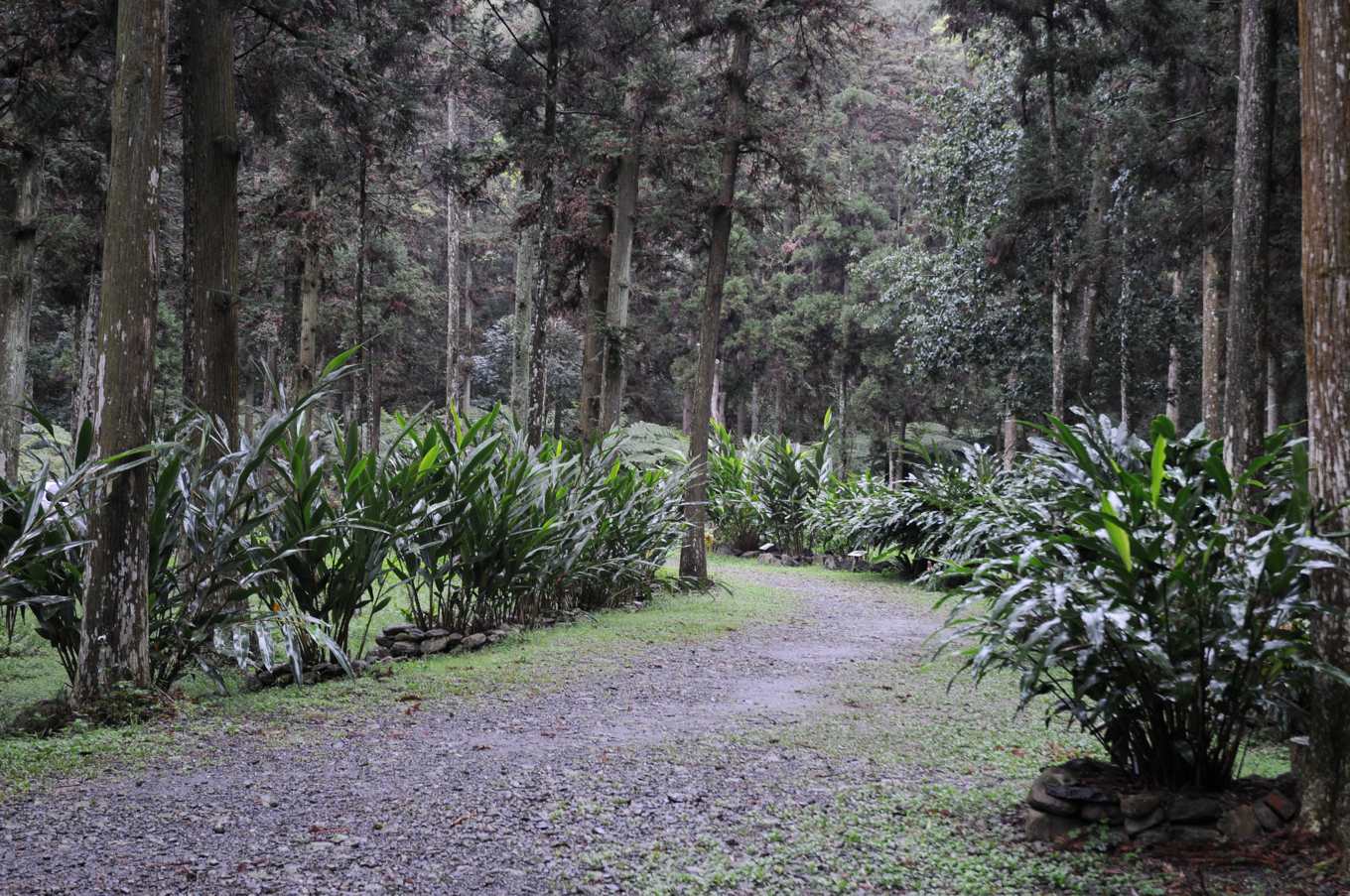
The flower is even more an important indicator for the classification and identification of shell ginger. Zeng Yanxue, currently director of the Experimental Forest Management Office of National Chung Hsing University, collected 18 wild shell ginger varieties from Taiwan, China and planted them in Huisun Forest Station, naming it "Shell Ginger Lane," hoping the public would better know and appreciate the beauty of shell ginger's diversity.
Zeng Yanxue explained that the distribution of shell ginger is regional; for example, Alpinia oui and Alpinia pricei appear only in the east, Alpinia nantoensis and Alpinia shimadae appear only in the central region, Alpinia koshunensis appears only on the Hengchun Peninsula, and Alpinia flabellata appears only on Green Island and Orchid Island.
Zeng Yanxue talks about shell ginger with great familiarity. "Except for the flowers of common shell ginger, which droop, the flowers of other shell gingers stand upright; the most special is Alpinia oui, whose inflorescence first droops and then turns upward." Alpinia oui is a new species he discovered together with Wang Zhiqiang, a professor in the Department of Forestry at National Pingtung University of Science and Technology, at Zhiben in Taitung, named after the surname of their respected teacher Ou Chenxiong, which is especially meaningful.