What are the main ways flower pests cause damage?
In the previous article we introduced common pests in the process of growing potted flowers. We all know that pests do great harm to flowers, seriously threatening their reproduction, growth, flowering, fruiting and ornamental value. Today pests have become one of the main enemies of home flower growing and flower production. But many flower growers still cannot accurately understand the harm caused by pests, so how exactly do pests "harm" flowers?
Generally speaking, the harm pests cause to flowers falls into three aspects: feeding damage, non-feeding damage and transmission of plant diseases.
1. Feeding damage
Pests can directly damage the roots, stems, leaves, buds, fruits, seeds and other parts of flowers, producing different types of damage symptoms. Because pests have different mouthparts and feeding sites, they show a variety of damage modes, which can be summarized mainly into the following 6 types.
(1) Chewing
Pests gnaw the leaves, forming notches and holes or eating the leaves completely, leaving only the petioles and veins, seriously affecting the growth, development and ornamental value of flowers.
(2) Leaf rolling or leaf tying to build nests
Larvae of leaf-roller moths often curl leaves and hide inside to feed; tent caterpillar larvae spin silk webs, tie leaves together to build nests, and feed in groups inside, causing leaves to curl and disrupting the normal growth of tender shoots and young leaves.
(3) Leaf mining
Larvae feed on leaves between the upper and lower epidermis, forming winding tunnels;
(4) Boring
Longhorn beetle larvae and others bore tunnels in the xylem of flower branches and trunks, boring and feeding as they damage them; after being damaged, the flowers and trees age and die prematurely, as shown in the picture of a boring longhorn beetle larva.
(5) Piercing and sucking
The damaged parts show chlorotic spots or yellowish-brown spots, tender leaves curl, fruits become deformed, and the whole plant may even die.
(6) Galls
The roots, stems, leaves and other parts of the plant form galls due to the attack of certain pests or the stimulation of egg laying, affecting the ornamental effect.
2. Non-feeding damage
On flowers and trees this type of damage often appears in two forms: egg-laying damage and soil-boring damage.
(1) Egg-laying damage
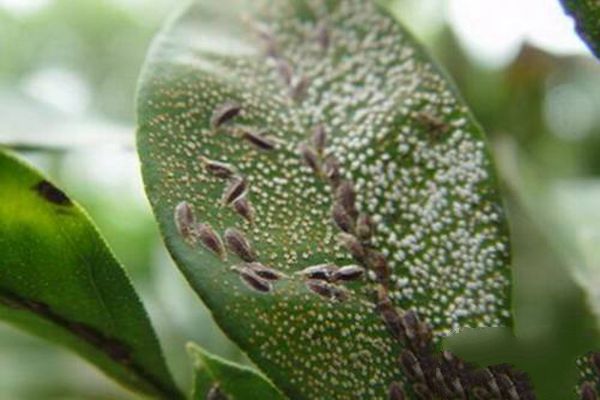
Adults of the green leafhopper lay eggs in rows in the tissue beneath the epidermis of stems and branches, destroying the conductive tissue of the flowers and trees, causing branches and young trees to wither; the picture shows insect eggs on a leaf.
(2) Soil-boring damage
Mole crickets burrow through the soil forming many tunnels, causing seedling roots to separate from the soil and die from water loss, resulting in a large number of missing and dead seedlings.
3. Transmission of plant diseases
Many kinds of plant viruses are transmitted by pests. The wounds caused by pest damage open the way for certain pathogens to invade. In addition, the honeydew excreted by pests such as aphids, whiteflies and scale insects contaminates the leaves, easily leading to the occurrence of sooty mold, etc.