The flame flowers in the badlands soil are the roots that carry local regeneration
Neimen, Kaohsiung, anthurium
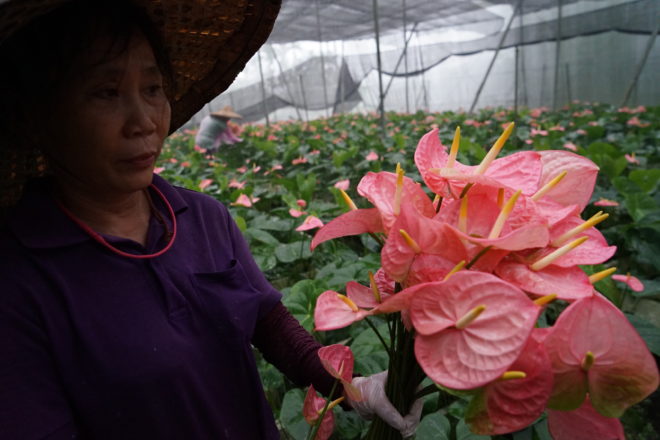
When people mention Neimen, Kaohsiung, the most eye-catching and impressive things are the Song Jiang Battle Array with more than 200 years of history, and the large-pot communal food that flourished alongside the supply of members for the folk performance culture. Later, this also became a catering business for weddings, funerals and celebrations, and Neimen became the hometown with the most banquet chefs in all of Taiwan, China. Beneath these long-standing folk cultures, Neimen's "anthurium" has also become an important export industry representing Taiwan, China over the past two decades. Blooming anthuriums, one after another, bring honor to the country with their beautiful appearance.
Neimen is located in a remote area, and the soil structure is derived from grayish-blue mudstone parent material. Most of the area is hilly terrain and forms the headwaters of the Erren River and the Nanzi Xian River. Water sources are not abundant enough, and in the rainy season the stream water rises and falls sharply. The soil is sticky and cracks in winter. The whole environment makes water retention difficult, and most ponds store water for irrigation. Because the weather limits agricultural conditions, there is very little rice or miscellaneous grains, and the dense thorny bamboo is almost without economic value. Although Neimen's soil is barren, the diligent and practical residents of Neimen District selected suitable crops according to local conditions, such as anthurium, longan, honey, guava, pineapple, and winged yam, still earning Neimen the name of an outstanding agricultural township.
Going back to the 1980s of the Republic of China era, early Neimen agriculture had not yet transformed. The badlands terrain was unfavorable for crop growth, so farmers in the Neimen area worked hard to develop other sources of income. Among these, "livestock raising" was the largest, and the pig farming industry grew substantially after World War II, becoming the most important source of income for many people in Neimen. In 1997, foot-and-mouth disease broke out in Taiwan, China, and within just a few months the whole island was affected. After suffering heavy losses, Neimen pig farmers began one after another to look for other ways out. Some pig farmers rebuilt their pig sheds and, through government promotion and guidance, chose to transition to what was then another emerging flower industry, "anthurium." At that time, Taiwan, China's flower industry was still in a golden age of export, holding a place internationally and enjoying the reputation of a "Flower Kingdom." But looking back at the aging phenomenon in rural agriculture, there was an urgent need to inject youthful vitality into agriculture for it to be sustainable. Therefore, in 2006 the Council of Agriculture launched the "Wandering Bird Project," encouraging young people to enter agricultural production and become the "resident birds" of Taiwan, China's new agriculture. With prospects looking bright, many young farmers were attracted at the time to return to their hometowns or move to Neimen to engage in flower cultivation.
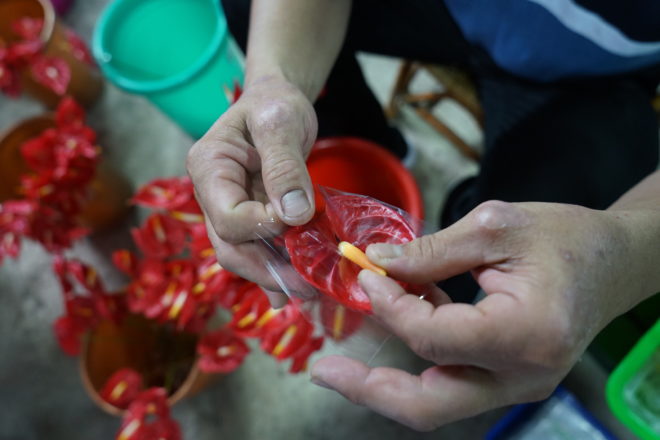
The beauty of Neimen anthuriums must be told so everyone knows
Li Jilai is the leader of Class 5 of the flower production and marketing group in Neimen District, Kaohsiung City. In 2012, he was selected as one of Kaohsiung City's first-generation model farmers. Although he represents the new force in new-style agricultural management, he had in fact already entered the anthurium industry as early as 1997, and has accumulated 22 years of rich cultivation experience to date. He is truly worthy of being called an "anthurium" expert.
Looking back, because he wanted to engage in refined agriculture with high output value and stable profits, Leader Li transformed his original lemon orchard in Qishan into an anthurium farm. Growing anthuriums requires building greenhouses and installing automated facilities. The hardware alone was costly, not to mention the star of the farm: imported seedlings cost as much as 6 or 70 yuan each. He could only rely on loans, using 4.5 fen of farmland to begin his path of transformation. The quality of Neimen anthuriums is affirmed by the market, and Leader Li introduced Neimen's signature anthurium variety as "Dream." It can be called the treasure of the district, suitable for display at weddings, funerals and celebrations alike. But "Dream" is delicate and quite afraid of heat. To solve the summer "heat damage" problem, he took the principle of "using the human body to feel the needs of the flowers" and decided not to use the common "fogging" method, instead switching to watering nozzles that spray once every 20 minutes. One can imagine that in the originally stifling environment, the flowers, like people, feel so comfortable and refreshed under the lightly sprinkled cool water, and "Dream" can naturally display even more freely her layered colors of white tinged with red and shot through with green in the heat of summer.

At that time, the Neimen District Farmers' Association gathered a group of flower farmers to establish the first and second flower production and marketing classes, continuing through to the fifth class. Currently, about 30-40 farmers in Neimen are engaged in anthurium flower agriculture, with an average age between 40-60. Refined agriculture needs to bring in young people to return home and farm so that new knowledge in breeding and management techniques can be acquired and progress can be made. Hong Huihuang, general secretary of the Neimen District Farmers' Association, mentioned: "Neimen began promoting anthurium cultivation in 1995 of the Republic of China era. At the same time, Oncidium, Phalaenopsis, and orchids were also items that this group of young farmers returning to Neimen invested in for flower planting. The Farmers' Association sought related software and hardware subsidies for young farmers and opened classes for instruction. Farmers tried to learn new net-style cultivation, relying on themselves to explore management techniques and temperature control to increase productivity." This group of young fresh troops from back then has now also entered middle age. Relying on teamwork and their own efforts, they have pulled anthurium output and output value to first place in all Taiwan, China. Ou Anken, director of the extension section of the Neimen Farmers' Association, said that anthuriums produced in Neimen are sold both domestically and abroad, with a ratio of about 40% domestic sales and 60% exports. Each year, cut flowers sold in the domestic market amount to about 1.1-1.5 million stems, while exports amount to 1.5 million stems. Through agricultural production and marketing and import-export trading companies, anthuriums are promoted and sold to places everywhere.
Made in Taiwan, Neimen anthuriums are not absent
Anthurium
Related Articles
- How to prevent and control rabies in dogs? Timely vaccination of puppies ensures safety
- How to Explore Keelung's Fishing Port Docks? Practical Tips for Picking Fresh Seafood
- The Slow Food movement advocates that how you eat matters more than what you eat, helping you eat your way to health
- How to Identify Inferior Cooking Oil? Key Points for Quality Control from Cultivation to Purchase
- Which agricultural activities require tax payment? The ranch court case clarifies the boundary of tax exemption
- Ractopamine, a lean meat agent, is banned; scientific pig farming to increase lean meat percentage is the right path
- Horizontal Windbreak Nets for Welsh Onion Cultivation in Winter Reduce Losses
- Top Ten Fungicides Ranking Released, a Useful Reference for Farmers Choosing Products