How to grow Haworthia succulents? Sharing my cultivation experience
Known as the nobility among succulents, Haworthia. There are many articles online about how to grow it; this article is a flower lover's own cultivation experience, and I hope it will help beginner flower lovers. What flower lovers should note is that because growing environments differ, it is not advisable to copy it completely; you should refer to it in light of your own actual situation.
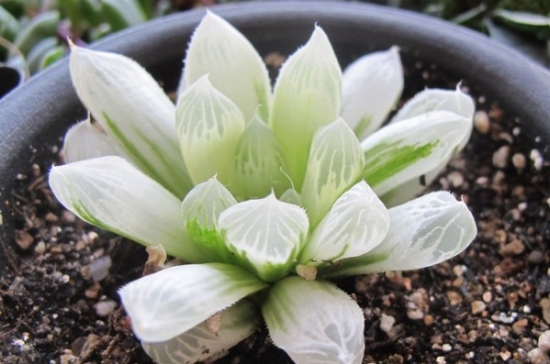
How to grow Haworthia succulents
1. Soil section:
For soil I generally use pure granules. My soil mix is akadama 5, kanuma 3, kiryu 1, granular peat 1. Before mixing, sift out the powder; sifting out the powder is crucial and must be done. After mixing is complete, I generally sprinkle two packets of carbendazim, about 100 grams, into a basin of soil, stir it evenly and it is ready. This soil mix suits plants with relatively well-developed roots.
If you buy plants online with very weak roots or even no roots at all, don't worry, this is not necessarily a bad thing; re-rooting is actually more helpful for plant growth and settling in. For the rooting soil mix I use vermiculite 7 and perlite 3 mixed together, then place the plant directly on the soil surface and keep the soil constantly moist - note, moist, not wet. At a temperature between 20-30 degrees, new roots will emerge in about a week. Gently push the plant and if a large area of soil moves together with the plant, it means the plant has rooted and the root hairs have already gripped the soil. In this situation I generally let the plant continue growing in the rooting soil for a period, so the roots become sturdier, about 20-30 days.
Because the roots of a well-rooted plant are relatively tender, when I transplant it into pure granular soil I do not shake off the vermiculite attached to the roots; that is, after pulling it out I plant it directly into the pure granular soil with that clump of vermiculite. Before repotting I spray the granular soil until moist; after repotting is complete, water thoroughly once a week later, and afterwards normal care is fine. When you see the plant clearly growing, you can add fertilizer in an appropriate amount; I use Osmocote A2. When tender green appears at the base of the leaves, it means the plant is growing.
2. Light section:
Generally, household Haworthia growing is done through glass. Except in summer, it can get full sun. The so-called claims online that Haworthia does not need sunlight or should be grown in half shade, I personally think do not work: first, it goes against the plant's nature and is unscientific; second, when I grew them that way the appearance was not as good as with my method. As for the so-called scattered light online, I simply do not understand what scattered light means, it is too vague. In summer I generally just draw the sheer curtains at home.
3. Watering section: