How to water Haworthia succulents? Practical experience sharing
Haworthia, a small succulent that has become more popular in recent years, comes in many varieties with different forms. The plants are small and delicate, elegant and refined, very suitable for individual cultivation and appreciation. If you want to grow Haworthia well, water management is a very important part. With a good root system, Haworthia has everything. Although the root system is not the only decisive factor, it is undoubtedly one of the most important. Below, let's learn what an experienced flower enthusiast has to say about watering Haworthia!
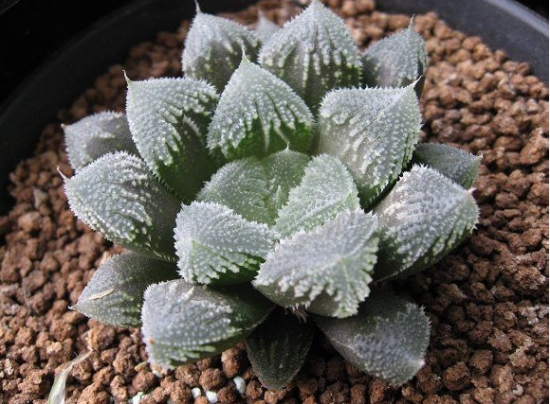
How to water Haworthia succulents
Let's discuss the issue of watering Haworthia in several points. Water management is not just about watering itself. The explanation of the watering method may only be a few sentences, but by understanding the principles and reasons a little, you can easily apply them flexibly to different environments, potting media, and plants:
1. Forms of water in potting media
Water in potting media usually takes two forms: one is capillary water, and the other is gravitational water. The two forms can convert into each other. When capillary water becomes oversaturated, a large amount of gravitational water appears on the physical surface of the potting medium, and when the gravitational water gradually dries, only capillary water remains in the potting medium.
Capillary water does not exist in large amounts on the surface of the potting medium. Instead, through siphon action, it is absorbed inside the medium of the potting material. Many potting materials can hold capillary water, such as inorganic akadama, coal cinder, orchid stone, and vermiculite, and organic pumice soil, peat, and bark. In any case, plant materials with pores all have the ability to adsorb and capillary water to themselves. Even when the potting medium is completely saturated, capillary water is not likely to accidentally cause root rot. On the contrary, it can be absorbed very well by the plant's root hairs.
Gravitational water often exists in open-air environments, but in greenhouses and on balconies, gravitational water can sometimes be very dangerous. To put it plainly, when the capillary water in the potting medium reaches saturation, the water remaining in the gaps between the potting material, or the water film on the surface of the potting material, is in the form of gravitational water.
When it rains, the soil is filled with a large amount of gravitational water, but at that time it is not necessarily unsafe, because rainwater from the sky usually carries a large amount of oxygen, and the repeated washing by rainwater also carries away and dilutes microorganisms. When there is oxygen in the water, the roots can even be completely soaked in a hydroponic solution without rotting. What truly causes root rot due to water management mistakes is that gravitational water covers the root epidermis, and the microorganisms originally present in the soil quickly consume the oxygen in this gravitational water. The parts of the roots that need surface respiration then have some cells drown and die, and thus the moist and microorganism-rich environment leads to rapid root rot. This is the initial situation in which water management mistakes cause root problems.