A floating bookshop of a fisherman's family, Wu Xiaomei and the Chunyang Hao Fishing Harbor Reading Room
Text / by Zhang Yayun, special correspondent for Shangxiayou
Strolling along the road of the Nanfang'ao Fishing Harbor, lined with seafood shops whose owners eagerly call out and compete for customers, past shops with dried eel hanging out front, you nearly reach the end of the row of stores. Beneath a mottled large horizontal sign reading "Sanxing Canned Fish Main Store," there is a small shop with lush green leaves, wooden cabinets and long benches, bookshelves and poster racks, and several spots marked with "Chunyang Hao." With its recessed, set-back storefront and no eye-catching signboard, it is easy to miss if you are not paying attention. This is the Chunyang Hao Fishing Harbor Reading Room, a hidden gem in the midst of the market.
Inside Chunyang Hao, the person in charge, Wu Xiaomei, arranges and introduces things as she goes. Using her mother-in-law's dowry desk as a themed local-reading book area, which is what she recommends most in the whole shop, publications related to Nanfang'ao are quietly displayed on the desk. One of them is "Hai Hai Ren Sheng - A Fisherman's Harbor Observations of a Nanfang'ao Daughter-in-Law" by Wu Xiaomei. Under the soft indoor lighting, it seems to give off a faint glow that says "read me, read me."

Ah Jie Zai's Daughter-in-Law, the Passcode for Making Connections in the Local Community
The renowned anthropologist Hu Taili wrote "Daughter-in-Law Entry" in 1982, leaving a record of the changes in Taiwan's rural culture and the image of women. If the role of "daughter-in-law" is used as a perspective for observing and understanding a place, it may seem bound by traditional culture, but invisibly it opens up a new possibility for dialogue between the inside and the outside.
Wu Xiaomei, formerly an interview director at Contemporary Design magazine, married into Nanfang'ao in 1997. For the first ten years, she was never truly able to integrate into mainstream Nanfang'ao society, that is, the fishermen and their surrounding community. "After living here for 10 years, I was still a nobody. Only my family knew my surname and my name." There were several times when Wu Xiaomei solemnly introduced herself, yet the other person still could not remember. In the end, Wu Xiaomei gave herself a simple and easy-to-understand nickname - "Ah Jie Zai's Daughter-in-Law."
Because her father-in-law Chen Jie was a successful retired fishing chief and also a well-known local figure, local people had also heard of "Ah Jie Zai's" family background (Chen Jie's father, Chen Donghai, once served as chairman of the Taiwan Provincial Fishermen's Association and a Yilan County councilor). Announcing herself as "Ah Jie Zai's Daughter-in-Law" often helped Wu Xiaomei gain the other person's trust in a very short time.
Writing About Nanfang'ao, the Real Beginning of Entering the Local Community
In 2007, under the design of her good friend and community worker Huang Shuying, Wu Xiaomei muddle-headedly agreed to write a documentary record of Nanfang'ao. "I took on this work mainly because I was driven by a sense of 'responsibility.' At the time, that sense of responsibility was so strong that it overwhelmed the 'guilt' that existed alongside it." To Wu Xiaomei, that responsibility was actually responsibility to herself, because after marrying into Nanfang'ao 10 years earlier, she was still ignorant of everything local and felt she was "far from passing." Thus that writing took on special meaning, helping her truly enter Nanfang'ao.
Through one interview after another, Wu Xiaomei came to know many interesting local craftspeople through the perspective of a Nanfang'ao daughter-in-law. Starting from the story of her own father-in-law, "retired large-scale purse seine fishing chief - Chen Jie," there followed "retired fishing net mender - Cai Xiuji," "senior fishing vessel customs declaration operator - Lin Baozhu," "retired coastal small-scale fishery boat owner - Lan Wenda," "current captain of a trawl fishery - Wang Fulong," "the last remaining harpoon pole shaver - Zhang Bailin," "retired shipbuilding master - Huang Amao," and "developer of patented new-style fishing gear - Wu Wenming." Through collecting these personal stories, the many trades and craftspeople surrounding Nanfang'ao's fishery became more three-dimensional and vivid.
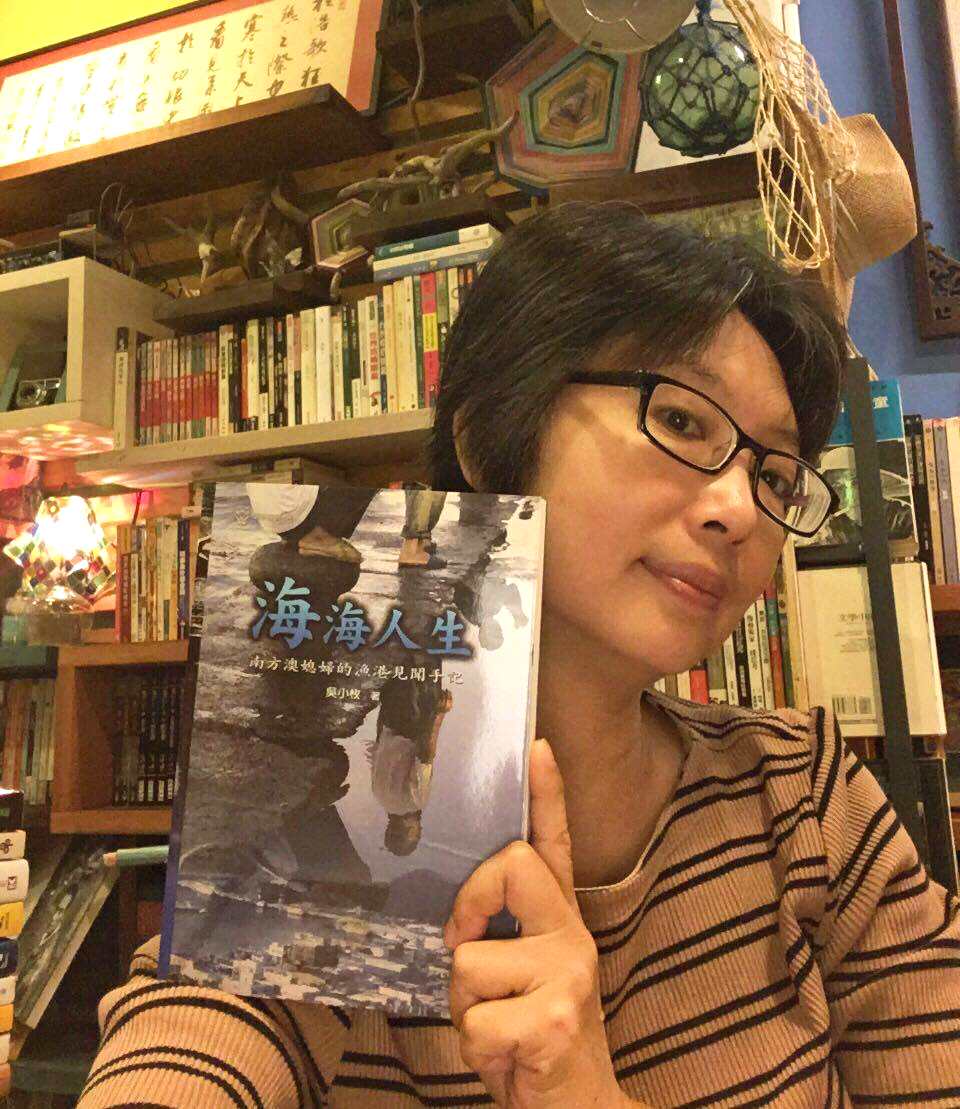
Chunyang Hao, a boat bookshop with family and a sense of place
Having missed the era of her husband's family's glorious, dominant chapter in the fishing industry, and because she loves books, Wu Xiaomei used "Chunyang Hao Fishing Harbor Reading Room" to express her identification with her family and Nanfang'ao. "Chunyang Hao" was the name of Wu Xiaomei's father-in-law's old fishing boat. As the name of the reading room, it perhaps metaphorically suggests that the Chunyang Hao, no longer fishing, continues to stand guard by the fishing harbor, passing on the fragrance of books, local customs, and a page of industrial change.
Walking into Chunyang Hao, the first thing that catches your eye is the wooden ship's helm from the Chunyang Hao in 1976 on the door panel. Hanging on the door panel, it is as if the Chunyang Hao keeps turning. If the reading room's main door is not yet open, you can ring the bell at the upper right of the door, which was a signal bell formerly used on harpoon swordfish boats. Wu Xiaomei makes good use of the "waste" left behind from shipbreaking. Items once used on boats, such as ship lamps, fish-attracting lights, large fishing flags, fishing nets, and anchors, have all become scenery in the reading room.
Entering the reading room, look carefully at the colors on the walls: blue, yellow, green, and red. Those colors seem somewhat familiar. Wu Xiaomei said: "These colors all come from the painted decorative patterns used on fishing boats. The layout and furnishings of the reading room were discussed together by me and a designer friend."


Related Articles
- How to prevent and control rabies in dogs? Timely vaccination of puppies ensures safety
- How to Explore Keelung's Fishing Port Docks? Practical Tips for Picking Fresh Seafood
- The Slow Food movement advocates that how you eat matters more than what you eat, helping you eat your way to health
- How to Identify Inferior Cooking Oil? Key Points for Quality Control from Cultivation to Purchase
- Which agricultural activities require tax payment? The ranch court case clarifies the boundary of tax exemption
- Ractopamine, a lean meat agent, is banned; scientific pig farming to increase lean meat percentage is the right path
- Horizontal Windbreak Nets for Welsh Onion Cultivation in Winter Reduce Losses
- Top Ten Fungicides Ranking Released, a Useful Reference for Farmers Choosing Products