A Detailed Guide to Common Types of Aquatic Flowers and Their Planting and Cultivation Techniques
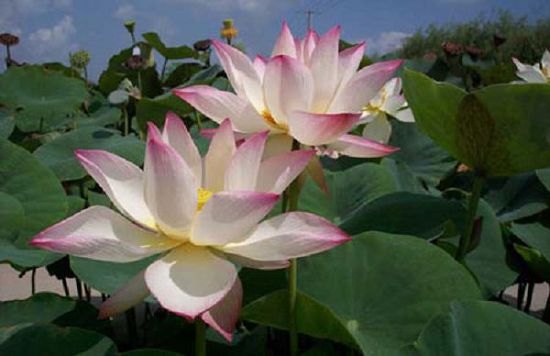
The Cultivation Value of Aquatic Flowers
Aquatic flowers are important materials for laying out water landscape gardens. A single lake or pond can use multiple species, or just one, forming scenic areas and viewpoints with unique charm together with garden structures such as pavilions, waterside houses, halls and lodges. Large lakes can be planted with submerged species such as bittercress, lakesides and marshy areas can be planted with marsh plants, and medium and small ponds are suitable for medium and small-sized varieties of lotus or water lilies, water hyacinths, etc. For ponds with piled mountains and stacked rocks, it is suitable to plant cattails and sweet flag at the pond corners and banks, while aquatic irises, rushes, etc. are suitable for planting in the rock crevices of rockeries and waterfalls or in stone gaps by streams. However, the quantity of aquatic flowers used for water landscape arrangement should not be too large; they should be arranged with appropriate density, with elegant water and abundant flowers, and the plants should not be allowed to completely cover the water surface.
Common Types of Aquatic Flowers
1. Emergent plants: lotus, bowl lotus, reed, cattail, wild rice stem, water rush, giant reed, water bamboo, sweet flag, pampas grass, water chestnut, etc.
2. Floating-leaved plants: water lily, water hyacinth, duckweed, spatterdock, banana plant, arrowhead, water caltrop, fox nut, small water hyacinth, etc., mainly plants of the Nymphaeaceae family.
3. Submerged plants: bitterweed, black algae, hornwort, Myriophyllum, lantern algae, pondweed, nitella, bladderwort, etc., mainly aquatic grasses.
4. Emergent herbaceous plants: canna, pickerelweed, purple loosestrife, Thalia dealbata, aquatic iris, red knotweed, Pennisetum, bulrush, Alisma, etc., plants suitable for growing at the water's edge.
Propagation Techniques for Aquatic Flowers
1. Seed propagation: The sowing method for aquatic flowers is to sow the seeds in a pot with culture soil, cover with sand or soil, and then immerse the pot in water. The immersion process should be carried out gradually, from shallow to deep. The germination speed of seeds varies by species; cold-hardy species germinate more slowly, requiring 3 months to 1 year, while non-cold-hardy species germinate faster, sprouting about 10 days after sowing. Sowing can be done indoors or outdoors; indoor conditions are easy to control, while outdoor water temperature is difficult to control, often affecting the germination rate.
2. Division propagation: Most aquatic flowers grow in clumps or have underground rhizomes, and can be directly divided or have their rhizomes cut into several sections for planting. When dividing rhizomes, note that each section must have a terminal bud and tail root, otherwise it will be difficult to establish a plant. Division is generally done in spring and autumn; some non-cold-hardy species can be done in late spring and early summer.
Cultivation Techniques for Aquatic Flowers
1. Sunlight: Most aquatic plants require ample sunlight, especially during the growing period (that is, between April and October each year). If sunlight is insufficient, phenomena such as leggy growth, small and thin leaves, and failure to bloom will occur.
2. Soil: Except for floating plants that do not need substrate soil, planting other types of aquatic plants requires field soil, pond mud and other organic clayey soil as the substrate, with a surface layer of coarse sand 1 to 2 cm in diameter, which can prevent water turbidity caused by watering or vibration.
3. Fertilization: Use oil cake and bone meal fertilizer balls as base fertilizer; about four or five fertilizer balls placed in the corner of the container is sufficient. Waterside plants do not need base fertilizer. For top dressing, use chemical fertilizer instead of organic fertilizer to avoid polluting the water quality, at a dosage ten times more dilute than for ordinary plants.
4. Water level: Aquatic plants have different requirements for water depth according to their growth habits. Floating plants are the simplest, needing only enough water depth to float. For submerged plants, the water must be higher than the plants, allowing stems and leaves to stretch out naturally. Waterside plants need to keep the soil moist, slightly in a waterlogged state. Since the stems and leaves of emergent plants extend above the water surface, a water depth of about 50 cm to 1 m must be maintained. Floating-leaved plants are more troublesome; the water level must be adjusted according to the length of the stems and stalks, so that the leaves float on the water surface in a natural state.
5. Thinning: If various types of aquatic plants are mixed and planted in the same pond, fast-reproducing species must be thinned regularly to avoid covering the water surface and affecting the growth of water lilies or other submerged plants. When floating-leaved plants become too large and their leaves shade each other, division must also be carried out.
6. Changing water: To avoid mosquito breeding or water quality deterioration, water must be changed when the water becomes turbid, and in summer the frequency of water changes must be increased.