What Does Succulent Tissue Culture Mean? A Detailed Explanation
Have you ever heard of such a fancy term as succulent tissue culture? Let's take a look below at what succulent tissue culture is.
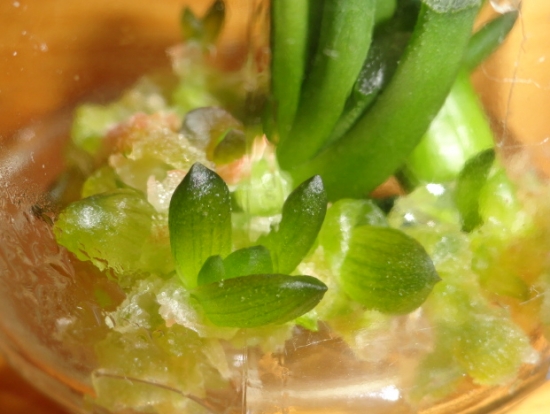
What Is Succulent Tissue Culture:
Succulent tissue culture refers to the process of using a certain part of a succulent plant to obtain new plants (cloned plants) through asexual vegetative propagation, also known as plant cloning.
The Story Behind Succulent Tissue Culture:
1. What exactly does the "tissue culture" that causes market turmoil refer to?
To be precise, it should be "in vitro rapid propagation," that is, a branch of tissue culture technology -- in vitro rapid propagation, abbreviated as "rapid propagation."This technique evolved from leaf cuttings and root cuttings. We use soil for leaf cuttings and root cuttings, while "rapid propagation" uses a synthetic medium that looks a lot like jelly, and the container is changed from a flower pot to a glass bottle. This is the plant tissue culture factory that people later saw on TV.
2. Why can the culture medium in a glass bottle achieve rapid propagation?
The reason lies in the superior external environment and the action of plant hormones. The temperature, light and humidity in a rapid propagation laboratory are all constant, and the "culture medium" contains sufficient nutrients and powerful plant hormones. These hormones can adjust the growth state of plants according to human wishes, making them grow roots or grow shoots (but this also depends on the operator's academic level and experience; people who can handle hormones with ease are limited in China).
When we normally do leaf cuttings and beheading, we also cleverly use some hormones. In fact, the act of dripping hormones onto leaf cuttings and beheaded plants is the same in nature and principle as "rapid propagation," and the plants obtained are also exactly the same. Many people do not realize this and think that plants obtained by different propagation methods will have different traits. In fact, the difference lies only in nutrient enrichment, that is, the plumpness of the plant. Leaf cuttings are always a bit weaker than beheaded plants and show their traits a bit later. This is caused by the endogenous hormones and nutrients in the part concerned, but the genome is exactly the same, and no trait drift will occur. Only chimeric traits, such as variegation, may show a "probabilistic" difference between leaf cuttings and beheaded plants.