Bee Die-off 0827"Not just bees, even ants are out of balance! Improper pesticide spraying in betel nut orchards has led to rampant ghost ants. When will the government face this squarely?
Text / by Upstream and Downstream reporters Cai Jiashan and Lin Peijun
Bee poisoning incidents have been reported repeatedly in Puli, Nantou, and the culprit is pesticide spraying in betel nut orchards, especially the banned pesticide fipronil, which is the most toxic to bees. Experts point out that in recent years, rampant ghost ants have been reported in the mountainous areas of Nantou and Chiayi, tormenting residents, and this is also related to improper pesticide spraying in betel nut orchards. Because ants live symbiotically with aphids and mealybugs, and these insects in turn harm betel nut, betel nut orchards spray heavily to control ants, but this may accidentally kill bees, and the ant infestation only gets worse.
In recent years, due to climate change, pests and diseases have increased. Betel nut farmers admit that they must use multiple insecticides at once, and that their pesticide use relies entirely on recommendations from pesticide shop owners and "trying it themselves." The government has not regulated pesticide use on betel nut for years, and the result is pesticides being sprayed indiscriminately everywhere, even including banned pesticides, harming innocent ecosystems, while the pests and diseases remain unsolved.
Miaoli District Agricultural Research and Extension Station investigation confirms fipronil is the main culprit in acute bee poisoning
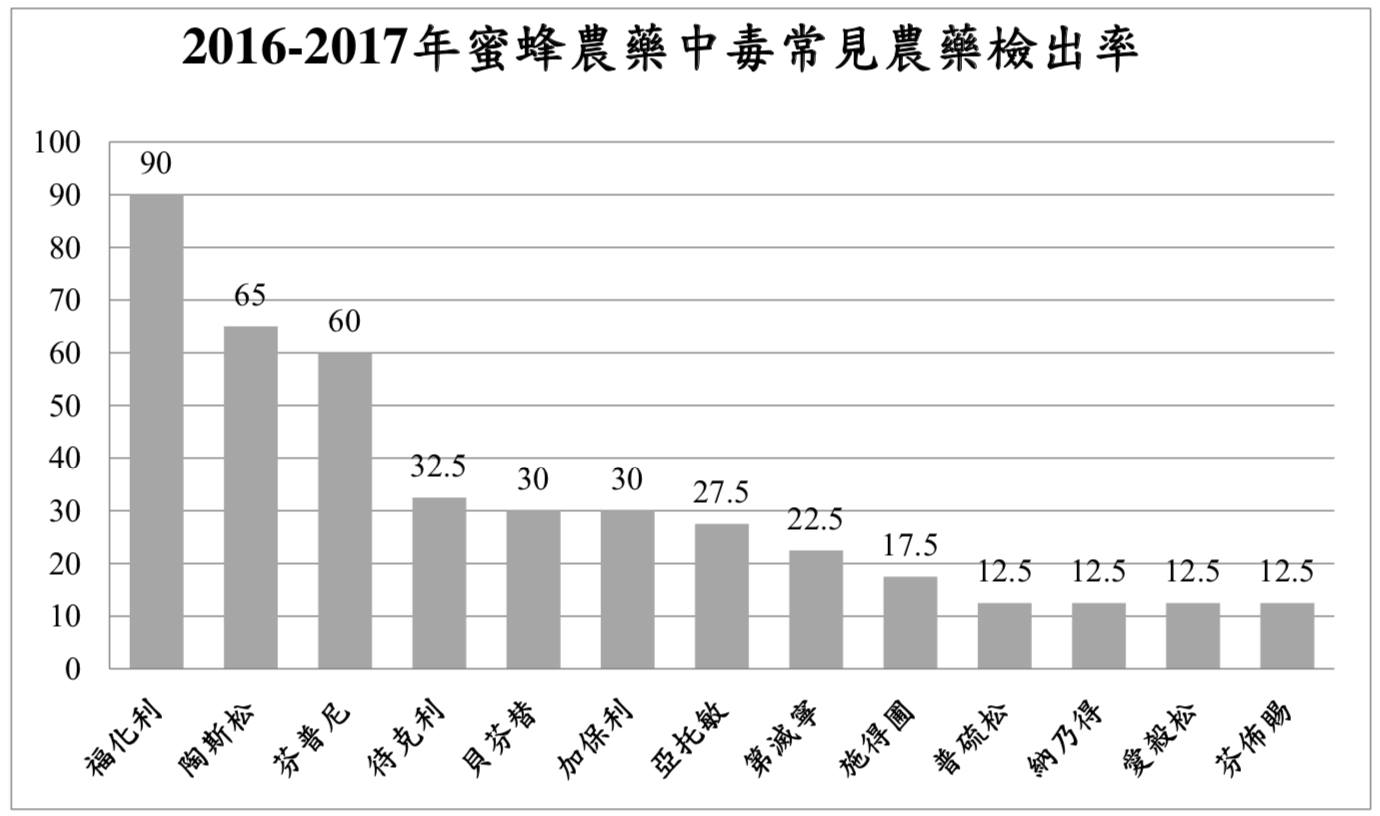
According to the 2018 (Republic of China year 107) paper "Analysis of Acute Bee Poisoning Patterns in Taiwan" from the Bee and Bee Products Seminar, the Miaoli District Agricultural Research and Extension Station investigated bee poisoning cases from 2015-2016 (Republic of China years 105-106) and confirmed that the pesticide most commonly causing bee poisoning was fipronil, followed by fluvalinate, then chlorpyrifos, carbaryl, and deltamethrin. Further analysis found that in cases where fipronil was detected, the main flowering plant sources were lychee and betel nut.
It is speculated that the reason should be that in recent years the lychee flowering period has encountered massive outbreaks of the lychee stink bug, and farmers used pesticides illegally. Betel nut also has more and more pests and diseases, yet there are no recommended pesticides at all and no sampling and inspection mechanism whatsoever. Various pesticides and the already banned fipronil suspension concentrate are very likely being used on betel nut.
Rampant ghost ants are related to pesticide spraying in betel nut orchards
Ant damage has been severe in the mountainous areas of Nantou and Chiayi over the past three years, with ant armies densely covering farms and invading homes. Ant expert Lin Zongqi, professor in the Department of Biology at National Changhua University of Education, points out that the main harmful species are the wandering ghost ant and the brown ghost ant, and that "the more serious places are all connected to betel nut orchards."
Guoxing Township in Nantou County and Zhongpu Township in Chiayi County, mountainous townships where ghost ants cause the worst damage, are indeed betel nut strongholds. Lin Zongqi said, "Because betel nut orchards apply pesticides, this instead makes the ant community composition become very simple. It kills off the ants originally native to the area, letting these rapidly and massively expanding ghost ants take over the territory."
Because ants live symbiotically with aphids and mealybugs, these insects secrete honeydew to feed the ants while also biting and sucking on crops, and the tender flower spikes of betel nut are also harmed. This is very likely one of the main reasons pesticide spraying in betel nut orchards has intensified in recent years.

Pesticide spraying in betel nut orchards harms butterflies, bees, and fireflies alike
A bed-and-breakfast owner in Yuchi Township, Nantou, is very troubled: ghost ants infest the house, while a nearby betel nut orchard outside has recently been spraying pesticides heavily, and guests are complaining constantly. He found that whenever the betel nut orchard is sprayed, half an hour later he can sweep up piles of struggling or dead butterflies, bees, and various other insects from the ground. Bees also slam into the glass as if lost.
"Before, when the firefly-viewing season came, the spectacular fireflies were like a Mayday concert, and now they are all gone." He angrily asks: ecotourism is a tourism highlight of Yuchi Township, but if the ecology is severely out of balance and the stench of pesticides drifts everywhere, will guests still come?

Incorrect use of fipronil fails to kill ants and instead kills bees
As pests and diseases increase, farmers respond by using stronger pesticides, and fipronil happens to be a powerful ant killer that also works on other pests. Although the 4.95% suspension concentrate has already been banned, judging from the fact that 60% of bee poisoning deaths over the years tested positive for fipronil, illegal use still exists.
Betel nut farmers may also use non-banned fipronil formulations to control ants. A reporter even bought 0.3% fipronil granules at a pesticide shop in Nantou (permitted only for rice and corn), and the owner explained that sprinkling these granules at the base of betel nut trees can prevent ants from climbing the trees.
However, Lin Zongqi points out that this control method is completely wrong and will fail entirely. "For killing ants, 0.3% granules are too high a concentration!" He explains that what is currently permitted for red imported fire ant control is 0.0143% granules, a 30-fold difference in concentration. "The purpose of this pesticide is to let ants come into contact with it, carry it back, and contact other individuals, spreading it, rather than killing them immediately, so it cannot be too toxic." At 0.3% concentration, ants die as soon as they touch it, and the chain-reaction ant-killing effect simply cannot be achieved; it is completely incorrect pesticide use.
Lin Zongqi also explains that this high-concentration fipronil granule can harm bees without needing to dissolve in water: "There is definitely moisture in the environment, and bees die once they touch it."
Betel nut has pesticide needs, and farmers are at a loss, "trying it themselves"
There are no official recommended pesticides for betel nut at all, so farmers can only rely on pesticide shop recommendations or learn from mistakes based on their own and their peers' experience. From the confession of this betel nut farmer in Nantou below, one can see the chaos and disorder of betel nut pesticide use.
"Betel nut is really very hard to care for now! In the past no spraying was needed, and one hundred betel nut flowers could grow into one hundred green betel nuts; now even half is considered good, and in some worse places only ten remain."
This betel nut farmer says that in recent years warm winters with little rain, plus air pollution making everything hazy, have both increased pests and diseases: "There are weevils, hanging-thread larvae (moth larvae), and also a kind of black ant." How to control them? "For weevils we all use chlorpyrifos and emamectin, for hanging-thread larvae we use carbaryl, and for other problems we also use imidacloprid."
"We all know a principle among ourselves: buying pesticide that does not work is worse than not spraying at all. Because if the pesticide does not work and you spray it, you will think the crop has already been protected and that you should not need to care for it anymore," while in fact pests and diseases still encroach, and in the end there is no harvest.
"Usually we use one pesticide for one pest, and sometimes even two pesticides. Each spraying uses at least five pesticides. The shop owner also often recommends that we use multiple pesticides at once, so we are less afraid of it not working," he adds. Besides exchanging information among peers about which pesticide shop sells more effective products, they also have to "try it themselves."
Betel nut pesticide use urgently needs investigation: a single dead bee tested positive for up to 18 pesticides
Thus bees have become victims of pesticide experiments on betel nut. The chlorpyrifos and carbaryl used by this betel nut farmer are both pesticides commonly detected in poisoned dead bees, while imidacloprid causes bees to lose their way.
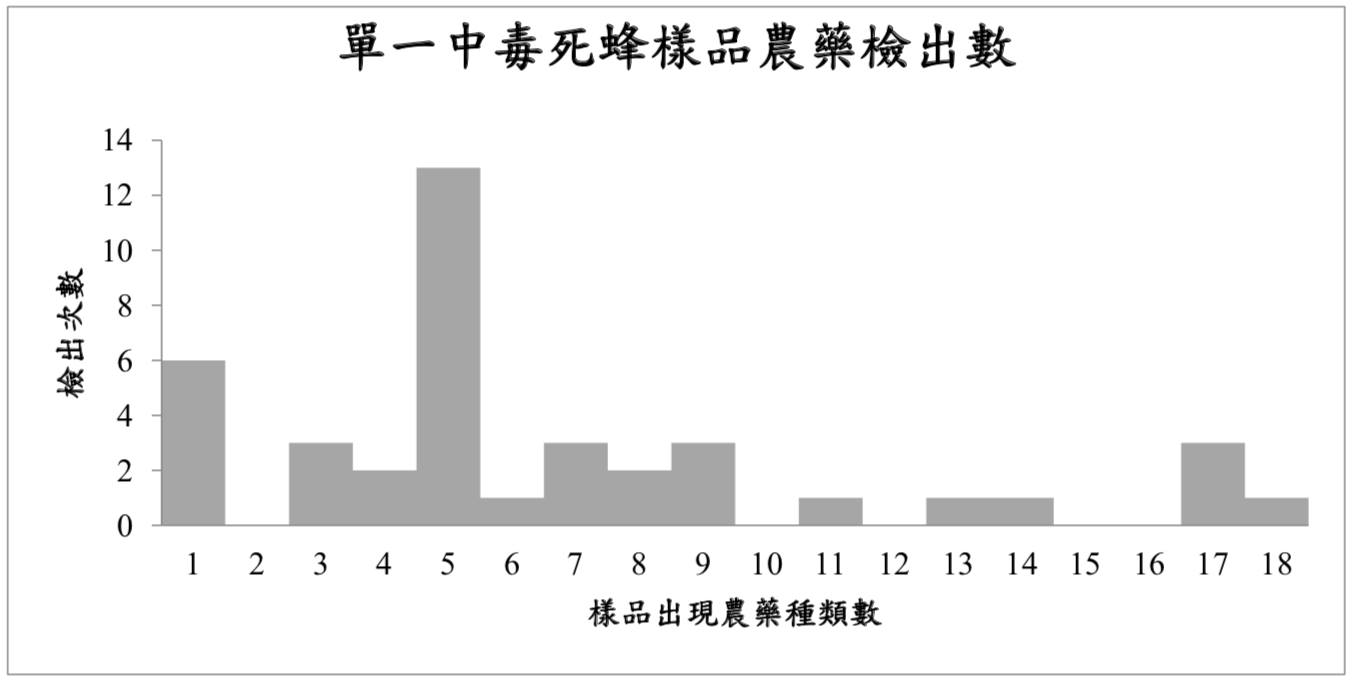
According to the paper published by the Miaoli District Agricultural Research and Extension Station, a single dead bee sample tested positive for up to 18 pesticides, with an average of 5. This shows that farmers' pesticide knowledge urgently needs strengthening through education, and for the more than 40,000 hectares of completely unregulated betel nut orchards, officials need to propose concrete control measures that do not harm bees as soon as possible.
Related Articles
- How to prevent and control rabies in dogs? Timely vaccination of puppies ensures safety
- How to Explore Keelung's Fishing Port Docks? Practical Tips for Picking Fresh Seafood
- The Slow Food movement advocates that how you eat matters more than what you eat, helping you eat your way to health
- How to Identify Inferior Cooking Oil? Key Points for Quality Control from Cultivation to Purchase
- Which agricultural activities require tax payment? The ranch court case clarifies the boundary of tax exemption
- Ractopamine, a lean meat agent, is banned; scientific pig farming to increase lean meat percentage is the right path
- Horizontal Windbreak Nets for Welsh Onion Cultivation in Winter Reduce Losses
- Top Ten Fungicides Ranking Released, a Useful Reference for Farmers Choosing Products