Chen Xingzong and Fang Jie's tea garden: little fertilizer, no pesticides, topsoil organic matter jumped to 5% after 5 years
- Networks -> Additional Network Options Customize Share Message (Advanced)Customize share message is an easy way to change the default shared information that is used by share buttons. Almost all social networks that plugin support uses URL as leading sharing parameter. This in brief means for you that when you setup custom share data you need to ensure that information is also available into social share optimization tags on the destination URL that plugin will share.Please do not foget to fill all parameters for better results because few of social networks support almost all parameters and data for them will be taken from that screen if filled or from post default data if they are empty.URLProvide custom URL to be shared.MessageProvide custom message to be shared (not all social networks support that option)ImageCustom image is support by Facebook when advanced sharing is enabled and Pinterest when sniff for images is disabledSelect File DescriptionCustom description is support by Facebook when advanced sharing is enabled and Pinterest when sniff for images is disabled&url=https://www.newsmarket.com.tw/blog/123817/&counturl=https://www.newsmarket.com.tw/blog/123817/','twitter','2109937687'); return false;" target="_blank" rel="nofollow" class="nolightbox" >
Agriculture is a high-tech industry, but unfortunately the common perception keeps its output value low, so it falls into a vicious cycle, and the bitter consequences that follow are borne by everyone together. I have written this article specifically to share with everyone the power of nature that I have seen, and to savor the beauty of pragmatic agricultural technology.
This is a tea garden at the southwestern end of the Pingdingpu tableland in Zhushan, covering an area of 0.45 hectares, at an elevation of only just over 150 m. Recently, with days of heavy rain, crops on most farmland and tea gardens across Taiwan, China have suffered severe damage, but the more the rain pours, the healthier this tea garden becomes.

Low-maintenance with no pesticides and little fertilizer: tea buds are plump and thick, and the quality is stunning
The elevation here is not high, yet the tea quality is quite stunning. The tea buds are plump and thick, fresh and tender with substance, and the green tea, oolong tea and black tea made from them are only tasted by Fang Jie's relatives and friends who have the good fortune.
Because the previous owner found management difficult and was dissatisfied with the profits, Fang Jie and her husband took over and bought the tea garden through an accidental opportunity. It was also at that time that I came to know Fang Jie and her family, due to the need for management consulting on this plot of land.
In the first two years after taking over, the tea garden's yield and quality were indeed not very ideal, but Fang Jie persistently insisted on managing the tea garden with correct management practices.
The so-called "correct management practices" are somewhat embarrassing to say, because at the beginning I only proposed low-maintenance management practices for the whole area that conformed to the principles, based on Fang Jie's family's expectation of no pesticides and little fertilizer. Because the owner also continued to have confidence in me, she cooperated fully and honestly. From the third year, the tea garden began to show positive improvement, and in the process the local neighbors also witnessed the changes in this tea garden.
In the early stage of system recovery after taking over in the year 103 of the Republic of China, there was almost no harvest. The winter tea of year 103 yielded 17 Taiwan jin of dried tea. From years 104 to 106, it was harvested once or twice each year. By year 107, it had reached three harvests a year, and the yield was already close to 50% of the neighboring conventional tea gardens.

Weeds and organisms are all diverse, and the tea plants are healthier with easy management
The most interesting thing is that Mr. Wu in the neighboring field's greenhouse betel leaf (who was also once a veteran conventional tea farmer) would chat with me every time he saw me. He always said: "I really can't understand what this tea garden is doing. I don't see her fertilizing or spraying pesticides either, so how can the tea plants be so healthy? How is it even easier than his past management experience? What on earth is happening?" He also often asked me what magic elixir I was giving her.
This tea garden often surprises me. I very much like to come and observe this tea garden and learn, to see how this tea garden, which was once over-influenced by humans, has changed under the low intervention and careful management of Fang Jie's family.
Fang Jie rarely fertilizes, and even the targeted foliar fertilizer I commonly use is skipped. Because even without fertilizer, they still grow very vigorously, without showing any symptoms of element deficiency. Only to increase theanine content, before the winter tea buds sprout each year, I will agree to apply a little soybean powder on the surface, within 100 kg per fen of land.
Completely no pesticides, insects are active, but the harm to the tea plants is limited
Although the site has a sprinkler irrigation system, ants often build nests and clog the pipes, making sprinkler irrigation a nightmare. After clearing them several times, the pipes were still clogged, so Fang Jie simply stopped sprinkler irrigationand it became the norm, with only rainfall from the sky as the main source of irrigation.
The weeds in the site are a relatively more commonly managed target. I suggest not being too aggressive, but Mikania micrantha must be completely eradicated. Now the weeds in the site show a diversified condition, and as long as they do not exceed 70% of the tea plants' height, they can be left alone.
Fang Jie uses no pesticides at all, yet she has never complained about pests or diseases. With no pesticide application, only the tea buds near the bamboo grove have relatively serious damage from tea mirids, and in the rest of the area there are occasional small green leafhoppers and leaf anthracnose damage, all within a tolerable range. Interestingly, throughout the area, flower spiders, planthoppers, brown-margined moth bugs, green moth bugs, jumping spiders, dragonflies, ladybugs, lacewings... and even more unknown insects are very active, which I rarely see in other tea gardens.

The soil has greatly improved, and topsoil organic matter content has risen substantially to 5%
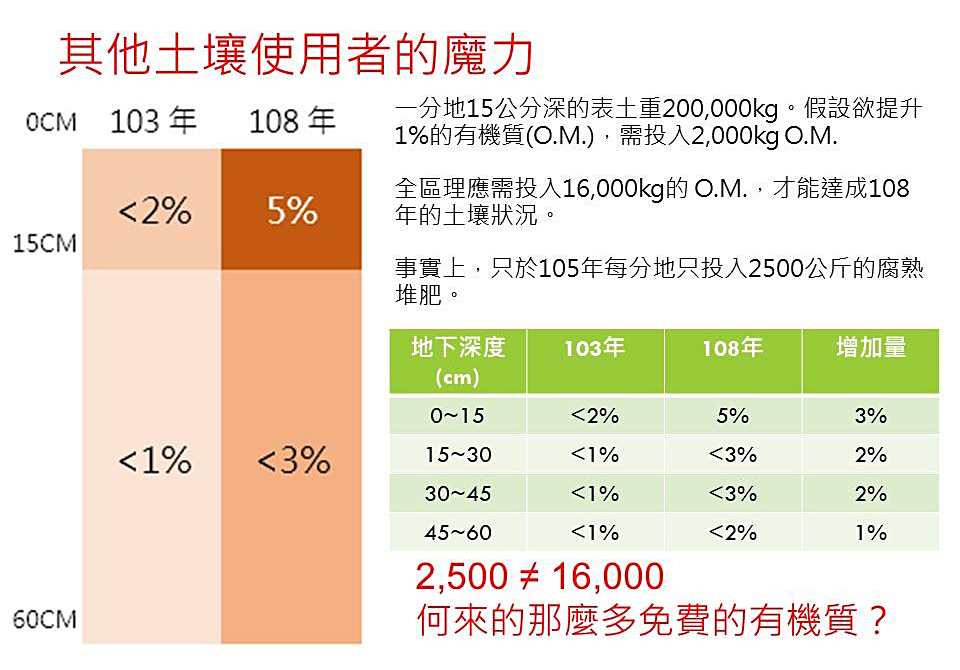
The soil beneath this tea garden has even more magical things continuously happening. At the first diagnosis in year 103, the tea garden's organic matter was concentrated in the topsoil range of 0-15 cm, with content at 1-2%. The soil below 15 cm was very dead, hard and structureless.
Now, at least above 40 cm there is well-structured soil, and aeration and drainage are no problem.
In the spring of year 108, the organic matter content in the tea garden's topsoil range of 0-15 cm was 5%. Below that, from 15-60 cm, it was also 2-1%. In conventional calculations, the topsoil 15 cm deep in one fen of land weighs 200,000 kg. Assuming one wants to increase organic matter by 1%, at least 2,000 kg of organic matter must be added. And the 0-60 cm soil of one fen of land increased by 16,000 kg of organic matter in five years.
In fact, in year 103 only 2,500 kg of decomposed compost was added. The difference in organic matter content between the two time points is 13,500 kg. What happened here?