China satellite imagery of Taiwan sparks controversy; Council of Agriculture terminates contract afterward, may have known earlier
Premier Su Tseng-chang declared at the beginning of the year that the nation would invest 25 billion in the third phase of the "Space Technology Development Plan," yet yesterday Apple Daily reported that the Council of Agriculture's Taiwan Agricultural Research Institute spent tens of millions to procure Chinese satellite imagery. The media questioned why the Council of Agriculture did not give priority to using domestic space technology to obtain satellite imagery information, and that purchasing Chinese satellite imagery is tantamount to handing over national territory information, raising concerns of endangering national security and information security, and questioning that the Taiwan Agricultural Research Institute under the Council of Agriculture is suspected of negligence. In addition, people in legal circles pointed out that the procurement process in this case was not handled in accordance with relevant procurement regulations and may be in violation of the law.
In response to media questioning, the Council of Agriculture held an emergency press conference yesterday (the 6th) to clarify. Council of Agriculture Deputy Minister Chen Chun-chi explained that the commercial satellite images used by the vendor are publicly circulated on the open market and inherently contain nothing sensitive. The images obtained by the Taiwan Agricultural Research Institute are only for internal researchers to interpret in order to grasp production and sales data, and there is no concern of information security leakage. Moreover, the Council of Agriculture did not restrict in advance the source of satellite images obtained by the company. It was only afterward that it discovered that the satellite imagery resources used by the company came from China. Considering society's concerns about Chinese information security products, it has terminated the contract with the vendor.
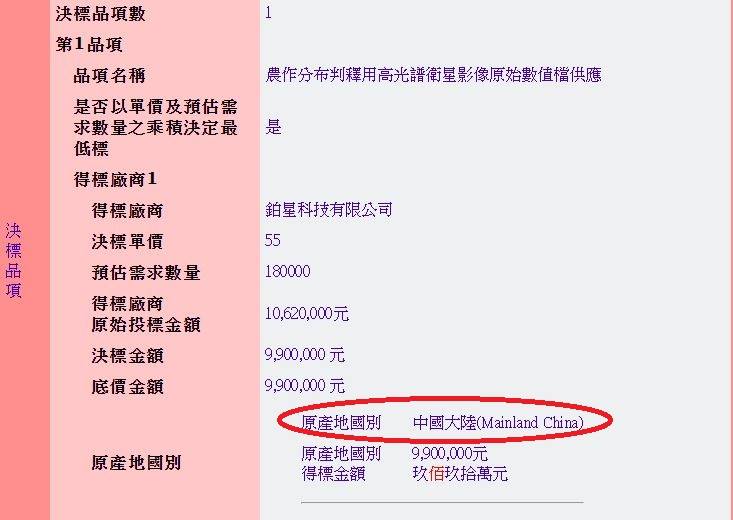
According to Chen Chun-chi's account, a reporter from News&Market checked the government procurement award announcement and found that the original "awarded item" already stated that the place of origin of the product was "Mainland China." It is highly likely that it was already known at the time of bidding that Platinum Star Company used Chinese satellite imagery, yet it still decided to award it the contract. This was not a case of "discovering it afterward" as Chen stated, and the contradictory account raises doubts.
A reporter from News&Market traced and found that the awarded unit price in this case was only 55 yuan per square kilometer, far lower than European and American imagery of the same band, and the Taiwan Agricultural Research Institute should have clearly known before the award that the vendor might use Chinese imagery. Last year, the Taiwan Agricultural Research Institute purchased German imagery from Xincai Company at a price of 53 yuan per square kilometer, but it had only five bands. Therefore, being able to buy twelve-band imagery at a similar price meant the source was very likely China. The address of Xincai Company happens to be the same address as Platinum Star Company, which purchased Chinese imagery in this case.