Hsu Cheng-yu's urgent petition requests the Fisheries Agency to suspend direct shipping of ribbonfish transport vessels to China
The Fisheries Agency has pre-announced the draft "Regulations Governing the Trial Operation of Fishing Vessels Transporting and Carrying Coastal and Offshore Ribbonfish." Because no catch limit for ribbonfish exported to China has been set, concerns have been raised across all sectors that this will cause a catastrophe for ribbonfish.
Hsu Cheng-yu, founder of the Responsible Fisheries Index; Chan Man-se (Associate Professor, Institute of Applied Economics, National Taiwan Ocean University); Huang Shu-te (Supervisor, Homemakers United Foundation Consumer Cooperative); and Chen Yung-sung (Assistant Professor, Department of Biotechnology and Animal Science, National Ilan University) and others have launched an urgent petition, demanding that the Fisheries Agency suspend implementation of the "Regulations Governing the Trial Operation of Fishing Vessels Transporting and Carrying Coastal and Offshore Ribbonfish" and convene a joint meeting of experts, industry, and civic groups to formulate a feasible plan consistent with marine sustainability and industry development, effectively manage overall catch and export volumes, and ensure the public's right to consume high-quality local fishery products.
The draft's pre-announcement period is only 14 days and will end on August 9. All sectors are urged to sign the petition enthusiastically and ask the Fisheries Agency to suspend the "Regulations Governing the Trial Operation of Fishing Vessels Transporting and Carrying Coastal and Offshore Ribbonfish" to ensure the sustainability of Taiwan's coastal and offshore fishery resources. (To sign the petition, please click here)
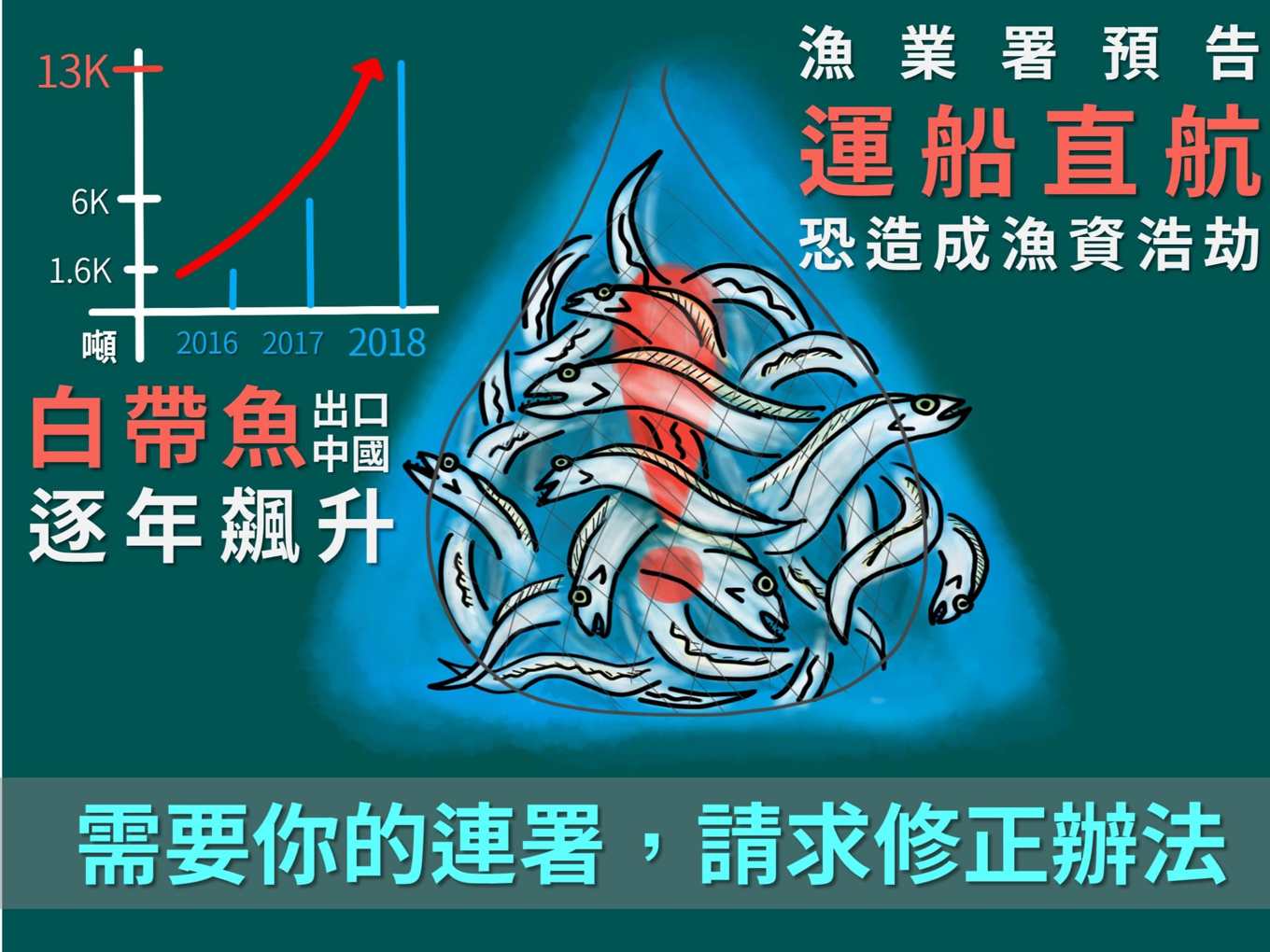
Summary of reasons for the petition: Pleading for the ribbonfish!
Taiwan's catch of chilled ribbonfish exported to China surged from 4 tonnes in 2014 to 13,720 tonnes in 2018, already bringing a huge impact on Taiwan's coastal and offshore resources. On July 24, 2019, the Council of Agriculture pre-announced the "Regulations Governing the Trial Operation of Fishing Vessels Transporting and Carrying Coastal and Offshore Ribbonfish" (Council of Agriculture Fisheries Notice No. 1081327625), which will open management rules for direct sailing to the mainland by transport vessels carrying chilled ribbonfish. This will greatly reduce the transportation cost and time for ribbonfish, making Taiwan's ribbonfish more competitive in sales, and it can be expected that more ribbonfish caught in Taiwan's coastal and offshore waters will be sold to China.
In recent years, China's demand for ribbonfish has been enormous. Even with an annual catch of more than 1 million tonnes, it is still not enough, and imports continue in large quantities. Even emptying Taiwan's waters would not fill the gap in China's teeth. The management regulations pre-announced by the Fisheries Agency set no "catch limit" or "total volume management," lack environmental assessment, and do not consider overall social interests. If implemented hastily, in the short term it may appear to increase fishermen's income, but in the long term it may lead to depletion of fishery resources, erode the development rights of all fishermen, and further harm the fishery resources shared by all citizens. Through this petition, we hope to request suspension of this case's implementation and to reopen only after more complete management regulations have been formulated.
Five petition demands: Suspend implementation of the draft, invite all sectors to fully discuss it, and formulate a reasonable plan
(1) Suspend the management regulations; they should not be implemented hastily: The management regulations pre-announced by the Fisheries Agency set no ribbonfish catch limit and will seriously harm coastal and offshore fishery resources.
(2) Hold public hearings: The Fisheries Agency should hold open meetings and invite experts, industry, and civic groups concerned about ocean issues to discuss an appropriate model for ribbonfish resource management.
(3) Immediately launch research and surveys: Establish resource information for Taiwan's ribbonfish, begin landing declarations, and investigate overall catch volumes.
(4) Avoid overfishing and control the export volume of Taiwan-produced ribbonfish: Before the survey of Taiwan's ribbonfish resources is completed, a cautious attitude should be adopted toward exports, and landing declarations must be strictly implemented, with rolling reviews based on monthly catch volumes to avoid overfishing.
(5) Principle of priority for domestic sales of Taiwan-produced fish: The marine resources in Taiwan's waters are shared by all citizens. To protect the public's right to consume high-quality local fishery products, a principle of priority for domestic sales must be established.
Why should we sign the petition? Ten detailed reasons
1. The volume exported to China in 2018 was 381 times more than in 2015
Ribbonfish is one of Taiwan's important commercial fish species caught in coastal and offshore waters, and in the past it was mainly sold domestically. In recent years, China's demand for ribbonfish has increased greatly. According to customs statistics, only 36 metric tonnes were sold to China in ROC year 104, rising sharply to 6,525 metric tonnes in ROC year 106, and doubling again in ROC year 107 to as high as 13,720 metric tonnes, with the volume continuing to climb sharply.
2. Opening direct shipping between Taiwan and China fishing ports will only make things worse!
In response to ribbonfish selling well in China, the Fisheries Agency has pre-announced the "Regulations Governing the Trial Operation of Fishing Vessels Transporting and Carrying Coastal and Offshore Ribbonfish," which will allow transport vessels to sail directly to China through designated fishing ports, greatly reducing transportation costs and shortening the voyage. It is estimated that more Taiwan-caught ribbonfish will be sold to China. However, how much ribbonfish resource is there in Taiwan's coastal and offshore waters, and is it enough to support sustained large-scale fishing? Apart from sales to China, how much ribbonfish does Taiwan consume each year? The Fisheries Agency admits that there are currently no statistics, nor any landing declaration data for reference.
3. Ribbonfish need 2 years to reproduce the next generation; once a decline in catch is discovered, it is already too late!
The main species of ribbonfish caught in Taiwan is Trichiurus japonicus, and most fish need a 2-year growth period to reach maturity. That is, the sharply doubled ribbonfish catch in recent years will at the earliest be reflected in catch volumes in the winter of 2019-2020. The Fisheries Agency's current view that "ribbonfish resources are sufficient" does not take long-term effects into account.
4. If the ribbonfish are gone, the Spanish mackerel may disappear too!
Ribbonfish is an important mid-level fish species in Taiwan's waters. Resource impacts include higher-level species such as spanish mackerel, billfish, sharks, and cetaceans. When ribbonfish are overfished, this also affects other fish that feed on ribbonfish. For example, the shortage of Spanish mackerel last winter may be one warning sign.
5. Taiwan has too little research and survey on ribbonfish; once overfishing occurs, it will be too late
There is very little domestic literature on ribbonfish, and nothing is known about population numbers. The only thing that can be confirmed is that ribbonfish are not suitable for aquaculture. Once overfished, aquaculture cannot serve as an alternative solution. The Fisheries Agency should launch detailed surveys as soon as possible, and before there is clear data, management should be carried out with the strictest attitude.
6. The export price to China is only 3.6 tenths of the Taiwan market price, selling Taiwan's ribbonfish resources cheaply!
In 2013-2015, the average wholesale market transaction price of ribbonfish in Taiwan's 14 major consumption areas was 146 yuan. After exports to China began in 2016-2018, the average ribbonfish price rose to 163 yuan, an increase of 11.6%. Exports to China caused domestic prices to rise, amounting to all citizens subsidizing exports. However, large-scale exports caused the boat-side price to fall. From 2013-2015, the average price in the wholesale markets of the 10 major production areas was 62.2 yuan, and in 2016-2018 the average price was 58.7 yuan, a decline of 5.6%, effectively selling Taiwan's precious marine resources cheaply.
7. If this law is implemented hastily, what impact will it have?
(1) Because costs for ribbonfish sold to China will decrease, wholesale prices at production areas will decline, stimulating even greater export demand.
(2) The average ribbonfish price in Taiwan's consumer market will continue to rise sharply.
(3) Marine resource volumes will decline rapidly, and ribbonfish resources will face collapse.
8. Why is direct shipping and direct selling of other fishery products not a problem?
Because currently only Taiwan's ribbonfish is a Taiwan offshore fishery, and its characteristics are completely different from deep-sea and aquaculture fisheries.
At present, Taiwan's transport vessels permitted to export to China include deep-sea squid, saury, and aquacultured grouper. Deep-sea fisheries are a global public good, and multinational fishery management organizations carry out resource management. Live grouper is a private good from aquaculture and does not involve domestic production management. Ribbonfish belongs to coastal and offshore state-owned resources, and the government is the only unit with management authority. Its responsibility is far greater than the management of deep-sea and aquaculture fisheries, and it should be considered even more cautiously.
9. Cheap exports carry suspicion of tax evasion and money laundering crimes
In recent years, China has been the largest export and import country for Taiwan's aquatic products, but cross-strait aquatic product trade management is extremely loose. Smuggling, tax evasion, money laundering, and food safety violations have become the norm. The government should first strengthen management to protect consumers and industry rights. Opening another cross-strait trading channel requires strict management to avoid further harm to national rights.
10. Fisheries receive national subsidies, so Taiwan's overall welfare should be prioritized on the basis of sustainable marine resources
Taiwan's fisheries are exempt from business tax, income tax, and export tariffs, and enjoy various subsidies. These are government benefits provided by all taxpayers on the basis of jointly maintaining the marine environment. Therefore, management regulations cannot be considered only from a purely commercial model; they must incorporate social perspectives such as environmental sustainability and the ability to supply citizens with high-quality seafood, and find an appropriate management model.
What can we do for Taiwan's ribbonfish?
(1) Share the message through Facebook, LINE, and various other channels with relatives and friends, and invite them to join the petition http://bit.ly/33jbJzI
(2) Tell your opinions or petition demands to the "Council of Agriculture Fisheries Agency" as soon as possible: [email protected], phone: 02-23835839, fax: 02-23327536.
(3) Report it to your legislator > http://bit.ly/2GKA47N (after clicking the legislator's name, there is a message board on the left)
(4) Anything else you think would help advance the action demands.
Petition initiators and groups:
Hsu Cheng-yu (Founder, Responsible Fisheries Index), Huang Shu-te (Supervisor, Homemakers United Foundation Consumer Cooperative), Chan Man-se (Associate Professor, Institute of Applied Economics, National Taiwan Ocean University), Chen Yung-sung (Assistant Professor, Department of Biotechnology and Animal Science, National Ilan University) (in order of joining; invitations continue)
For the current number of signatories, please click here: http://bit.ly/2yxxXjj
The petition content was compiled with assistance from Chen Jui-pin of the Environmental Information Association. Contact information: phone +886-2-2933-2233, Email: [email protected]