Taiwan's white ribbon fish sell well in China, with no limits on catches: does this impact fishery resources?
The white ribbon fish is one of the important commercial fish species caught in our coastal and offshore waters. Its flesh is delicate and it is deeply loved by people in our country, and in the past it was mainly sold domestically. In recent years, China's demand for white ribbon fish has increased greatly, and Taiwan has ridden this wave of demand for white ribbon fish in China. White ribbon fish caught in coastal and offshore waters have been sold to China via the "Mini Three Links," and the quantity has risen sharply. According to customs statistics, in ROC year 104 only 36 metric tons were sold to China, but by ROC year 106 it had surged to 6,525 metric tons, and in ROC year 107 it doubled again, reaching 13,720 metric tons.
In response to the strong sales of white ribbon fish to China, the Fisheries Agency yesterday gave advance notice of the drafting of the "Regulations on the Trial Operation of Fishing Vessels Transporting Coastal and Offshore White Ribbon Fish," which will allow carrier vessels to sail directly to China through designated fishing ports, greatly reducing transport costs and shortening the voyage, and it is estimated that more Taiwanese-caught white ribbon fish will be sold to China. However, how many white ribbon fish resources are there in our coastal and offshore waters, and are they enough to support sustained large-scale fishing? Apart from sales to China, how many white ribbon fish does Taiwan consume each year? The Fisheries Agency admits that there are currently no statistics, nor any landing declaration data for reference.
Research fellow Cheng Ming-hsiu of the Biodiversity Research Center, Academia Sinica, said that domestic literature on white ribbon fish is very scarce, and nothing is known about population numbers, and the only thing that can be confirmed is that white ribbon fish cannot be farmed. Once the white ribbon fish caught become smaller and smaller in size, that is a warning sign of overfishing. To avoid repeating the overfishing of mackerel, sea cucumber, and other species, a fishing ban should be imposed during the white ribbon fish's reproductive cycle to ensure the sustainable development of marine resources.
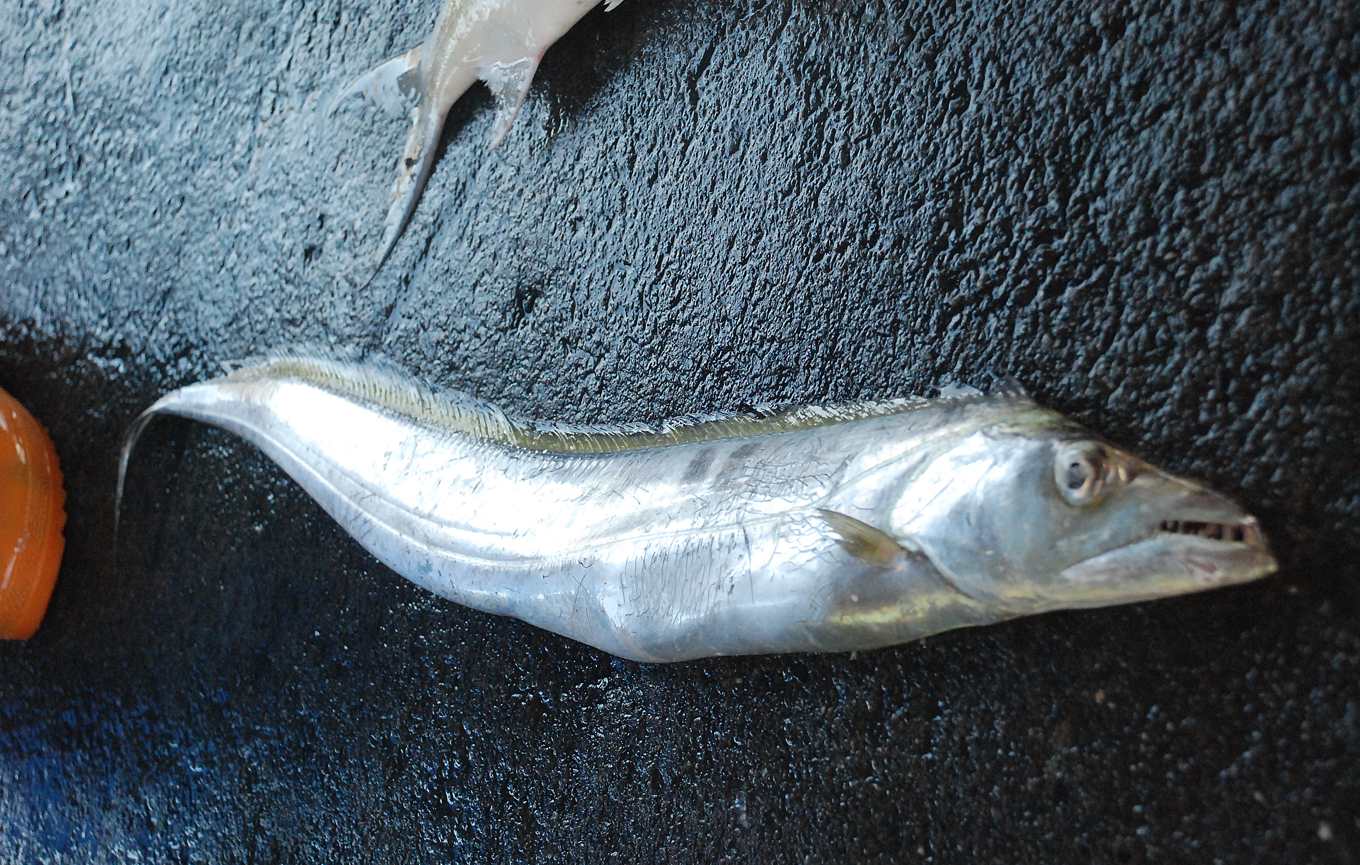
Research fellow: Taiwan has very little research on white ribbon fish; if body size becomes smaller, that is a warning sign
Research fellow Cheng Ming-hsiu of the Biodiversity Research Center, Academia Sinica, said that domestic literature on white ribbon fish is very scarce, and nothing is known about the white ribbon fish's population size, numbers, or where juveniles grow, but what can be confirmed is that because the white ribbon fish moves differently from other fish, it cannot be farmed.
Cheng Ming-hsiu suggested that once the white ribbon fish caught become smaller and smaller in size, that is a warning sign of overfishing. To avoid repeating the overfishing of mackerel, sea cucumber, and other species, a fishing ban should be imposed during the white ribbon fish's reproductive cycle to ensure the sustainable development of marine resources.
Fisheries Agency: A white ribbon fish catch database must be established before sustainable management can be discussed
Deputy Director-General Wang Cheng-fang of the Fisheries Agency responded that the "Regulations on the Trial Operation of Fishing Vessels Transporting Coastal and Offshore White Ribbon Fish" are intended to save fishermen's transport costs. Through exports by fishermen's associations, landing declarations can be made, effectively grasping and building a catch database, and it will not have much impact on fluctuations in market prices.
Regarding possible overfishing of fishery resources, Wang Cheng-fang said that there is no complete domestic survey literature specifically on white ribbon fish, but at present there should temporarily be no problem of insufficient resources. As for whether sales of white ribbon fish to China will cause overfishing, this will continue to be observed; in the future, an ecological research survey of white ribbon fish will first be conducted to confirm the white ribbon fish's way of life and reproduction, and based on this data a fishing strategy will then be formulated.
With a low rate of landing declarations, how can resources be grasped?
According to Fisheries Agency statistics, the current national rate of landing declarations for coastal and offshore fishing voyages is 28.7%. At present, only four fisheries - mackerel and scad, larval anchovy, coral, and flying fish roe - have calculated declaration rates. White ribbon fish was previously not a fishery specially managed by the government, so not only is it impossible to grasp the landing declaration situation, it is also difficult to grasp the actual catch quantity.
In response, Wang Cheng-fang said that current landing declarations are all paper-based operations and are voluntarily declared by vessel owners, but paper-based operations are rather cumbersome, and a review is currently underway. There are plans to digitize landing declarations in the future, with options under consideration including app development or recording by instrument when entering port for weighing. The difficulty in carrying out digitization lies in the fact that there are 222 ports across Taiwan, with fishing vessels entering and leaving 24 hours a day, so it is still being evaluated how to implement it in a way convenient for fishermen.