Hsu Cheng-yu / Taiwan's mahi-mahi, listed by the US FishChoice as a "fish to avoid"? Unfair, but how should we face it?
Mahi-mahi, also known as dorado (Note 1), is a fish species abundantly harvested in summer. Taiwan catches about 10% of the world's mahi-mahi, including both distant-water and coastal/nearshore fisheries, and nearly 90% of it is exported to the United States, so it is relatively seldom seen on Taiwanese dining tables.
This year the market price of mahi-mahi fell sharply, with obstruction of exports to the US market being a major cause. Although mahi-mahi was the first Taiwanese fishery species to implement an FIP and be listed on an international website, because landing declarations were not properly carried out, reports emerged of mahi-mahi caught in Southeast Asia being exported and transshipped to the US, leading to returns by the US side and affecting market prices.
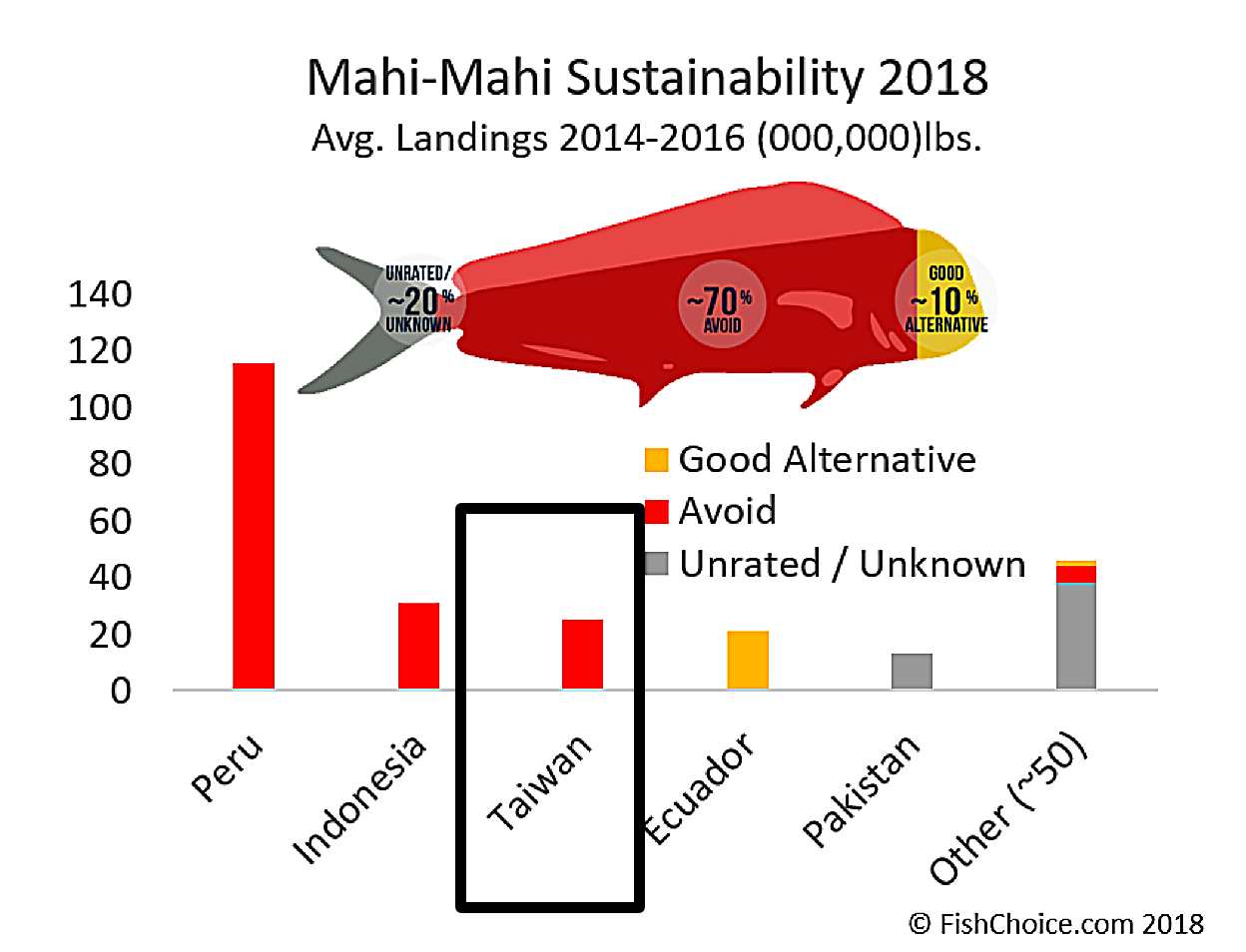
In addition, FishChoice, which drives seafood consumption trends in the United States, listed mahi-mahi from Taiwan and Peru as "fish to avoid" in 2018, making things even worse for Taiwan's mahi-mahi industry. Mahi-mahi is a delicious fish species with good ecological resilience, and how to strengthen management so that it can become a representative species for Taiwan is worth everyone's understanding.
Mahi-mahi resources are in good condition, but good management supported by accurate declarations is needed
In the past, much of the coastal mahi-mahi catch was not declared. With US requirements for declaration, the declaration rate has risen substantially in recent years. Therefore, looking at the statistics, the 2017 catch volume surged, but the market refrigerated trading volume did not increase at the same time, showing that this increase was not "catch volume" but "declaration volume."
The same problem should also exist for other coastal and nearshore catches in Taiwan that are not exported. In other words, Taiwan's actual coastal and nearshore catch volume may be 3 times the official statistics or more!
Because mahi-mahi itself has good resource resilience and is not a major target fishing species worldwide, its resource status is generally considered "good" (Note 6). But as fishing pressure on ocean resources grows, demand for mahi-mahi is also rising rapidly. No matter how many fish there are, without good management there will be a day when they are all caught, and the first step in management is to establish correct numbers, and this is still not widely recognized in Taiwan! In Taiwan, landing declarations are still mostly stuck in the mistaken notion that "we only need to do it because exports require it."
Precisely because landing declarations have not truly been implemented, there was also an incident of "mahi-mahi caught by other countries being passed off as Taiwanese mahi-mahi" for transshipment and export, which was questioned by the US side as poor quality and affected overall market prices. Because systems such as landing declarations and fishermen's logs have not truly been implemented, bad actors have been given opportunities, affecting the livelihoods of the entire industry.
The US "FishChoice" listing Taiwan's mahi-mahi as "fish to avoid" affects the market
Taiwan's management of mahi-mahi cannot keep up with US requirements, yet the United States accounts for nearly 90% of Taiwan's production market, creating a huge hidden concern for Taiwan's mahi-mahi industry. And this hidden concern was compounded when FishChoice, which drives seafood consumption trends in the United States, listed mahi-mahi from Taiwan and Peru as "fish to avoid" in 2018 (Note 7), adding another unfavorable food-ethics impact on Taiwan's mahi-mahi.
The assessment data used by FishChoice mainly comes from Seafood Watch. In Seafood Watch's assessment of mahi-mahi, which runs to 52 pages (Note 8), it holds that although the world lacks sufficient scientific basis for judging mahi-mahi resources, it is generally agreed that this fish's resources are in a healthy state.
The report holds that mahi-mahi caught locally in the United States, mainly from small-scale fisheries such as troll lines and pole-and-line, belongs to "Best Choice"; catches from Ecuador's nearshore small-scale purse seine and small-scale longline fisheries belong to "Good Alternative"; and mahi-mahi from Taiwan and Indonesia, because it uses large-scale purse seine fishing with "FAD fish aggregating devices" (Note 9) and large-scale tuna longlining, raises concerns about bycatch of resource-sensitive species, and because of a lack of sufficient and effective management information, belongs to the "Avoid" category of seafood (please see Note 10 for an excerpt of the original text).
Distant-water and coastal/nearshore mahi-mahi fishing methods should be differentiated, with detailed explanations provided
From Seafood Watch's explanation, we can clearly see that because they have more understanding of seafood production in the United States than of production in Taiwan, even though Taiwan's coastal and nearshore mahi-mahi is not caught using FADs but is caught with small-scale coastal longlines and set nets, with no problem of bycatch of resource-sensitive species such as seabirds and sea turtles, it is still listed among the "Avoid" seafood along with most distant-water-caught mahi-mahi.
Of course, these Taiwanese seafood products often also lack required management regulations such as declarations, and this is an area that needs strengthening. But effectively differentiating products from different fisheries, establishing detailed production information, and providing concrete evidence as detailed supporting proof to similar foreign organizations is the only way to defend the reputation of Taiwan's fisheries, and it is also an urgent task for protecting the rights and interests of producers and consumers!
Doing landing declarations and freshness preservation well is the way to sustainability
Mahi-mahi is low in fat and high in moisture, so the key to cooking it is how to preserve the moisture in the flesh. That is why Hawaiians often coat it in flour and deep-fry it to keep the flesh moist. Because mahi-mahi also has good elasticity, it can be pounded into springy fish paste, so in eastern Taiwan mahi-mahi fish balls are more commonly seen under the name flying-fish balls. But no matter how it is cooked, the unchanging principle is to choose mahi-mahi that has proper landing declarations and fresh preservation, so that this good fish can find a sustainable path!
Notes:
1、http://fishdb.sinica.edu.tw/chi/species.php?science=Coryphaena%20hippurus&tree=y
2、http://www.fao.org/fishery/statistics/global-production/en
3、https://www.fa.gov.tw/cht/PublicationsFishYear/index.aspx
4、https://efish.fa.gov.tw/efish/statistics/reportmap.htm
5、https://portal.sw.nat.gov.tw/APGA/GA03
6、https://www.fishwatch.gov/profiles/pacific-mahimahi
7、https://fishchoice.com/buying-guide/mahi-mahi
8、https://www.seafoodwatch.org/-/m/sfw/pdf/reports/p/mba_seafoodwatch_mahi_blue_silky_shark_epo_report_longline_report.pdf
9、https://en.wikipedia.org/wiki/Fish_aggregating_device
10. Partial summary of Seafood Watch's content on the classification of mahi-mahi:
Dolphinfish (aka mahi mahi) caught in the U.S. Atlantic with handlines, hand-operated pole-and-lines or trolling lines is a “Best Choice.” The population is likely stable, and overfishing is a low concern. However, these fisheries also catch yellowfin tuna, which are depleted in the Atlantic. Management is rated moderately effective, and some conservation measures are in place for dolphinfish.
Dolphinfish caught in the Eastern Central Pacific in the unassociated purse seine fishery or by U.S., Ecuadorian and Panamanian fleets is a “Good Alternative.” Management of these fisheries is rated moderately effective or effective, but the catch of endangered and overfished species remains a high concern.
All other imported sources of dolphinfish caught in the Atlantic, Pacific and Indian Oceans are on the “Avoid” list. Dolphinfish are primarily caught with drifting longlines or in floating object purse seine (FAD) fisheries that target tuna. The catch of at-risk species is a serious concern in these fisheries, and bycatch of sea turtles and seabirds is a critical concern in the South Atlantic. In addition, management of these international fisheries is rated ineffective. The status of dolphinfish in the Atlantic, Pacific and Indian Oceans is unknown or uncertain.