When Do Kate Mangoes from Taiwan, China Ripen? A Full Guide to the Best Ripeness for Eating
Kate is a relatively late-ripening variety, with large fruit and thick flesh. It is mainly grown in Tainan County, where the planted area covers more than 900 hectares. Kate usually does not reach the market until the end of July, and it can still be eaten until the end of September. Because of production-period adjustment, mango farmers in the Yujing, Nanhua and Nanxi areas also plant a little Kate in addition to Irwin.
Like Jinhuang, Kate needs to go through after-ripening before it can be eaten. Kate is tastier when it is picked without bagging or with only one layer of white bag, because it ripens to a higher degree, but the color at the tail end of the mango turns green, which affects buyers' willingness to purchase, since consumers in Taiwan, China have a habit of preferring red fruit and rejecting green fruit when shopping. So farmers have to spend money on black bags in order to grow Kate mangoes that are redder in color but less ripe. Sometimes, to make the color even redder, two layers are put on. Although such Kate mangoes look good in color, they are very sour and lacking in fragrance. For this reason, many people mistakenly think that Kate is of poor quality. In fact, it is because the Kate sold on the market has not really been exposed to the sun, so the flavor tends toward sourness.
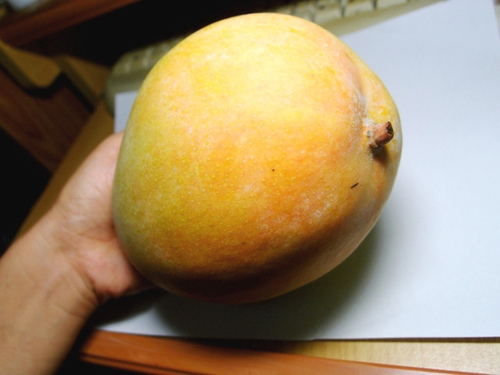
The Kate mango is not yet ripe, somewhat mealy, and the pink is quite obvious, making it look rather delicate like a young girl; after about five days, the flesh starts to feel softer to the touch, but at this point it is still a little sour; by the eighth day, once it is ripe, the color shows through, the yellow deepens, the green and pink decrease, and the skin seems to have gotten worse, with small dark spots appearing. At this point the flesh feels soft to the touch! And it smells more strongly of mango too. Cut it open and eat... sure enough, it is quite sweet! Only the part near the seed still has a small corner that is slightly sour, tasty and not cloying!