Agricultural Insurance Act sent to the Legislative Yuan: natural disasters, pests and diseases to be covered, target of 60% of farmland covered
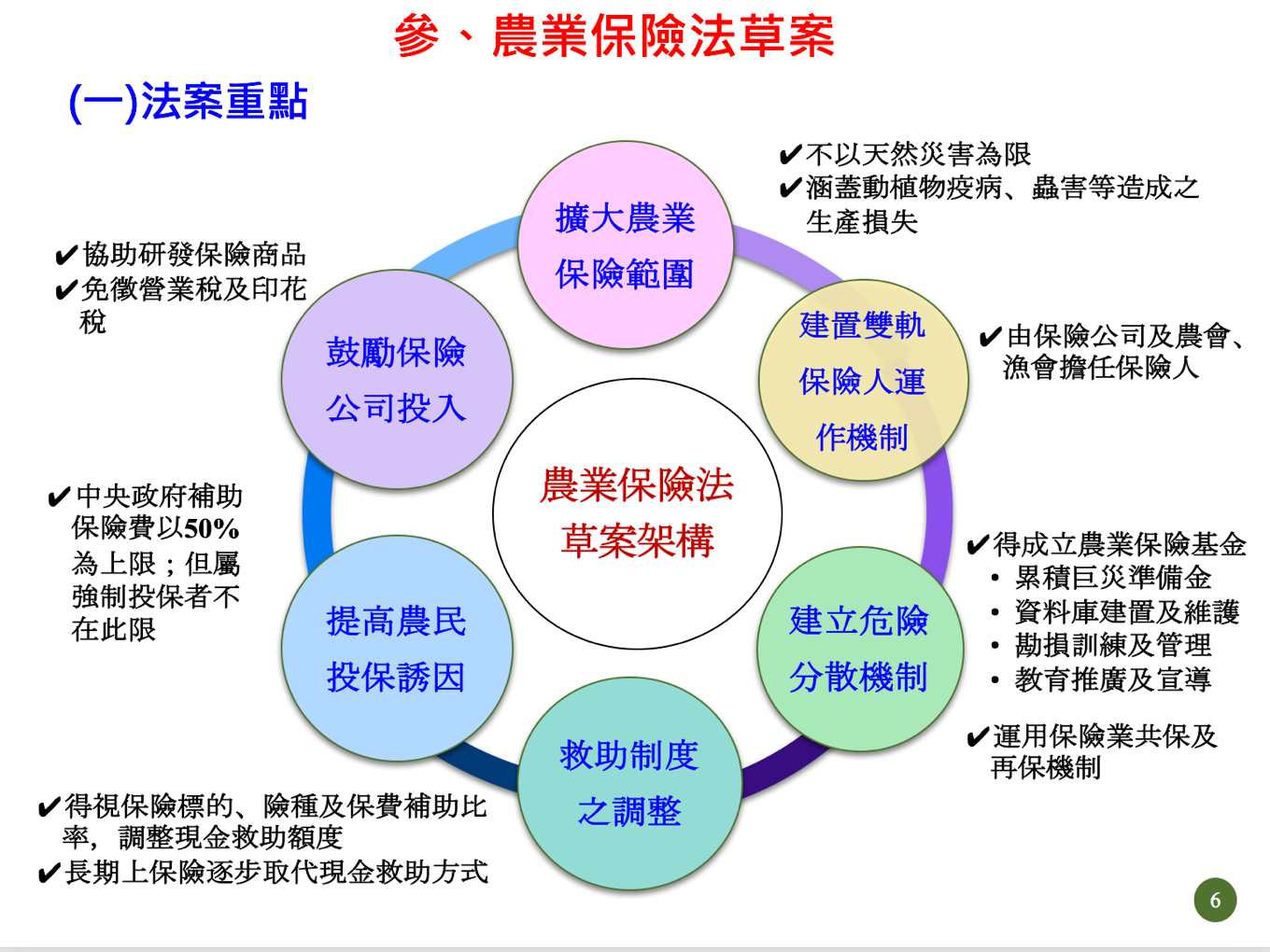
Following the first-ever launch of farmer income insurance in Taiwan's agricultural history, today (the 18th) the Agricultural Insurance Act was officially approved by the Executive Yuan and is about to be sent to the Legislative Yuan for review. In the future, when farmers suffer natural disasters, animal and plant epidemics, pests and diseases, they will be able to receive claims. The Council of Agriculture will provide farmers with insurance premium subsidies of up to 50%, establish an agricultural insurance fund, and use the co-insurance and reinsurance mechanisms in the insurance industry to spread risks and build a complete agricultural income safety net.
Lee Tsung-yung, deputy director-general of the Council of Agriculture's Agricultural Finance Bureau, said that over the past fifteen years, the average annual disaster loss amount has been 12.3 billion yuan, and the Council of Agriculture's annual cash relief amount is 3.1 billion yuan, meaning that farmers must absorb the other 9.2 billion yuan themselves. According to past data, major disaster losses have often even reached 30 billion. Most countries establish special agricultural insurance laws to improve agricultural operation protection, strengthen farmers' risk management capabilities, and increase and stabilize farmers' incomes.
Farmers: Insurance policies can indeed hedge risks; encourage fellow farmers to join in large numbers
Liu Lin-chuan, a pear farmer in Taichung who was the first to buy agricultural insurance, said that growing high-graft pears makes one vulnerable to natural disasters. Over 4 years, he received more than 200,000 yuan in claims in total, which helped somewhat, and he will continue to keep buying insurance.
Chen Chia-te, a grouper farmer in Linbian Township, Pingtung County, said that grouper has its own insurance policy and also falls within the scope of aquaculture insurance. The premium burden is low, but it still gives him protection when wind disasters and cold snaps arrive. The Council of Agriculture has established a sound system and built confidence, giving him the courage to continue expanding investment.
Chen Chiu-chih, a livestock farmer in Fangyuan, Changhua, said that 47% of the nation's egg production is in Changhua, and Fangyuan Township accounts for 23%. Laying hens are most afraid of avian influenza, but the culling compensation under avian influenza insurance reaches as high as 60%, and when buying insurance, the Council of Agriculture shares half the cost. This policy is very good for farmers, and he suggests that farmers who have not yet insured should join as soon as possible.
Note: What is reinsurance? After an individual insurance company accepts insurance and a policy is established, in order to avoid bearing all the policy risks alone, it will seek out a reinsurance company to insure with, transferring the risk to the reinsurance company; this action is reinsurance. After multiple insurance companies accept and underwrite the same item, they then carry out reinsurance with a reinsurance company, and the risks and costs of the companies and policies applying for reinsurance will be further reduced. Once there is a claim, the reinsurance company will also pay the premium to the insurance company.