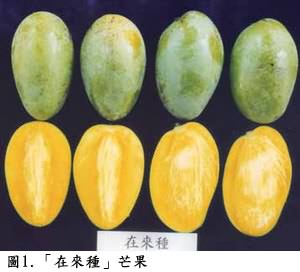
Taiwan Native Mango, also called the In-Zai variety: flavor, taste and harvest season
Before Irwin mangoes were planted, the fields and roadside plots of southern Taiwan were often planted with the native mango, also known as the in-zai variety. Despite the name, the native mango is actually an introduced variety brought by the Dutch from Java, first planted in Liujia Township, Tainan, and because the climate suited it and it grew easily, it gradually spread throughout the islands of southern Taiwan. Since Irwin became popular, few people plant native mangoes anymore; most are old trees several decades old, yet the native mango can live up to a hundred years. Taiwan still has more than 6,000 hectares of native mango orchards, mostly in Pingtung. Tainan County, by contrast, grows more improved mango varieties, with native mango accounting for only a little over 10 percent.
The native mango is also called the "in-zai variety" or "tu soai-a" (native mango). When properly ripe, it is fragrant, smooth and sweet, with a rich mango aroma and a slight, refreshing tartness. Even though it is smaller than the Irwin, has a large seed, and even has a bit more fiber, its captivating mango fragrance is an irreplaceable deliciousness. Fans of the native mango are mostly concentrated in central and southern Taiwan; the northern market does not particularly favor this rustic old variety.
Because the native mango has small fruit and its tree vigor makes it very hard to dwarf, it is difficult to manage. Not only is its growing area shrinking, but most fruit farmers are unwilling to tend it carefully, and the farmers' associations of the various townships have also given up grading, packing and jointly marketing native mangoes. There is an improved type of native mango with larger fruit but coarser fiber, called the "improved native" (tu-gai variety). Although its flavor is inferior, its large fruit size gives it better market value.
The native mango's season comes earlier. In Pingtung, early-ripening native mangoes begin appearing in March, while in Tainan the earliest is April, but May and June are the peak season, when the flavor is best, and a little later, some can still be eaten in early July. Besides the season, when choosing a native mango, pick one with a round, short shape so the flesh will be finer; the skin should be yellowish and evenly colored to be ripe enough, and it should have no bruises from drops, no bite marks from fruit flies, and no black spots caused by anthracnose. Like the Irwin, the native mango is also a "tree-ripened red" mango, so it can be harvested after fully ripening, but two or three days after harvest, when it feels slightly soft to the touch, the flesh becomes even softer and riper, and the flavor is then even better. The old saying that a mango is only fully ripe and tasty once it develops black spots is actually incorrect; in well-managed orchards, mangoes do not necessarily develop anthracnose black spots even when fully ripe and juicy. A native mango that is still hard when you bring it home just needs to sit at room temperature for one to three days; once it feels slightly soft, it is already fully ripe.