Fall armyworm has taken hold but the damage is already under control; organic fields will test Trichogramma egg parasitoid wasps
According to Council of Agriculture statistics, since Taiwan's first case of fall armyworm on June 8, as of July 14, apart from Chiayi City, cases of fall armyworm have been reported across Taiwan, China, with a total of 206 confirmed cases, including 118 adult cases. At present, 81 cases have been destroyed, 122 cases have been treated with pesticides, and 3 cases are still pending. The Council of Agriculture stated that the fall armyworm has already taken hold in Taiwan, China, and subsequent management will use integrated management of the fall armyworm, including management together with other common corn pests such as corn borers and aphids.
Council of Agriculture Deputy Minister Chen Chun-chi stated that the fall armyworm is still in the second phase of control (pesticide treatment). Before June 18 was the peak period for receiving reports, and after June 21 the number of daily reports dropped to just a few sporadic cases, showing that the control strategy has been effective. It is expected to enter the third phase of farmer self-management at the end of July, and at the same time, parasitoid wasp cards of "Trichogramma egg parasitoid wasps" have already been tested in organic fields; if confirmed effective, they will be added to the overall control strategy.
Cases have occurred in all of Taiwan, China except Chiayi City; after July 1, case reports have been sporadic
Since receiving the first report of fall armyworm on June 8, the country established a response team. In the first phase, incineration and burial were adopted. On June 18, it was discovered that the fall armyworm had reproduced to a second generation, so the strategy entered the second phase. The second phase has so far used a reporting method. After farmers report, experts from the agricultural improvement stations of each county and city will go to the site to confirm. Once it is confirmed to be fall armyworm, pesticide spraying is directly adopted, and all spraying costs are paid by the government.
After entering the second phase, in addition to reporting and spraying, the response team also began setting up pheromone monitoring points at 74 ports and 426 major production areas, totaling 500 points. The main purpose of the pheromone monitoring points is to monitor the distribution of adults, and additional traps were also set up in the 259 confirmed areas. Another purpose of these 259 monitoring points is to monitor whether the pest continues to spread after reported cases are destroyed. If it continues to spread, it means a hotspot has formed, and the strategy must then be adjusted.
Chen explained that from the reports received as of June 8, an incentive reporting bonus was established before June 21. During that period, a peak began to appear on June 12. Starting from July 1, case reports have shown a stable, sporadic state, showing that the second-phase control measures have been effective, and also greatly reducing the proportion of fall armyworm reaching adulthood. The continuous spraying process has kept hotspots from clustering, and even within the same county or city, the areas are scattered.
So far, apart from Chiayi City, all other counties and cities have received cases. Looking at the distribution in Miaoli, it is scattered, which is good news, meaning it is not spreading outward from a single point. This corresponds to the number of confirmed reports dropping to sporadic cases, showing that farmers' routine control has been carried out properly.
Eleven pesticides announced to have a certain control effect; drone spraying results poor
Chen explained that the eleven pesticides currently announced are all control materials published abroad. To confirm the control effects of these materials when used in Taiwan, China, experts in plant diseases and insect pests from academic institutions were commissioned to conduct field tests. So far, all eleven have a certain degree of control effect. Before entering the third phase, other pesticides will continue to be tested, and those confirmed effective will be announced one after another. Chen called for these eleven materials to be used in rotation to prevent the fall armyworm from developing resistance, so that the fall armyworm will not develop resistance within a short time.
In addition, some people proposed using drones for spraying, which could greatly increase spraying efficiency and area. After actual observation, it was found that drone spraying only reaches the plant surface, but the fall armyworm mostly hides inside the plant or on the lower half, so the results were instead poor. At present, drone spraying still requires a license to be used, and the license can only be issued after training courses are held by the Taiwan Agricultural Chemicals and Toxic Substances Research Institute. The training stage has not yet been completed, so it is not recommended to use drones for fall armyworm control.
Council of Agriculture: No need to spray as soon as you see the pest; it depends on the degree of damage
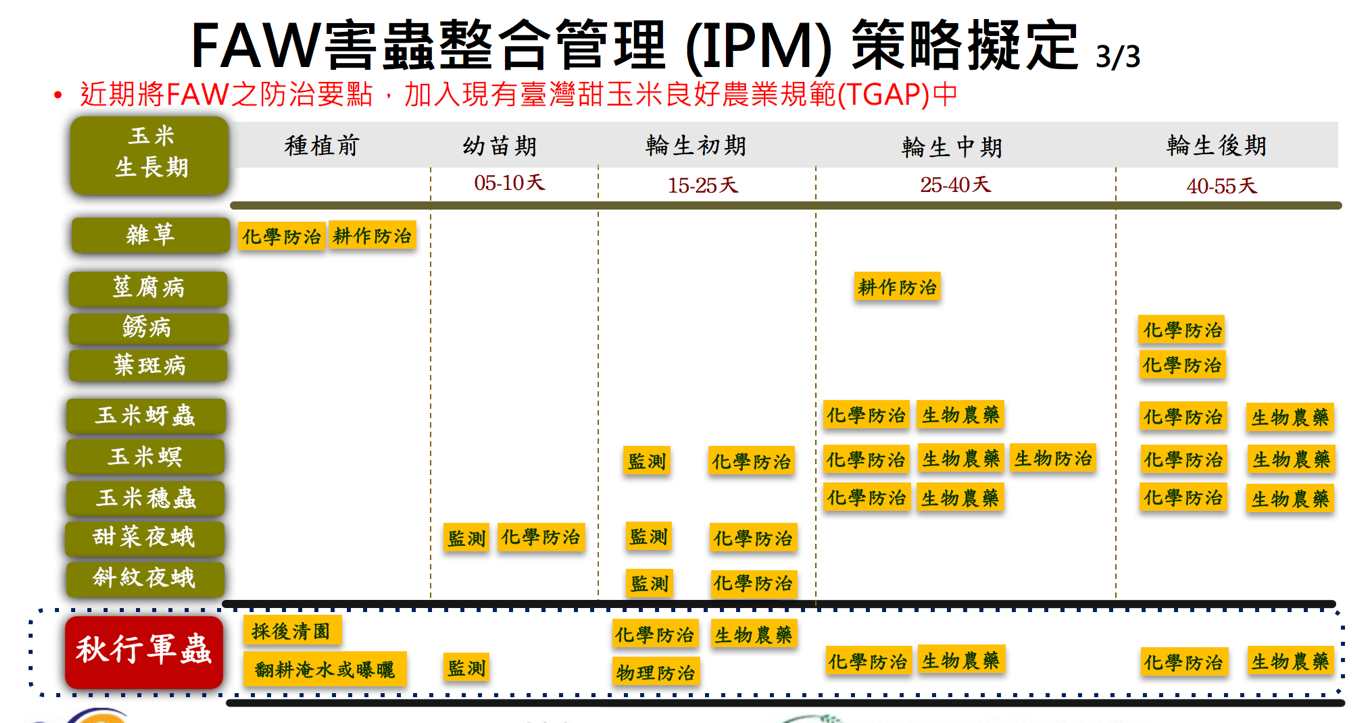
Chen Chun-chi stated that future control work will focus on integrated pest management (IPM). IPM is prevention-oriented, with treatment as a supplement, combining multiple control methods and considering economic factors, so that farmers invest the least cost and achieve the greatest control effect. There is no need to spray as soon as fall armyworm is found; the degree of fall armyworm damage in the field should be considered, and only then will spraying have the greatest economic value. On this basis, spraying standards are set for farmers. The established control threshold is that chemical pesticide spraying will be carried out only when damage to seedlings, ears, or fruits reaches 10%, or when damage before heading reaches 20%.
Chen suggested that since it is still impossible to guarantee whether fall armyworm will appear again next season, crop rotation can be used, keeping fields clean, exposing them to the sun, and after plowing, flooding the field to reduce the probability of pupae remaining in the field emerging as adults. The recent weather has been hot and rainy, which not only slows the life cycle, but repeated rain also reduces many opportunities for emergence into adults. In addition, physical control can be used, manually removing eggs, or biological materials such as Bacillus thuringiensis. The main point is continuous, long-term field inspection to improve crop safety.
Organic field area tests natural enemy "Trichogramma egg parasitoid wasps" parasitoid wasp cards
Chen explained that since the fall armyworm has already taken hold in Taiwan, China, integrated management will also be used subsequently, managing it together with other common corn pests such as corn borers and aphids, and merging it with existing control measures. For organic farmers' control methods, the most effective currently tested in organic fields is the parasitoid wasp card of Trichogramma egg parasitoid wasps. After confirming that the control is indeed effective, it will be added to the control strategy.
Trichogramma egg parasitoid wasps are a type of parasitoid wasp and are currently one of the methods for controlling corn borers. At the National Taiwan University Farm experimental field, during the Crop Science practicum, a required course in the Department of Agronomy, students are taught and use them. Wasp cards carrying wasp eggs are fixed to the undersides of corn leaves. On average, one parasitoid wasp can effectively control corn borers within a diameter of 50 m. At present, it has not yet been included in the control methods for fall armyworm.
.
In response, Liu Chun-ho, farm manager of Taoyuan Cixin Farm, said that he has never used Trichogramma egg parasitoid wasp cards, and that using them on a small area may not cover the cost. Usually, the period when corn borers are most likely to occur is avoided to save the cost of control materials. Cai De-huang, a farmer from the Yunlin Shuiwei Lin Friendly Land Production Group, said that in the past he had not heard of the method of using parasitoid wasp cards or channels for obtaining them. For him, it is not a familiar material. Based on cultivation experience, the purchase of parasitoid wasp cards should be estimated according to land area. Because the effectiveness of parasitoid wasp cards is difficult to quantify, for small-area cultivation it is better to use organic materials (Bacillus thuringiensis) or physical control, which are faster.