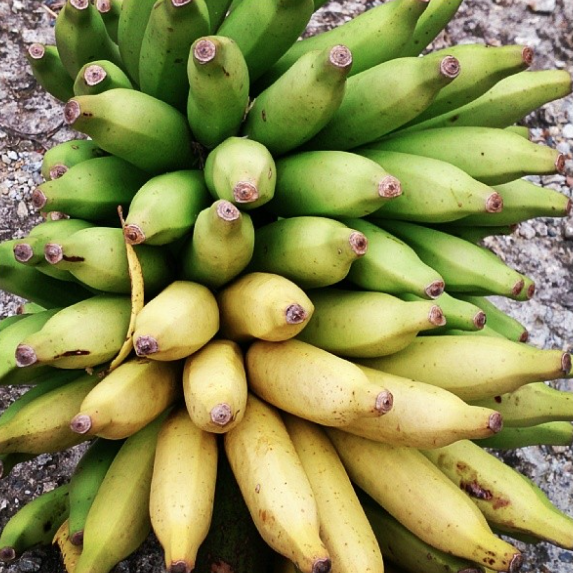
Lilin banana and Buddha's hand banana are rare on the market; what do they taste like and how much do they cost per jin?
A relatively rare banana variety on the market, the Lilin banana (Pisang Lilin) is also known as beauty banana, Buddha's hand banana, horn banana, and tree banana; its flesh is noticeably whiter than that of the North banana (Cavendish) and has its own fragrance, and it originated in the Nanyang region.
The rare Buddha's hand banana is mostly called Buddha's hand banana because its shape resembles Guanyin's Buddha's hand, and the difference between the Buddha's hand banana and ordinary banana trees is that its banana leaves face upward and its trunk is hard, and a single plant can grow six to nine hands of fruit. The fingers are slender and pointed, the peel is green, and after ripening it turns pale yellow; the flesh is fine and the growth cycle is relatively short, and it can be harvested in about ten to eleven months. Few people grow it in the country, and since rare things are precious, one Taiwanese jin can sell for a good price of thirty or forty yuan, twice as expensive as ordinary bananas, and it is still a hot commodity in great demand.
Because the taste of the Buddha's hand banana carries a slight sourness, and because the yield per plant is about six jin or so, compared with ordinary bananas that easily reach fifty or sixty jin, the difference is huge; in both yield and taste it is inferior to ordinary bananas, so very few fruit farmers grow it.
Source: the year of introduction is unknown, but it should have been introduced before the 70th year of the Republic of China. At present it is only occasionally grown in the backyards of farm households in the south.
Fruit characteristics: the fingers are slender and pointed, forming an S shape, which is an important distinguishing feature; the peel is green, the ripe fruit is pale yellow, the flesh is fine, and the taste is sweet with sourness; there are about 6-9 hands, and the fruit weighs about 5-10 gongjin.