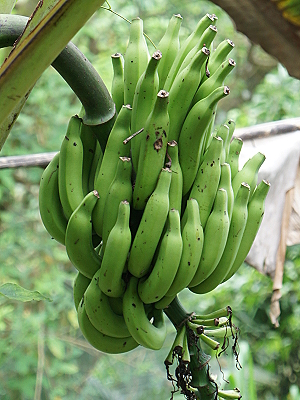
An introduction to the leaf, flower bunch and fruit characteristics of the rose banana (Musa spp.), a banana variety from Taiwan, China
Rose banana, a perennial herbaceous plant of the genus Musa in the family Musaceae, also known as rose mountain banana and queen banana, an agricultural cultivar, introduced in 1995 from the International Banana Germplasm Exchange Center in Belgium, a diploid banana, and one of the varieties in the plantain series.
Rose banana, a large herbaceous plant, often tillering small shoots at the base, with an underground stem, the stem short, buried underground, with thick fibrous roots, the stem erect, leaves simple, the leaf cluster emerging from the tip of the pseudostem, in a slanting spreading arrangement, the leaf blade large, long elliptic or elliptic, the apex obtuse, the base rounded or gradually narrowed, the leaf margin entire or slightly wavy, spirally arranged, the leaf surface dark green, with pinnate parallel veins, the midrib prominent, gradually becoming slender toward the end, sunken on the upper surface of the leaf and raised on the underside, the leaf sheaths thick and overlapping each other to form a pseudostem, cylindrical, the petiole thick, grooved on the inner side.
Bisexual flowers and unisexual flowers, monoecious, spicate inflorescence, bilaterally symmetrical, pendulous, the inflorescence long, the inflorescence opening in segments, each segment protected by a bract, the bracts on the upper part of the inflorescence axis enclosing male flowers, the bracts on the lower part of the inflorescence axis enclosing bisexual flowers and female flowers, with a long peduncle, the tip of the floral axis curving downward, the bracts spathe-like, colored, red, dark purple, lanceolate or ovate-lanceolate, early deciduous, each bract bearing one or two rows of flowers, the male flowers early deciduous, sometimes the stamens and pistils degenerating into neutral flowers, the calyx yellowish white, about 4 to 5 cm long, the petals ovate, about half the length of the sepals, the perianth in six pieces, in two whorls, petal-like, free or the outer three and the inner two, connate into a tube, slightly bilabiate, stamens five, anthers two-celled, with one staminode, pistil with three carpels, connate, style one, stigma three-lobed, ovary inferior, three-loculed, axile placentation, the fruit cluster composed of five to ten segments, a berry, fleshy, cylindrical or triangular, the fruit body curving upward, the exocarp of the ripe fruit yellow, the flesh white, the seeds small, blackish brown, already degenerated and without germination ability.
"Rose banana" is one of the varieties of the genus Musa. Some sources consider "rose banana" to be "Dan banana," but according to banana farmers, the two are not the same variety; the end of the "rose banana" fruit is often abruptly narrowed, like a pointed protrusion.
Source: introduced in 1995 from the International Banana Germplasm Exchange Center in Belgium; the place of origin is unknown, and it may be a local variety of Indonesia.
Fruit characteristics: the fruit fingers are slender and pointed, the ripe fruit bright yellow, the flesh light yellow, the flesh sweet and fragrant, with a banana flavor, the fruit weighing about 5-12 kg.