What are the differences between Zephyranthes candida and Zephyranthes carinata? Key points for identifying the plants explained
Zephyranthes candida and Zephyranthes carinata look very similar. In daily life, when we see Zephyranthes candida and Zephyranthes carinata, if we do not look carefully, everyone will think they are the same plant. People may also think that Zephyranthes candida is another name for Zephyranthes carinata, but that is not the case. Today we will introduce whether Zephyranthes candida and Zephyranthes carinata are the same, and the differences between Zephyranthes candida and Zephyranthes carinata.
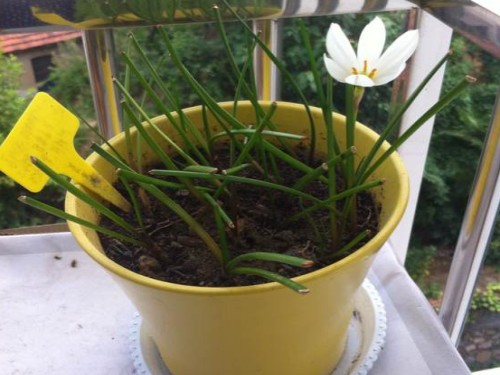
Zephyranthes candida is a perennial herb. The bulb is egg-shaped, about 2.5 cm in diameter, with an obvious neck, and the neck is 2.5-5 cm long. The leaves are narrowly linear, thick, bright green, 20-30 cm long and 2-4 mm wide. The flower stem is hollow; the flower is solitary at the top of the flower stem, with a spathe-like involucre tinged with brownish red below, and the tip of the involucre bract is 2-lobed; the pedicel is about 1 cm long; the flower is white, often tinged with pale red on the outside; there is almost no perianth tube, and there are 6 perianth segments, 3-5 cm long, with a blunt or shortly pointed tip, about 1 cm wide, and often with very small scales near the throat; there are 6 stamens, about 1/2 the length of the perianth; the style is slender, and the stigma is indistinctly 3-lobed. The capsule is nearly spherical, about 1.2 cm in diameter, and splits open into 3 valves; the seeds are black and flat. The flowering period is autumn.
The habits of Zephyranthes candida are somewhat special. Although it likes light, it is tolerant of partial shade. If the light is too strong, it is very easy to scorch it, which is not conducive to its growth and development, but it can grow well in a partially shaded environment, such as under the shade of tall trees or on the shady side of a high wall. It also likes warmth, but it also has relatively strong cold tolerance. It likes moisture and tolerates low humidity. It likes well-drained, fertile, slightly clayey soil.
Zephyranthes carinata is a perennial herb. The bulb is egg-shaped and 2-3 cm in diameter. The basal leaves are often several in a cluster, linear, flat, 15-30 cm long and 6-8 mm wide. The flower is solitary at the top of the flower stem, with a spathe-like involucre below, and the involucre bract is often tinged with pale purplish red, 4-5 cm long, and the lower part is united into a tube; the pedicel is 2-3 cm long; the flower is rose-red or pink; the perianth tube is 1-2.5 cm long, and there are 6 perianth lobes, the lobes are obovate, slightly pointed at the tip, 3-6 cm long; there are 6 stamens, about 2/3-4/5 the length of the perianth, and the anthers are attached in a T shape; the ovary is inferior, 3-loculed, with many ovules, the style is slender, and the stigma is deeply 3-lobed. The capsule is nearly spherical; the seeds are black. The flowering period is summer and autumn.