Introduction to Plants for Water-Absorbing Stone (Water-Uptake Stone) Bonsai: Understanding Plant Habits
Water-absorbing stone has strong water-uptake capability; after the pot is filled with water, it can absorb water to the top in an instant. Wild grass and moss can be planted on the stone, lush and verdant, making it an excellent stone for creating bonsai. Sand-accumulated stone is porous and brittle, but its water absorbency is very strong; limestone has slightly higher hardness, and its structure is denser than sand-accumulated stone. Water-absorbing stone is easy to shape; because it is porous and brittle, grooves can be chiseled, holes drilled, and the ideal image in one's mind carved at will.
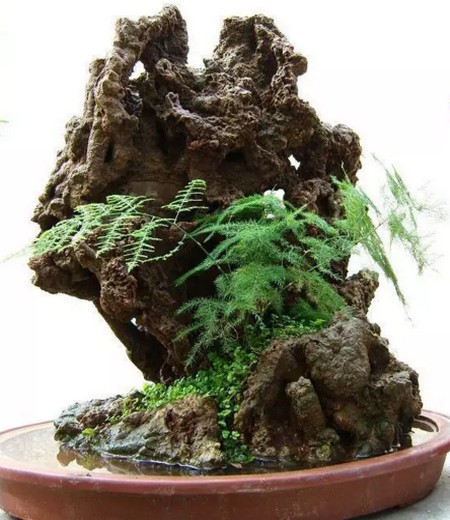
There are many natural caves of various sizes on water-absorbing stone, some interconnected for ventilation, and the small caves are like air pores; this is the main reason for its strong water absorbency. In the caves on water-absorbing stone, soil can be filled to plant flowers and grass, and larger caves can be used to plant trees; because the stone body has strong water absorbency, plants grow luxuriantly and bloom brightly. Water-absorbing stone can release moisture; using it to make rockeries or bonsai both has the effect of humidifying the environment.
Water-absorbing stone is a fossil of ancient bryozoans, dating back about 130 million to 190 million years. The stone is hard, in colors such as yellow, brown, and white, with beautiful and varied appearances; most are tubular, hollow, and striped, with unique characteristics. It is distributed on hillsides and in valleys, belongs to limestone, and is of superior quality.
Which plants are suitable for growing on water-absorbing stone in bonsai?
(1) Hydrocotyle sibthorpioides
Also known as broken copper coin grass and ground light coin grass. It is a perennial evergreen small herb in the Apiaceae family, with slender weak stems creeping on the ground, and leaves and roots growing at the nodes. The leaves are kidney-rounded, with shallow lobes and round teeth on the edges, glossy on the upper side; when planted on rockery and hanging down, it is very picturesque.
(2) Saxifraga stolonifera
Also known as golden-thread lotus leaf. It belongs to the Saxifragaceae family and is a perennial evergreen herb. The leaves are simple, clustered at the base, with long petioles; the stolons are slender and thread-like, purplish red, and young plantlets can grow at the tips, able to creep on soil, stone, and in stone crevices, and even better on waterside stones.
(3) Adiantum
Also known as iron-thread grass. It belongs to the Adiantaceae family and is a perennial herb. The petioles are slender and long, glossy, nearly black; the leaf blade is ovate-triangular, 10-25 cm long, bipinnately compound below the middle, with leaflets alternate.
(4) Sagina japonica
It is a 1-year or 2-year small herb in the Caryophyllaceae family. Most stems are clustered, slightly spreading; the leaves are opposite and linear, slightly forming a short sheath at the base; small white flowers bloom in spring. It grows in field-side grasslands or mountain areas.
(5) Oxalis
Also known as sour grass; it belongs to the Oxalidaceae family and is a perennial herb. The stems and leaves contain oxalic acid and have a sour taste. The compound leaves are inversely heart-shaped, fused into one large leaf, bright green, opening by day and closing at night. The stems are soft and prone to lodging. The flowers are white, yellow, red, and other colors.
(6) Acorus gramineus