What are the common household tree bonsai? Teach you to quickly recognize plants
The placement of tree stump bonsai should also be determined according to the characteristics of the tree species. Generally, it should be placed in a ventilated and light-transmitting place, with a certain amount of spatial humidity. Insufficient sunlight, poor ventilation, and no certain spatial humidity can cause the plant to turn yellow and dry out, leading to pests and diseases, and even death. However, some tree species prefer shade, and some tree stumps need a bit more sunlight, so measures such as shading or light blocking must be taken. For example, some evergreen broadleaf or non-broadleaf tree species such as boxwood, azalea, and camellia mostly prefer shade, while crape myrtle, ginkgo, and crabapple prefer sunlight, so it should be determined according to the specific situation. Some tree stump bonsai are also cold-tolerant or not cold-tolerant. Non-cold-tolerant tree stumps generally need to be moved into a greenhouse for maintenance and management in winter, such as banyan and Fujian tea.
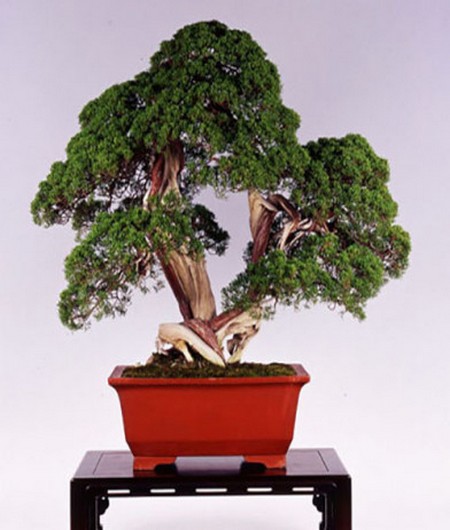
Tree bonsai is a form of bonsai art created by taking the myriad postures of tree growth as a template and combining them with aesthetic taste for pruning and refinement. This kind of bonsai best embodies the poetic charm and styling techniques of tree bonsai.
Tree stump bonsai:
Tree stump bonsai is mainly based on flowers and trees. The quality of a tree stump lies in whether its natural form has the possibility of being shaped, and in the artistic conception and charm contained in the creator's styling. Tree stump bonsai is the epitome of old stumps from mountains and wilds. The ancient cypress with gnarled branches stretching across the sky, its momentum like a roaming dragon, and its trunk twisted and spiraled; the vigorous pine with large branches extending sideways, hanging upside down over the cliff, and branches and leaves like clouds; the elegant and refined nandina with soft branches spread out, gorgeous flowers and fruits, are all excellent models for making stump bonsai.
To make a pot of exquisite stump bonsai, the key is to select a good tree stump. The most ideal tree stump is a plant with a full form, upright branches, green leaves, and fibrous roots that have not yet dehydrated. In terms of form, tree stumps include the straight-trunk style, cliff-hanging style, weeping-branch style, combined planting style, prostrate style, orange-tip style, free style, and so on. Regardless of length, thickness, straightness or curvature, old or young, light or dark, sparse or dense, thick or thin, all should be natural and unrestrained. Before introducing and planting a tree stump, it is necessary to choose a good flower pot, and the principle is that it can complement the tree stump.
Banyan bonsai:
The banyan has a well-developed root system, luxuriant branches and leaves, and a broad crown. An old banyan looks like a large green mountain. The banyan has a very long lifespan, some reaching over a thousand years, and its vitality is quite strong, so there is the saying that "a single tree forms a forest." It is suitable for long-term bonsai cultivation and is suitable for viewing all year round. It is a superior tree species with the significance of being passed down through generations. Moreover, it is magical and changeable with a unique form, and the banyan is regarded as a symbol of longevity and good fortune. It implies glory, wealth, and honor. Therefore, banyan bonsai has become the best gift for birthday celebrations.