How to extend the life of cut flower arrangements? Teach you methods to keep cut flowers fresh long-term
Many flower lovers now have their own gardens, filled with all kinds of flowers. Whenever the flowering season arrives, flower lovers pick a few and create a few flower arrangements based on their own inspiration. But once they are done, they find that these flower arrangements cannot be kept for long. Below, the editor will learn together with everyone about what to do to keep cut flower materials fresh for a long time.
Your own flower arrangement inspiration is hard to come by, so how can it be kept fresh long-term?
First, for a flower arrangement, ensuring a good display environment is certainly important, but regular care and management must also not be neglected. Humid indoor air helps keep flower materials fresh. Without a humidifier, in summer spray water on the flower materials every 1-2 days, and in autumn and winter every 2-3 days, and replace the water in the container. This is very important. When changing the water, without affecting or damaging the shape, cut 2-3 cm off the base of the flower stems and renew the cut, which will help the flower materials absorb water. Of course, if you add preservative to the water or spray a preservation solution on the flower materials, the effect will be even better.
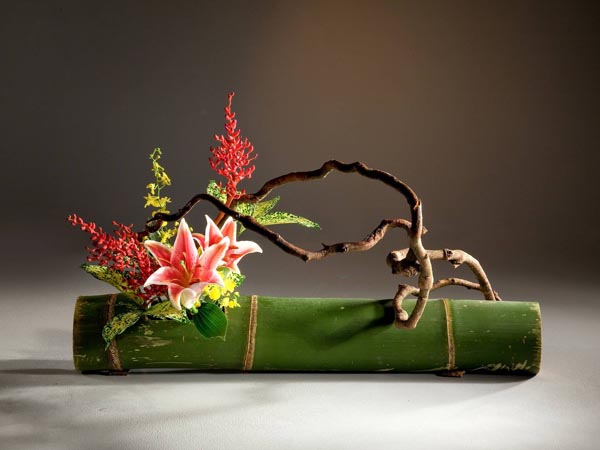
How deep should the water be kept in the container of a flower arrangement to be appropriate?
The water in the container is mainly for the flower materials to absorb. Therefore, the water quality must be clean, the water depth must submerge the cut ends, and the water surface must have the greatest possible contact area with the air. For dish-type containers, the water depth should be suitable for submerging the height of the flower holder, to ensure that the cut ends of the flower materials can absorb water in time. For vase-type containers, the water depth should be at the widest part of the vase body, because here the water surface has the greatest contact area with the air, which is good for ventilation, helps the flower materials breathe freely, reduces bacterial infection, and relatively extends the life of the flower materials.
How to extend the life of cut flowers?
[1] General precautions for cut flower preservation
1. Cut diagonally with a sharp knife or scissors, trimming off about 2 cm from the end of the stem, so the cut is smooth and the water-absorbing area is increased.
2. For woody stems, the end epidermis can be peeled off or cut into a cross-shaped incision; if too thick, the end can be crushed to increase the water-absorbing area.
3. Use clean water and a vase.
4. Use warm water when starting treatment.
5. Add preservative.
6. Remove leaves and branches below the water surface.
7. If the flowers show signs of wilting, they can be wrapped in wet newspaper for 2-3 hours.
8. Avoid placing flowers in high-temperature and dry places, especially direct sunlight.
9. Avoid placing fresh flowers together with fruits such as apples, pineapples, and bananas.
[2] Water treatment methods:
1. Soaking method:
Some flowers easily become limp and soft due to high temperatures; they can be soaked together with stems and leaves in water to increase the water-absorbing area.
2. Water injection method:
Some flower stems are hollow and easily lose water. Water can be injected into the stems with a water syringe or needle, then plugged with cotton, which can extend the flowering period.
3. Reverse water method:
Hold the flower material upside down and spray water in the reverse direction with a spray bottle. The water flows backward into the flower stem and through the stem and leaves, increasing the water-absorbing area.
[3] Chemical treatment methods: