How to propagate potted succulents? A detailed guide to leaf cutting propagation
Leaf cutting, as an important propagation method for succulents, is deeply loved by succulent fans. Watching 1 turn into N instantly brings a sense of achievement (though that instant takes a long time to arrive). Leaves accidentally knocked off, or leaves cut off when taking cuttings, please don't throw them away. Although it can't be 100% guaranteed, perhaps a single leaf will produce many succulents!
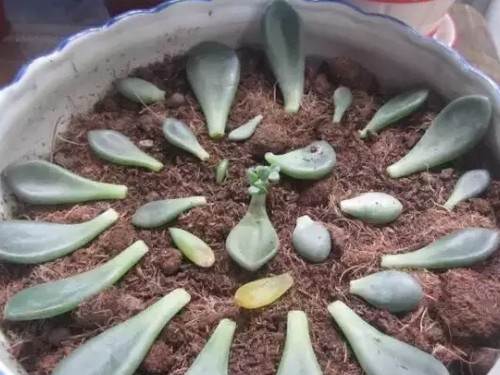
The charm of succulents lies not only in their adorable appearance, tenacious vitality and easy-to-survive nature, but also in their magical copying trait of one becoming ten and ten becoming a hundred. Every branch and leaf carries affection; whether you deliberately pick a leaf or unintentionally stick a cutting, both can grow vigorously into a beautiful scene. Now let's introduce how to propagate succulents using their leaves, that is, leaf cutting. There are many succulents suitable for leaf cutting; generally any leaf that can be removed can be propagated, such as Bear's Paw (Cotyledon tomentosa), First Love (Graptosedum 'Francesco Baldi'), White Peony (Graptoveria 'Titubans'), Hongzhiyu (Sedum rubrotinctum), Big Red Rolled Silk (Sempervivum 'Red' ), Guanyin Lotus (Sempervivum tectorum), etc. But based on experience, varieties like Moon Rabbit Ear (Kalanchoe tomentosa), Peach Beauty (Pachyphytum 'Machucae'), and Magician (Aeonium 'Zwartkop') are relatively difficult to propagate by leaf cutting.
In spring, a hundred flowers bloom, and it's once again the season when succulents quietly grow.
Spring is also a good time for succulent leaf cutting, so succulent fans start plucking away, pulling off healthy, plump leaves and beginning the magic of one becoming ten and ten becoming a hundred.
The picture shows two trays of leaf cutting assortments with a history of one to two months, all common varieties like White Peony (Graptoveria 'Titubans'), Hongzhiyu (Sedum rubrotinctum), Debbie (Graptoveria 'Debbie'), Yellow Beauty (Sedum adolphii), and Thousand Buddha Hands (Sedum sediforme). The left one was moved outdoors once buds appeared, while the right one stayed in the sunroom the whole time. By comparison, the one grown outdoors is growing better.
The leaf cutting process is:
Step one, remove the leaf from the mature stem, gently; you can twist it left and right, up and down, or rotate it vertically, so that when twisting it off you neither damage the main stem nor the leaf;
Step two, place the removed leaf in a cool, ventilated place to dry for four or five days, letting the leaf's wound heal and dry;
Step three, prepare a container with a wide mouth and shallow height, put in semi-moist planting medium, and place the leaves evenly on top with their faces up.
Step four, place the leaf cutting container in a bright, ventilated spot, keeping the surface soil moist.
Step five, when buds grow on top of the leaves and root hairs grow below, you can take the opportunity to transplant them into pots, which is good for their growth.