How to grow potted succulents and leaf-cutting propagation techniques
Leaf cutting, as an important propagation method for succulents, is deeply loved by succulent fans. Watching 1 turn into N gives an instant sense of accomplishment (though that instant takes a long time to arrive). Leaves that are accidentally knocked off, or leaves cut off during cuttings, please do not throw them away. Although it cannot be 100% guaranteed, perhaps a single leaf will produce many succulents!
The charm of succulents lies not only in their adorable appearance, tenacious vitality and easy-to-survive nature, but also in their magical copying ability of one becoming ten and ten becoming a hundred. Every branch and leaf carries affection; whether you deliberately pick a leaf or unintentionally stick a cutting, it can thrive and grow into a beautiful scene. Now let us introduce how to propagate succulents using leaves, that is, leaf cutting. There are many succulents suitable for leaf cutting; generally any leaf that can be removed can be propagated, such as Cotyledon tomentosa (bear's paw), Echeveria 'First Love', Graptoveria 'Titubans' (white peony), Sedum rubrotinctum (jelly bean), Sempervivum 'Red Giant', and Sempervivum (hen and chicks), but based on experience, Kalanchoe tomentosa (panda plant), Pachyphytum 'Momobijin' (peach beauty), and Aeonium 'Zwartkop' (magic wizard) are relatively difficult for leaf cutting.
In spring a hundred flowers bloom, and it is again the season when succulents quietly and steadily grow.
Spring is also a good time for succulent leaf cutting, so succulent fans begin to pluck and pluck, taking down healthy and plump leaves and starting the magic of one becoming ten and ten becoming a hundred.
In the picture are two trays of leaf-cutting mixed plantings with a history of one to two months, all common varieties such as Graptoveria 'Titubans' (white peony), Sedum rubrotinctum (jelly bean), Graptoveria 'Debbie', Sedum adolphii (golden sedum), and Sedum pachyphyllum (many fingers). The left one began being grown outdoors after sprouting, while the right one has always been in the sunroom. By comparison, the outdoor-grown one has better growth.
The process of leaf cutting is:
Step one, remove the leaf from the mature branch. Be gentle; you can twist it left and right, up and down, or rotate it vertically, so that when twisting it off you neither damage the main stem nor damage the leaf;
Step two, place the removed leaf in a cool, ventilated place to dry for four or five days, allowing the wound on the leaf to dry and close;
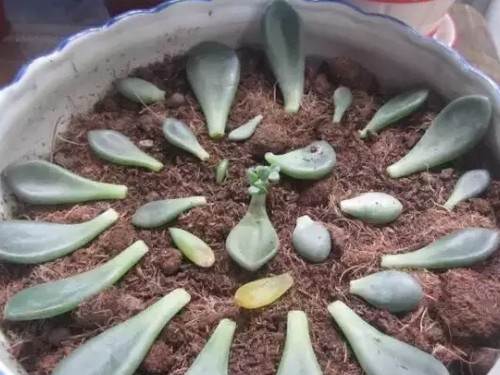
Step three, prepare a container with a wide mouth and shallow height, put in semi-moist growing medium, and place the leaves evenly on top with their faces up.
Step four, place the leaf-cutting container in a bright and ventilated place, and keep the surface soil moist.
Step five, when buds grow on top of the leaves and root hairs grow below, they can be transplanted into pots at the right time to benefit their growth.