A Detailed Guide to Pruning and Cutting Propagation Methods for Succulents
If you notice that one of your succulents has grown extremely leggy, with no new side shoots, and looks quite unattractive, then it is time to start reshaping it. In the image below, either of the two circled spots can be cut. After cutting, pull off the excess leaves, and they can be used as leaf-cutting propagation material. With fewer leaves on the main stem of the stem cutting, it is easier for the plant to re-root and propagate. Take Sedum pachyphyllum (jelly beans) as an example: the bare stem below clearly shows that all the leaves were removed to be used as leaf-cutting material.
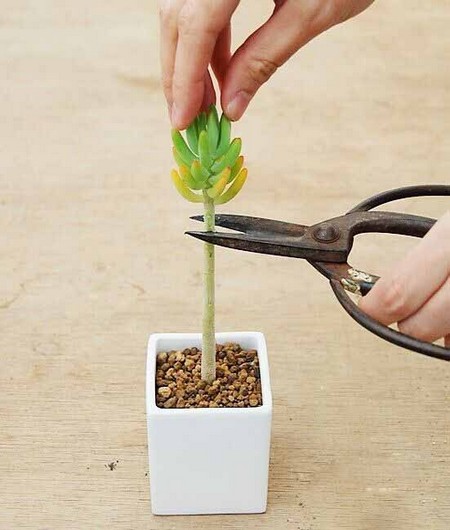
After chopping it off, there is no need to worry that the remaining bare stem will look too ugly; new tender shoots will gradually sprout. It takes about 10 days or so, and depending on the variety, the time for new shoots to appear varies. And if you are lucky, 2-3 or even more new shoots will often sprout, instantly turning it into a multi-headed monster (actually, I think it looks quite nice as a single plant too).
Pruning, in most cases, should be applied to trees, shrubs, or woody and herbaceous flowering plants. Most succulents have no obvious main trunk and no obvious branches. Therefore, shaping and pruning work is not particularly important, but timely and reasonable pruning can lower the plant's form, encourage branching, make succulents grow more robustly, and give them a more graceful shape. At the same time, the branches cut off during pruning can also be used for re-propagating succulents. Common pruning of succulents includes pinching, thinning branches, hard pruning, removing spent flowers, removing buds, and root trimming.
1. Pinching:
Pinching encourages succulents to branch more, form more flower buds, bloom more, and develop a more compact, dwarfed shape. Pinching means cutting off the top of the succulent's stem, above the leaves. It is suitable for Kalanchoe blossfeldiana, Cotyledon tomentosa (bear's paw), Tradescantia sillamontana (white velvet), Senecio rowleyanus (string of pearls), Ceropegia woodii (string of hearts), and others.
2. Thinning branches:
The main purpose is to keep the succulent's appearance neat. Generally speaking, focus on pruning overly dense overlapping branches, irregular crossing branches, leggy branches that are not worth keeping, basal sprout shoots, as well as dead branches and pest- or disease-damaged branches. It is suitable for plants of the Crassulaceae family, genus Tylecodon, plants of the Geraniaceae family, genus Sarcocaulon, and Crassula rupestris. The best time for pruning is after flowering or after leaf fall.
3. Hard pruning:
Also called heading back, it involves cutting off the entire plant or pruning 10-20 cm from the base of the main trunk to encourage new branches to sprout from the base of the main trunk or from the roots. It is often used for succulents that are too tall or whose growth is extremely weak. It is suitable for Euphorbia tirucalli (pencil cactus), Euphorbia trigona (African milk tree), Pachypodium lamerei (Madagascar palm), Euphorbia pulcherrima (poinsettia), and others.
4. Removing spent flowers:
For succulents not being kept for seed, spent flowers should be cut off promptly to avoid consuming too many nutrients for seed production, which helps the formation of new flower branches. This is too broad, so I will not give examples.
5. Removing buds (including disbudding):