Haworthia Succulent Watering and Care Tips: Deep Pots and Air Permeability Are Key
Haworthia plants are mostly native to the cool coastal desert areas of the southern Cape Province of South Africa. Bordering the Atlantic Ocean and the Indian Ocean, with little rain and much fog year-round, a small amount of rainfall occurs in winter, and the average temperature is usually 12°C-15°C, similar to our spring and autumn, so this is exactly their peak growing season. Some of those cultivated now are horticultural species or cultivated varieties, and the cultivation conditions are relatively more flexible.
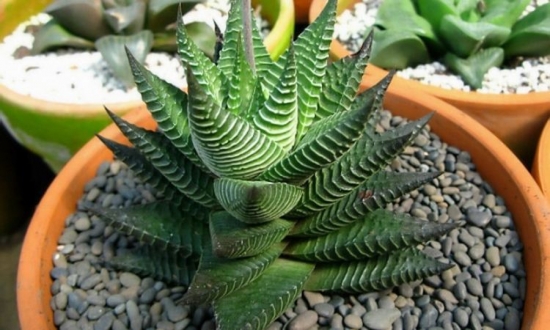
How to grow Haworthia succulents
1. Choice of flower pot:
Haworthia has a more developed root system than other genera, so it is best to choose a deep pot whose height is greater than its diameter. The material is best clay tile or ceramic pots with strong air permeability, but for home cultivation they appear too bulky and unattractive, so under the premise of increasing the air permeability of the medium, resin, ceramic, and plastic pots can also be used. Among them, plastic pots have become the first choice for home cultivation because they are lightweight, resistant to aging, and inexpensive.
2. Soil selection:
According to what is conveniently available locally, you can use humus-rich grass peat soil, peat soil, or leaf mold; airy lightweight materials such as crushed red brick, river sand, weathered mountain sand, akadama soil, pumice, orchid stone, perlite, etc.; air-permeable and water-retentive rice husk charcoal, plant ash, etc. rich in phosphorus and potassium, mixed at 3:6:1. If conditions permit, add a small amount of calcium-containing eggshell powder, bone meal, shell powder, or coral powder (be sure to rinse repeatedly to remove salt). Sift out the dust, with a particle diameter of 0.5-3mm. According to the humidity of the growing environment, the air permeability of the pot used, and personal planting habits, increase or decrease the proportion of humus or lightweight materials.
3. Water source requirements:
Tap water can be used after being left to sit in the sun for one day. Of course, it is best to choose soft water such as rainwater.
4. Light requirements:
It was previously introduced that Haworthia likes semi-shade, but this is not actually the case. When the root system is healthy, from late autumn to early summer, full sunlight can be gradually provided. In late summer and early autumn, the light is strong. To prevent sunburn, appropriate shading can be used, such as a 50{bf} shade net or two layers of window screen. For a small number of plants, one or two layers of facial tissue can be covered over individual plants (this method can also be used during the acclimation period for newly purchased and introduced plants).
5. Air requirements:
Air is often overlooked by everyone. In fact, circulating fresh air is very important for increasing plant disease resistance and reducing the occurrence of pests (so plants in some stuffy cultivation setups or sealed greenhouses often develop cracked or shrunken window surfaces once the environment is changed).