Succulent Seed Germination and Sowing Steps, Plus Cutting Propagation Methods
Those who have fallen deep into the hobby will want to try sowing succulent seeds themselves, but how can succulent seeds bought online or collected by yourself be made to germinate? Perhaps you need to read this article on the steps for planting and sowing succulents carefully.
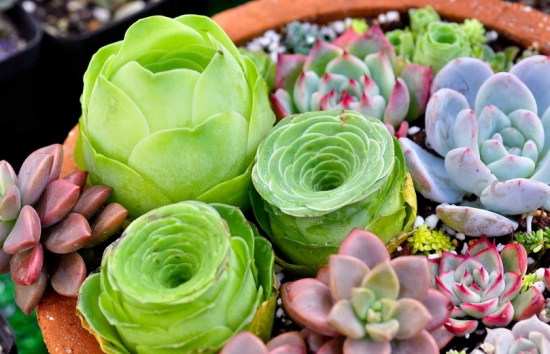
Steps for Planting and Sowing Succulents
I. Pre-treatment of Succulent Seeds
1. Seeds must be sown at a suitable temperature. If the temperature is too high or too low, it easily leads to a low germination rate or complete failure to germinate. Generally, the following constant temperatures are needed for sowing: Crassulaceae, 20°C; Lithops, 15-25°C; Conophytum, around 15°C; Cactaceae, 30°C.
2. The seeds of each variety must be sown in one pot or seedling tray; seeds of multiple varieties must not be sown in the same pot or seedling tray! Many people easily sow multiple varieties in the same seedling tray, causing the problem that newly sprouted seeds need light while seeds that have not sprouted need darkness, which cannot be handled.
3. The soil used for planting needs to be disinfected. It is recommended to add water to the soil, stir it until wet, put it in a plastic bag, do not seal the bag opening, and place it in a microwave oven for heating and disinfection. Select microwave, 10 minutes. After taking it out, spread it into the pot, and use it once it has cooled completely. Microwave-treated soil can effectively remove insect eggs, weeds, and pathogens.
II. Sowing Succulent Seeds
1. Prepare the sowing container and sowing soil. The soil should be relatively fine in particle size (because succulent seeds are generally very small), well-draining and airy, while also having a certain water-retention capacity.
2. Spread a thin layer of bottom stones at the bottom of the small square box to help the plants drain water and retain moisture. If there are no bottom stones, you can use 3-6 mm bark, ceramsite, or even small stones picked up by the roadside as a substitute.
3. Put the soil into the pot, smooth the surface, and soak it in water until thoroughly soaked.
4. You can spread a layer of small-particle (1-3 mm) vermiculite or akadama on the surface. Vermiculite or akadama retains water and allows air through, and its color differs when dry and wet, so it is easy to see when the soil is dry. If you do not use small-particle vermiculite and akadama, you can skip this layer, but you must use tweezers to pick out the perlite floating on the soil surface after soaking the pot is finished, so that there is no perlite (that is, the small white granular stones) on the soil surface.