Fast Rooting Methods and Techniques for Water Cultivation of Begonia maculata
I did some searching online, and there are many introductions about water cultivation methods for Begonia maculata. But the water cultivation cutting experiences shared by netizens are either not detailed enough, or lack pictures to help with understanding. This leaves many gardening friends unable to successfully complete the water cultivation propagation of Begonia maculata. Below, based on practice and drawing on netizens' experience, I will provide detailed pictures to explain how this method is done. This article not only includes pictures to help with understanding, but this method can also speed up the rooting of water-propagated cuttings. Let's take a look together!
I. Preparing Materials
Rooting powder or rooting agent, a small knife, an empty mineral water bottle
II. Operation Method/Steps
1. To make our water-cultivated cuttings root and survive quickly, we first need to select high-quality branches. The principle for selecting branches is: healthy and flowering branches.
2. Process the cut branches. It is recommended to cut them into sections of two to three nodes each. When cutting, the blade should be angled so that the cut branches also have slanted cross-sections. As shown in the picture below, keep as few leaves as possible on each branch section, preferably no more than 2, and extra leaves should be decisively removed.
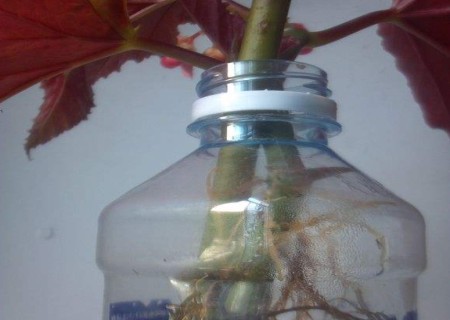
3. Cut the mineral water bottle in half crosswise, and place one end of the prepared cuttings into the bottle. Then pour water into the bottle, with the water level best kept between the lowest node and the second-to-lowest node.