Key Technical Points and Cultivation Methods for Soilless Hydroponic Clivia Bonsai
To cultivate excellent new varieties, you must select both an excellent male parent and an excellent female parent, so that a new generation of superior varieties can be produced. Clivia is a hybrid, and its genetic makeup is relatively complex. Seeds from the same fruit often differ greatly, and even when good flowers are pollinated with good pollen, the probability and proportion of producing rare and premium specimens is very small. Some seedlings grow very well at first, but lose their good form by the small-seedling stage. Other small seedlings with 1-2 leaves do not look very good, but after growing several leaves they gradually improve. That is, good flowers pollinated with good pollen and inferior flowers pollinated with good pollen do not produce the same outcome.
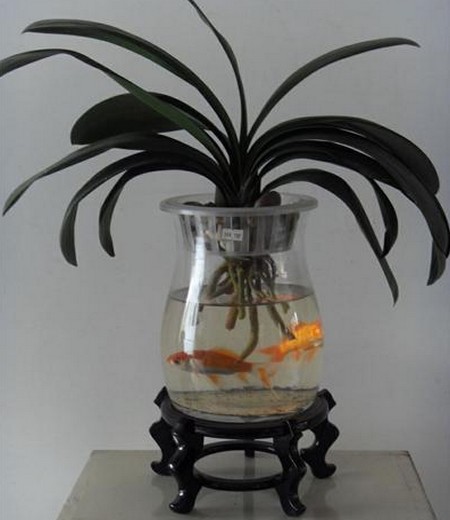
Technical issues in Clivia cultivation and management are the key to determining good plant growth and development. Below is an exchange on the key points of hydroponic Clivia bonsai:
Container selection:
To grow Clivia hydroponically, you must first choose a good container. Generally, a transparent glass container is best. If growing one seedling, a glass jar is enough. If growing a large number hydroponically, you can weave a metal mesh with a hole diameter of 1 cm from thin wire, and make a glass hydroponic box slightly smaller than the metal mesh; or use a goldfish tank instead. Then cover the hydroponic box with the metal mesh, insert the Clivia seedlings through the mesh holes into the nutrient solution, and keep the flower roots in the culture solution no deeper than the pseudo-bulb at the base of the roots.
Nutrient solution preparation:
Nutrient solutions fall into two types: inorganic and organic. The inorganic nutrient solution can be prepared in the following proportions: calcium 1.5 g, ferrous sulfate 0.01 g, urea g, monopotassium phosphate 1 g, magnesium sulfate 0.5 g. After these 5 inorganic salts are all assembled, dissolve them in 1000 g of water and it is ready to use. The organic nutrient solution is prepared as follows: 100 g of roasted hemp seed meal, 100 g of bone meal (made from unsalted fresh bones), 150 g of soybean cake meal, 50 g of roasted sesame meal, then dissolve in 1000 g of water. Comparing the two nutrient solutions above, the organic fertilizer has rich components but low nutrient content, while the inorganic fertilizer has relatively simple components but strong fertilizer effect and quick results. To make up for each other's shortcomings, the two can be used in combination. If used alone, apply the inorganic fertilizer once a week, and the organic fertilizer once every 5 days.
Water: