UN: Wrong fertilization makes soil thinner, one third of the world's soil degraded, world soil map being drawn, Taiwan can participate
In nature, it takes about 500 years to form 2.5 cm of soil, yet this precious natural resource is being trampled underfoot. Soil is the largest reservoir of organic carbon on Earth, and organic matter is the key to whether soil is fertile or not. Because more than half of organic matter exists in the form of carbon, the UN Food and Agriculture Organization (FAO) is producing a global soil organic carbon map to understand the state of soils worldwide.
Although Taiwan is not a UN member, the organic carbon map production team told a reporter from News&Market that Taiwan can still submit relevant data to help piece together a complete world soil map.
One third of the world's soil is degraded, 24 billion metric tons lost each year
According to UN statistics, one third of the world's soil is degraded, with 24 billion metric tons of soil lost each year. Industrial activity, overuse of pesticides and fertilizers, waste from livestock raising, and even household plastics all pollute soil. The problem is serious but receives limited attention. The few large-scale surveys that exist reveal worrying data: the United States has over a thousand contaminated soil sites, Australia has more than 80,000, and nearly 20% of China's arable soil is contaminated. In India, 70% of arable soil is degraded, with an average of 16 metric tons of soil lost per hectare each year.
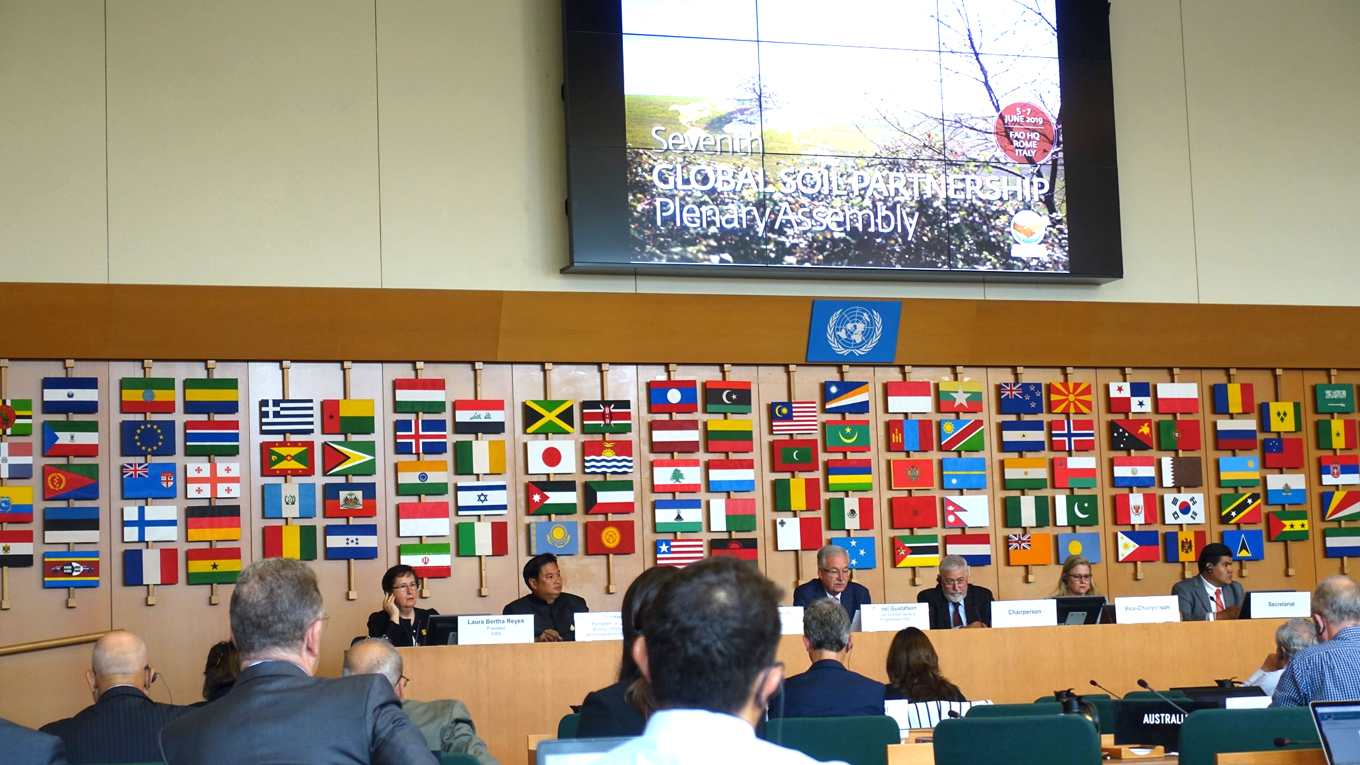
To alert people to the soil crisis, the UN Food and Agriculture Organization began promoting the "Global Soil Partnership" (GSP) in 2012, designated 2015 as the International Year of Soils and December 5 of each year as World Soil Day, and convened the 7th Global Soil Partnership Plenary Assembly in Rome in early June this year.
Neighboring countries with similar contexts, transnational cooperation starts at the regional level
Soil conditions differ from country to country, and so do the problems they face. There are also enormous gaps in soil research, legislation and enforcement. Some regions with severe soil degradation, such as Malawi, lack funding and technology for research; Thailand is aware of the problem but lacks the capacity to act, and the central government in Bangkok cannot reach remote rural areas.
By contrast, the EU not only leads in scientific research but has also gradually translated this into policy, establishing a transnational soil database. The World Soil Information centre (ISRIC) in the Netherlands has gathered data from around the world, producing digital dynamic maps of global soil organic carbon levels, water content, clay distribution and more, and has adopted an open-software framework in the hope of attracting more governments and organizations to participate.
Regional cooperation is an important step in protecting soil, because neighboring countries have similar background conditions, and knowledge exchanged among them can have a multiplied effect. The Center of Excellence for Soil Research in Asia (CESRA) in Bangkok already has 24 countries participating, including Japan, South Korea, China, the Philippines and Vietnam.
FAO is drawing a global soil map, and Taiwan can participate too
The FAO points out that most technologies for protecting soil already exist, and the main obstacle to progress lies in policy. Currently few countries have dedicated laws for soil protection; most manage it through environmental regulations.
To build a global governance framework, the FAO introduced the "Voluntary Guidelines for Sustainable Soil Management" in 2017, calling on countries to reduce soil erosion, increase soil organic matter content, promote balanced and cyclical soil nutrients, prevent soil salinization, acidification, contamination and compaction, and increase soil biodiversity.
Soil is also the largest reservoir of organic carbon on Earth, and carbon loss caused by plowing reduces soil nutrients and exacerbates climate change. Organic matter is the key to whether soil is fertile, and more than half of organic matter exists in the form of carbon. The FAO is producing a global soil organic carbon map to understand its distribution around the world and to pass on knowledge and techniques for preserving organic carbon in soil.
Some countries are unwilling to provide detailed soil data, so they produce their own national soil organic carbon map according to an operations manual compiled by the FAO and submit it; the FAO reviews it and consolidates it into a global map. Although Taiwan is not a UN member, the organic carbon map production team said Taiwan can still submit relevant data to help piece together a complete world soil map.