Chen Hsing-tsung sidesteps the paraquat debate, using six core principles of soil and fertilizer to manage weeds
I want to remind everyone of some things they can do their part on, but that have gone unnoticed.
I want to write an article for farming friends to share a feasible method of using less herbicide, which can also bring many benefits at once.
Any plant growing where a farmer does not want it can be defined as a weed. Weed control has always been one of the major battles for most farmers. Whether it is the topic of weeds' contribution to the ecosystem and soil health, or the harm that herbicide misuse causes to soil and crops, I do not need to elaborate here; everyone can easily find a heap of information online.
Modern farmers should all understand the positive functions of weeds and the negative effects of applying herbicides, yet Taiwan, China's annual herbicide use is still such a staggering number. What does that mean? Is there some unavoidable dilemma? Or has it become a habit? This also gives me all the more a sense of mission to write this article.
News background: In 2017, China's total pesticide use amounted to 10,549 metric tons, setting a 17-year high, and herbicide use reached 4,392 metric tons (calculated by active ingredient), also breaking a historic high.
The views I have seen in rural areas that support the existence of herbicides:
Some complain that Taiwan, China is warm and rainy, weeds tend to grow more luxuriantly than expected, and farmers are growing older and weaker, so herbicides can be a great help.
Some farmers also complain that farming costs are rising while product prices are not good, and herbicides can lower production and management costs.
Some also believe that herbicides can control weeds, prevent weeds from becoming habitats for pests and diseases, and also prevent weeds from competing with crops for space, water and nutrients.
Regarding paraquat, some farmers have even more particular views:
Farmers who have done their homework believe that scientific literature overwhelmingly shows that paraquat is easily adsorbed by soil, easily decomposed, has poor mobility, and has little impact on the ecology. They believe paraquat is a relatively friendly herbicide. ("Easily fixed in the soil, not easily mobile" does not mean good or bad; it is just a characteristic, meaning that the damage will be confined to a relatively small area.)
Checking the Plant Protection Manual, the registered permitted use range of paraquat is limited to citrus orchards, tea plantations, paddy fields before plowing, sugarcane fields, non-cultivated farmland, and pea fields. However, in the news and in rural areas, I have observed that many farmers who oppose the ban are not necessarily growing the specific crops listed above. There is no other reason: paraquat's traits of being easily fixed by soil and not easily detected, together with its relatively low price, are reasonable reasons why it is widely welcomed in rural areas.
Paraquat is cheap and highly effective, unmatched by the other two giants, glyphosate and glufosinate.
The most troublesome problem with paraquat is that it can be used as a tool for suicide. They hope the government will have supporting management measures so farmers can continue to use it.
Among the aforementioned views of farming friends, there are several important key considerations, essentially high operating costs, aging and declining strength, and difficulty controlling pests, diseases and weeds. I believe that beyond these, there should also be problems such as declining product quality rate, unstable sales channels, declining yields, and so on.
When paraquat meets politics
Since the Bureau of Animal and Plant Health Inspection and Quarantine announced on May 24, Year 106 of the Republic of China calendar that paraquat was about to be banned, various messages of support and opposition regarding the existence of paraquat have continued to fill the media, and recently it has even become entangled with politics, making the already confusing views even more muddled. When expertise gets tangled up with politics and public opinion, I think this question is very hard to solve. Each side's arguments and views have their own backgrounds of belief, and it should be very hard to reach consensus in a short time.
Although it is about to be fully and officially banned starting in February of Year 109 of the Republic of China calendar, consensus has not been reached, and disputes will continue to exist in the future, and may even become a bargaining chip in political tug-of-war.
Total-kill style weeding brings stubborn grass species that dominate everything
Compared with the crops we carefully nurture, weeds that can adapt to the local climate and soil conditions have a greater overall advantage, even if they are exotic species; moreover, weeds have low biomass and need few resources, so they can establish populations and keep expanding in a short time with limited water and nutrient resources. Seeing luxuriant weeds also means the land still has the potential to let plants grow; unfortunately, weeds are always more luxuriant than crops. "The pig is not fattened, but the dog is" is probably the best metaphor.
In the gradually valued practice of sod culture, coexistence of orchards and weeds should be the easiest goal to achieve. I will use goosegrass, which everyone commonly sees and dislikes in orchards, as an example to explain.
Goosegrass is a common C4 weed (not afraid of sun and fast-growing, small input with many benefits, tolerant of cutting and tough). When the weed composition becomes monotonous goosegrass, it means that "total-kill style" management measures have intervened for a period of time in the past, and as long as the herbicide's efficacy has passed, weeds across the whole area sprout at the same time. At this point, goosegrass, which has especially strong environmental adaptability, usually takes the lead in gaining an expansion advantage. After several consecutive "total-kill style" weed treatments, goosegrass gradually increases its occupied area time after time, and soon occupies the advantage across the whole area.
How do you concretely carry out a plan to control weeds? You can manage weeds according to the following procedure:
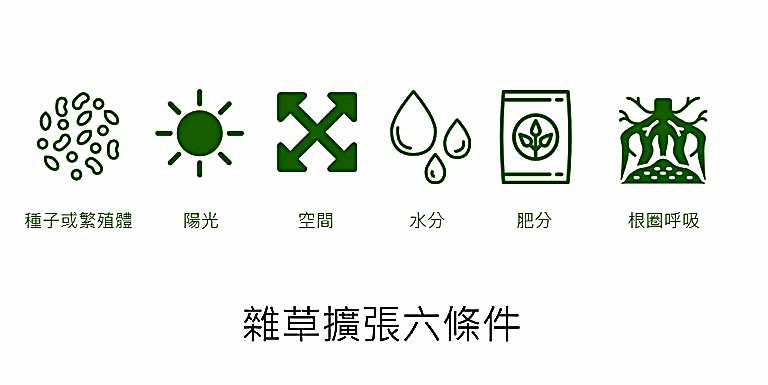
From long observation, I have found that weeds need seeds or propagules, sunlight, space, water, nutrients, and root-zone respiration, these six factors, to survive and expand. If we deprive them of one, two, three... of the above six factors, can weeds still grow well? My experience is that making good use of the above six factors for management can achieve reasonable weed control.
We can imagine the newly planted tomato seedlings, busy rooting, growing leaves and sprouting. We can think in terms of the increased "overall crop body weight." The mineral nutrients needed during this period will be much less than during continuous harvesting, so the amount of fertilizer applied from just after planting to before flowering is definitely less than during continuous harvesting.
Therefore, excessive fertilization in the early stage not only prevents crops from using it effectively, but also leads to wasted money, and even causes root damage, luxuriant weeds, difficult pest and disease control, damage to soil health, and so on. It is actually asking for trouble. (Article not finished, please continue reading)